0
0

Planning and political will needed in the NWFP
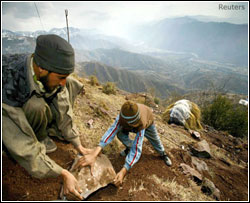 OVER three million survivors of the Oct 8 earthquake in the North-West Frontier Province are facing an uncertain future. Three months after the killer earthquake that rendered tens of thousands of families homeless, many of the affected people are still without adequate shelter.
As they brave inclement weather in tent villages, they are faced with the prospect of being relocated after temporary settlements are closed down by the end of March. The persisting cold weather has added to the misery of the survivors whose children are particularly vulnerable.
A small fraction of the displaced population has received winterized tents, while some others have been provided housing with corrugated galvanized iron (CGI) sheets.
The remaining people have been left at the mercy of the weather in flimsy tents covered only with plastic sheets. The army and relief organizations lack the means to protect the displaced families from the harsh weather, owing to the scarcity of CGI sheets.
The 7.6 magnitude earthquake killed 22,625 people, wounded another 40,139, and damaged 567,143 houses over an area of 17,105 square kilometres in five districts of the NWFP — Abbottabad, Mansehra, Battagram, Shangla and Kohistan. A total of 3,247,916 people have been declared as affected. Over 2,000 widows and orphans in the five districts are facing a host of problems.
Most of the survivors are prey to ailments. The World Health Organization said after a rapid assessment survey that the displaced population needed a special immunization campaign against preventable diseases.
The displaced people have been provided temporary shelters in 24 camps jointly managed by the army, UN agencies and its partners. Another 124 impromptu camps run by religious organizations, NGOs and philanthropists are still out of the reach of the government and international relief agencies.
Official statistics show that Rs267.48 million had been paid in compensation for the dead and the wounded in the five districts till Dec. An amount of Rs5.85 billion has been paid to the affected people for the construction of shelters. Of this amount, Rs25,000 was paid for each damaged house. Among the affected districts, Mansehra and Battagram are the worst-hit, where a total of 21,111 people were killed and 174,184 houses were damaged.
The army, UN bodies and NGOs have distributed about 20,038 tons of food items in the quake-hit areas. Officials of the World Food Programme (WFP) said that on an average 100 metric tons of food items are being sent daily to the affected areas since the disaster and, so far, 20,863 metric tons of food items have been dispatched.
The WFP has prepared an emergency food supply plan and will feed one million people by the end of April, while the government will feed 1.3 million people in the five districts. Official figures revealed that a total of 226,275 tents, 640,617 blankets and 27,606 tarpaulin sheets have been distributed among the quake survivors.
Helicopters, which played a major role in the relief operation, have airlifted a total of 2,040,104 kg of relief items, including tents and medicines.
Due to mismanagement and lack of coordination, bulk of the relief goods is alleged to have been wasted or misused. Official statistics show that the army distributed 438,606 blankets, while the NGOs distributed 202,011 blankets, as against the Pakistan Red Crescent Society, the International Federation of Red Cross and the Red Crescent Societies, which claim to have distributed 322,598 blankets among the affected people alone.
About 20,000 troops, UN bodies, its partners, workers of the National Volunteers Movement and nearly one hundred NGOs backed by helicopters and the latest means of communication are present in the quake-hit areas. A number of foreign and local NGOs, with donor-driven macro-and micro-schemes in their laptops, have landed in remote parts of the province. But, still, the survivors complain of inadequate relief. Also, because of the ill-planned and haphazard distribution of relief items, the survivors have developed a dependency syndrome.
Needless to say, lack of governance, lack of trust in the army, UN agencies and its partners and lack of transparency are major issues, which hamper relief activities.
The military authorities have identified non-availability of winterized tents, provision of heating in tents, streamlining of food supply, construction of shelters, access to impromptu camps and lack of coordination among various stake-holders as the major problems hampering relief operations.
The provincial and district governments, which are supposed to play a leading role in the post-disaster activities, are no longer in the picture, leaving the ground for the army and NGOs. Alongside the prevailing mistrust among the aid agencies and the army, yet another phenomenon has emerged, with the affected people being reluctant to repose faith in local government representatives. The army’s mandate is to coordinate relief activities, but it has become involved in the distribution of compensation amounts.
Allegations of misappropriation in the distribution of compensation and misuse of relief goods by councillors, nazims, naib nazims and revenue staff have served to adversely affect the survivor’s faith in the relief operations. Army officers say the provincial government is yet to prepare itself to shoulder its responsibilities and take part in the relief activities.
“The provincial government has come forward to look after only four or five relief camps. How long will the army carry out the local administration’s task?” asked a senior army officer. Despite the fact that eight districts, including the five devastated by the quake, have been declared calamity-hit, the NWFP government does not have any expertise in disaster management. The provincial government is managing only one camp with the assistance of the Commissionerate for Afghan Refugees. The government machinery in the quake-hit areas came to a grinding halt due to the large scale destruction and damage to infrastructure.
In spite of tackling the disaster, the provincial government has engaged itself in paper-work to prepare a Disaster Management Strategy for the future. Removal of rubble, settlement of land disputes among the victims, reconstruction of damaged infrastructure, resources generation and socio-economic rehabilitation of the displaced families are gigantic tasks requiring a strong political will and extensive planning by the government.
The World Bank and the Asian Development Bank assess that the damaged infrastructure in the NWFP requires Rs91.767 billion to be repaired. The rehabilitation cost for the displaced people including provision of permanent shelters is estimated to be about Rs70 billion.
The military-led Earthquake Rehabilitation and Reconstruction Authority (ERRA) has been tasked to look after the reconstruction and rehabilitation process in the quake-affected areas, including development of building codes, architectural designs and rehabilitation of the affected people.
The reconstruction agency proposed to be set up by the provincial government under the command of the ERRA will develop outline plans for sectoral reconstruction down to tehsil and union council levels. Officials said the reconstruction agency would be headed by the additional chief secretary of the province.
Senior government functionaries say that keeping in view the existing capacity and size of the destruction, the provincial government cannot deliver on its own.
Summarizing the overall situation, the provincial Planning and Development Department said in a statement: “During the last eight years, the province’s total development budget was around Rs94 billion. With the future development budget difficult to be determined at this juncture, and keeping the World Bank and ADB estimates and past development budget estimates intact, if the provincial government allocates even its entire development budget for the uplift of these (earthquake-hit) areas, it would still take another decade to fully develop them”.
“The magnitude of the devastation is so big that even if we create five more P&D departments like the one we have at the moment, we don’t think we can achieve the goals of reconstruction,” said a senior official. “We have yet to prepare a flawless and transparent assessment report that doesn’t exaggerate the damage”, he said.
The reconstruction plan in the affected areas will depend on the Geographic Information System (GIS) report. Officials say that sites for future settlements will be specified in the light of the GIS report, which is being jointly formulated by Turkish, Chinese and army teams.
Time to involve local communities
WITH many communities cut off by bad weather amid an outbreak of diseases and growing complaints of unavailability of medicines, food, and corrugated metal sheets, the situation in the areas affected by the Oct 8 earthquake remains unstable.
This raises questions about both the effectiveness of the ongoing relief efforts and the proposed long-term planning for the rehabilitation of the survivors. It also focusses attention on the reconstruction work which is scheduled to start after winter.
Many villages in the NWFP’s Kohistan areas, including Maidan Sherpal and Qila Tandol Bala, have not yet received their share of corrugated metal sheets, tents and warm clothing from the relief supplies sent in by the international community and which are stored at the Chaklala air base.
Special teams of the World Food Programme (WFP) supplied emergency food to these areas through helicopters only in the first week of January, almost three months after the earthquake and at a time when thousands of people were on the verge of starvation.
Requesting anonymity, a senior WFP official told Dawn that there was lack of coordination in the relief efforts due to the inability of the Earthquake Rehabilitation and Reconstruction Authority (ERRA) to fulfil its promise.
He said ERRA and WFP had agreed that sufficient food would be supplied, a month before the snows began, to the high altitude areas by the WFP and the low-lying areas and cities by ERRA.
However, as WFP tried to complete its mission, complaints of shortage of food started coming in from the low-lying areas. When the officials of the ERRA were asked to attend to the affected people in their jurisdiction, they urged the WFP to start distributing food in those areas as well. The WFP refused. As a result food could not be distributed in many of the badly affected low lying areas at a time when snow had already started falling.
Almost all of the high altitude villages in tehsil Forward Kahuta of Bagh district visited by this correspondent had not received corrugated metal sheets and food till Dec 28. The people there feared it would be too late to build temporary shelters when they finally received the sheets.
Winterized shelters have still not got to a majority of the affected people. Cases of fire outbreak are increasing as people desperately try to heat up their tents. Women can be seen cooking in the open air, surrounded by a thick white blanket of snow.
Bhedi — a union council of Forward Kahuta with a population of 22,000 who generally subsist below the poverty line — are the worst victims of the prevailing poor planning. The area is surrounded from three sides by the Line of Control. Only a single muddy and dangerous road connects it with Azad Kashmir. The road was blocked by snow in the first week of December, leaving helicopters as the only means of distributing relief supplies.
However, more than 100 families, that had come down to relief camps in Bagh said the people were still waiting for food, metal sheets and warm clothing. The UN agencies said they had supplied enough food for the whole winter soon after the earthquake.
Delay in the construction of winterized shelters in high-altitude areas was also caused by a controversy that surfaced after the army said grants of Rs25,000 were claimed even by those whose houses had not been damaged.
Despite the fact that patwaris and teachers, assisted by army personnel, had assessed the damage, claims of double payments and payments to undeserving people did not stop until the army opened an investigation into the matter. As a result, many families in the Bagh district and Mansehra were asked to either pay back the amount or establish that their claims were genuine. Some families had received double payments because of the joint family system. In many cases two to three families lived within one boundary wall but in different portions of the same building.
In areas near the Sudhan Gali and Beer Pani villages of Bagh district, and Jabori, Pherma Pata, Banda, Gankook and Jigal villages in Mansehra district, people complain that they are being constantly harassed “for the sake of just Rs25,000”. Instead of constructing their shelters, people are spending hours in trying to convince the authorities of their losses, says Ghulam Ali, a resident of Sudhan Gali.
The government must rethink its policy in order to dispel the common impression that the authorities are not willing to properly distribute international relief supplies and funds.
Essential medicines provided by UN agencies and the international community are also not being used, properly especially in the high altitude villages which are still without basic health units and doctors. Even villages with populations of 4-5,000 in the mountainous regions are still doing without doctors and medicines at a time when pneumonia, cold, cough, flu, fever, diarrhoea and water-borne diseases are common.
It takes hours of battling with snow to bring patients to metalled roads from
the cut-off villages. More time is taken up in transporting the patients to hospitals on roads that are now covered with snow.
After a hundred days of the earthquake, the time has come for the authorities to get people and communities involved at the union council level in the decisions being taken for reconstruction. Damage assessment must be conducted independently and an emergency plan formulated to rehabilitate schools, hospitals and roads before anything else.
Complaint boxes must be installed at each and every village. People must be allowed to meet military officials controlling the relief operations in their areas at open katcheries. An investigation should be launched into the commoner of the allegations about food and relief good’s distribution.
Finally, the government should deal firmly with all those who are attracting charges of corruption and favouritism.