0
0

 KARACHI, Dec 1: Prime Minister Shaukat Aziz on Thursday emphasized the importance of ‘partnership’ between the government and the private sector in the education sector to meet the future challenges by ensuring ‘education for all’.
Inaugurating an international conference on ‘Towards 2035: The School of Tomorrow’, he said that developing human capital with tools to survive in a global village was imperative.
The prime minister referred to increased allocation for education and stressed the need for improving the curriculum, enhancing capacity and reforming the educational funding system.
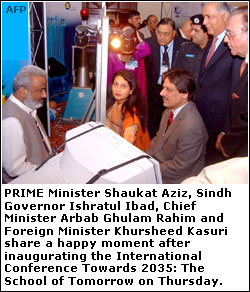
Sindh Governor Dr Ishratul Ebad Khan, Chief Minister Dr Arbab Ghulam Rahim and Foreign Minister Khurshid Kasuri were present at the conference held under the auspices of the Beaconhouse School System.
Mr Aziz said that his government’s education policy aimed at ensuring ‘easy access’ to quality education, expanding literacy programmes, development and expansion of vocational education as well as skill development.
He said it was not possible in a globalized world order to use the skill in isolation and no country could grow behind the barriers of tariff and other restrictions.
Referring to regional inequities, he said the government was focusing on improving the curricula and enhancing the relevance of tertiary education in line with the market needs.
He acknowledged that the challenge was enormous and owing to that his government had ‘almost doubled’ the expenditure on education in the past five years, from Rs56 billion in 2001 to Rs116 billion in 2004-05. He said the expenditure had increased from 2.7 per cent to 4 per cent of the GDP. He hinted at further increases and stressed the need for moving forward to ‘knowledge-based economy’.
“We recognize that human capital is of fundamental significance for moving forward and to compete in this global village,” said the premier, adding that investment in education was an investment for the future.
“Therefore, the challenge for us is to link this investment to reform - not just more funds but fundamentally better education system, accelerating improvements in curricula, standards and opportunities and giving all our young boys and girls the chance to succeed. This is a key for the schools of tomorrow.”
He said the government was trying hard to re-orient the education system to help the next generation meet the future demands.
He expressed the hope that the ‘schools of tomorrow’ would have web portal where both students and teachers would share information and have access to resources, knowing how to use new technologies to improve social integration and national cohesion besides building bridges with the knowledge-based community.
Mr Aziz said: “What we must see now is a system of independent and self-governing schools, underpinned by fair admissions, fair funding and fair inspections, where parents are equipped and enabled to drive improvement.”
He stressed that the students must be provided with a holistic education focused on both academic and non-academic domains.
“We have to give our students a range of experiences to develop robustness that enables them to retool and rebound from setbacks and the confidence to build and cross bridges they will inevitably encounter in their lives.”
He said all we need is to lead young people to new learning for tomorrow based on three pillars: “Shared vision – imagine together, skill development - learn together, and shared leadership - lead together.”
He pointed out that it was not only the education sector that lacked experts. He said that bankers were complaining of shortage of skilled hands in their sector and added that the country was also facing a shortage of skilled personnel in the telecom sector where over 3,000 expatriates were filling in the void.