



 0
0

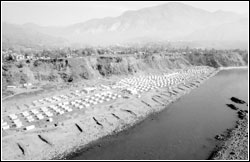 THE October 8 earthquake presents unique challenges particularly of scale and logistics as evident from the number of deaths, injuries, homeless people and colossal economic losses.
The earthquake is reckoned to be the 13th most destructive in world’s history. Tables I helps in gauging the impact of the earthquake on various sectors of the local economy.
The World Bank, the Asian Development Bank and government of Pakistan estimate reconstruction cost to be around $5.2 billion. The preliminary needs assessment carried out by donor agencies in close coordination of the government puts the total reconstruction cost for social infrastructure as under; private housing $1,552 million; health $303 million; education $472 million; environment $151 million; public administration $72 million.
Physical infrastructure includes transport $416 million; water supply and sanitation $32 million; irrigation $10 million; energy/power/fuel $40 million. Economic sectors: agriculture and livestock $300 million; industry and services $155 million.
Funds for relief, rehabilitation, and reconstruction may be generated using both indigenous as well as foreign sources. For local sources, ability and willingness of the private sector and individuals to contribute rests how effectively the government shapes its policy keeping in mind transparency and accountability.
Transparency and accountability should be the top priority of the government (GoP)in post earthquake scenario, given the 15th most corrupt nation status in the world by Transparency International and the culture of kickbacks and commission. Donors also raise questions how their money is to be used by the government.
As reported in Table I, over 200,000 houses were destroyed due to the October 8 earthquake. Highly vulnerable people should be the focus of reconstruction costs and financial aid.
Figure I: How the earthquake struck the local economy of affected areas
The government will have to make sure that the distribution system both for goods and money remains as transparent as it can be to win the confidence of donor countries. The government shouldn’t be doing handpicking to form the committee. Getting people who enjoy good reputation in the area to serve on the committee will help. A background check of all individuals who are supposed to be serving on the committee be carried out. Trusted MNAs or MPAs or Nazims (not incompetent or people having bad reputation or enjoy patronage with the establishment) having good repute be asked to volunteer their services.
Besides having man in uniform (no choice), elected representatives from the affected areas, a representative from the donor agency, a representative from active NGO and a representative from local administration should be part of the team which monitors the distribution and reconstruction process.
If possible, an auditor from a reputable private audit firm may be asked to sit on the committee for transparent disbursement. The committee can be best served at town levels and town can be divided as per population/area.
The aid/loan must pass through a test of transparency where every concerned citizen and donor agencies will have access to the information. A big task for the government indeed. A dedicated website where details about all expenditures are made available for general pubic would be a right step in the right direction.
It is very important that decisions are to be made taking local people and leadership into confidence rather than asking them to follow what is decided in Islamabad or Rawalpindi. Coordinated efforts are needed among all concerned agencies to ensure a joint and smooth effort in the same direction.
A technical committee comprising of engineers/experts will approve the type of housing in the affected areas and can provide technical help to rehabilitation and reconstruction committee and local villagers on construction matter to suit local conditions.
As suggested by donor agencies in their report, that the government should maximize use of local initiative, resources, and capacities. Along with local and national institutions, the civil society should be encouraged and empowered to manage the recovery process.
Decisions will have to be decentralized to speedup the process. Exemplary punishment is recommended if anyone found involved in misappropriation of public fund. Speedy justice guarantees effective monitoring and effective monitoring helps transparency and transparency will build up further confidence of the lenders and donors.
A separate desk may be created in the high court for this purpose which will deal with all such corruption cases and will make decisions within 15-20 days.
As the reconstruction of private buildings would require huge amount of construction materials, it is suggested that the private sector engaged in the related businesses should come forward and work hard with the concerned institutions to ensure timely availability of construction materials at affordable prices.
Every effort is to be made by the government to ensure that the construction material is available in the affected areas and at subsidized rate. This is in addition to the already committed money of Rs25,000 per households by the government. It will help eliminate any demand-supply gap and hence prices will remain stable.
The government may wish to intervene in the market to avoid having any rent-seeking activity during implementation phase. The role of the Monopoly Control Authority (MCA) is important to check any cartel formed by the firms during the implementation phase to stabilise prices of construction material.
Figure II: Schematic flow diagram about accountability and transparency in RRR working.




























