



 0
0

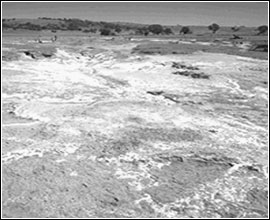 ABOUT 60 per cent of tubewell water used for irrigation in Pakistan is saline to sodic in nature that adds salt in agricultural lands each year. The overall aquifer, with a potential of about 50 MAF, is being exploited to an extent of about 38 MAF by over 562,000 private tube-wells and about 10,000 public. On an average, this water contains 1,250mg of soluble salts per litre of irrigation water.
The poor quality of water has adversely impacted the land resources of irrigated area. About three million hectare of agricultural land is severely affected since the adaptation of tube-well water for irrigation during SCARPs project for land reclamation. The over-use of groundwater has encouraged intensive farming in rural areas but is being over-exploited.
Due to the lack of management, a number of socio-economic problems in terms of farmer’s limitations in its continuous uses due to salinity hazards have cropped up. Salinity leads to dispersion of fine soil particles, crust formation, and a decrease in water movement within soil profile. The amount of sodium accumulated onto the soil particles and in irrigation water greatly influences crop production potential of the cultivated lands.
Most of the groundwater resources are confined to the Indus Plain, extending from the Himalayan foothills to Arabian Sea. The plain is about 1,600km long and covers an area of 21Mha and is blessed with extensive unconfined aquifer which is fast depleting and deteriorating due to over-exploitation and continued dry spell years.
The unchecked installation of tube-wells with little know-how among farming communities in the selection of extraction depth has aggravated the pre-existing salinity problem in these areas. Apparently farmers have no technical assistance to go through this worsening situation. In several areas like some parts of Faisalabad, Hafizabad, Okara, Kasur and many other districts of both Punjab and Sindh provinces, the upward groundwater is extremely saline to saline-sodic in nature.
At the turn of the 20th century large water reservoirs were built and a network of canals turned the plains of north Pakistan green. Later on, silently the irrigation system began to blight the land it had brought to life. Seepage from the network of unlined channels raised the water-table, while washing the salts from the soil into water. At the surface, sunlight and wind evaporated the water and left the salt on surface soils. This endangered withered plants and killed soil organisms creating dead and barren wasteland and mild to severe desertification.
Not only in Pakistan but from Morocco to China and to Australia, this phenomenon has affected soil environment. According to the FAO, about 77 million hectares of agricultural land, an area twice as big as Germany, has been devastated by salt and salty/brackish waters.
In Pakistan 16 million hectares of agriculture area is fed by a network of canals and tube-wells and 26 per cent has become moderate to severe salt-affected by this secondary or irrigation salinity phenomena. But on the other side in many parts of irrigated zone where groundwater is sweat and fit for irrigation, other factors like intensive farming, lack of canal water and fragmentation of farm land have accelerated over-exploitation of aquifer.
It has been observed in some parts that each landholder of only three hectares has his own tube-well. This mobilizes the groundwater flow beneath the soil surface in the aquifer, thus polluting it significantly.
In many areas, the naturally developed partitioning beneath the soil surface between fresh and brackish water is diminishing and pollution of fresh water aquifer is on the increase. This underground flood of brackish water toward fresh waters has also gained momentum due of the lack of natural recharge carried out by the rainfall.
Natural imbalance in terms of fewer rainfalls coupled with global warming and futile recharge of aquifer and mismanagement in the use of natural resources may lead to sever desertification of our land resources. The subsequent and overlapping factors may affect the productivity of our agricultural sector and the economy. To overcome this most undesirable socio-environmental dilemma following steps are suggested.
* Over installation of tube-wells should be discouraged through effective campaigns.
* Provision of necessary technical assistance to farming communities should be available to guide them at what depth they should extract the ground to extract fresh water instead of saline water.
* In severally affected areas bio-saline agriculture should be promoted to mitigate ill-effects of salinity hazardous.
* Conservation strategies should be put into practice to make the optimum use of available fresh water.
* Cropping pattern should be fairly modified to produce those crops in sensitive areas which are water and salinity resistant.





























