0
0

 THE intensity of the earthquake that hit Azad Kashmir, northern regions, some areas of the North West Frontier Province and Islamabad on October 8 was bound to cause widespread, unprecedented devastation.
However, not all the havoc suffered by these parts of the country was the result of nature’s fury, relentless and callous exploitation of some vital economic resources and environmental assets of these areas over the years contributed substantially to the misfortune of the lands and their populations.
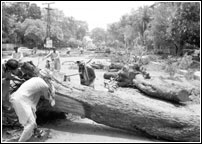
It may not be wrong to attribute at least one third of the massive death and destruction in the affected areas to elements that have denuded forests and crushed rocks in to smithereens for starkly commercial ends without any care or concern for their affect on the local economy, environments and lives of the people. Their criminal activities have added to the people’s miseries no end.
An earthquake measured at 7.6 at the Richter scale is an unmitigated calamity, man can do nothing to contain the annihilation it unleashes. One cannot but accept what has happened as more powerful than means of human beings.
No government can build protective measures against earthquakes of this magnitude. But governments and exploitative groups can certainly aggravate or diminish their deadly impact. The brutal stripping of natural resources of these regions over the last half a century has undeniably been a factor in multiplying misfortunes heaped by the earthquake.
Azad Kashmir and NWFP originally possessed immensely rich forestry and were studded with ranges of rocky hills. There hasn’t been any time in the history of the regions when trees were not felled in large numbers by groups generally referred to as ‘timber mafia.’
They have incessantly pulverized vast stretches of forests, some of them comprising valuable trees for personal gain and reduced hill tops, mountains and plain lands to surfaces sans their natural greenery for the same ends.
Trees play a major role in consolidating land. This root zones preserve the earth on which they grow. They also counter sedimentation by strengthening river banks that are eroded by sharp and cutting flow of water in hilly areas. The need was to increase forestry. Instead, forests were extensively eliminated.
The absence of forests made the lands hit by the earthquake on the morning of October 8 easy prey, made them targets whose strength to defend them had been shredded.
Among other negative fall out, the extensive and continuous rape of forests has also been instrumental in increasing sedimentation levels in water reservoirs and reduced their capacity. But that is another aspect of extensive and incessant slaughter of trees in these regions linked with the dwindling of the strength of land to withstand natural disasters like earthquakes to a higher degree.
The ruthless exploitation of forests of Azad Kashmir by the ‘timber mafia’ and cutting, even completely uprooting of trees for fuel wood on a similar scale by Afghan refugees since the outbreak of conflict in Pakistan’s north western neighbour towards the end of 70’s when over three million people sought shelter in Pakistan have been instrumental in adding to the scale of the tragedy inflicted on these areas by the earthquake.
A measure of the devastation of forestry is available in the fact that the Azad Kashmir region comprised 42 percent forests in 1947 while the area has now been scuttled to about one fourth of that size or 10 to 12 percent; even this figure may be on the higher side. The forests of Azad Kashmir included ceder, (deodar), pine, fir, willow, maple, oak, alpine and many other valuable trees. The region is now a wasteland, a naked and desolate landscape.
Another economic aspect of the earthquake must have been felling of walnut, apricot, apple and other fruit trees that provided people with income generating crops as also nourishment, particularly to otherwise undernourished children. There are no reports of damage to fruit trees but one can imagine that their shallow roots could not have escaped perishing by a calamity that razed supposedly strong structures to ground.
This criminal activity had gone on for years with the connivance, indeed direct involvement of governments, at lest of many functionaries of the establishments of Pakistan and Azad Kashmir. One felt that perhaps the appointment of an army general as President of Azad Kashmir through elections would stem the torrid tide but apparently even that has not halted the flow of the region’s forest resources to commercial markets to supply expensive wood for luxury bungalows of the high and the mighty.
The despicable elements pursuing their nefarious activities had no difficulty managing their ends because of connections in the officialdom. Individuals and groups with easy access to corridors of power successfully served their own greedy ends by playing up to the greed of corrupt officials. Considering every thing, even the survival of 10 per cent of the original forest is something remarkable.
After the earthquake, I telephoned some people residing along the route connecting Azad Kashmir with the national capital to find out if there had been any change in the situation in recent times and was told that the activity has continued unabated.
Apparently, no one seems to link the cutting down of trees with a natural calamity or perhaps no one cares about what happens to the populace. I was also told that what to say of recent times, wood is being transported even now with as much regularity as before.
At least ten to a dozen trucks so heavily loaded with tree trunks that tyres of vehicles carrying them look flattened ply on the route every day. The merchants of slow death for trees and population have obviously no intention to relent.
The expensive wood from Azad Kashmir is used as inexpensive material for construction business. Some of it may have gone in to the buidling of Margalla Towers that suffered fatal collapse on the morning of October 8. This merciless massacre of trees was not balanced at any stage by planting of new trees as is evident from the steep fall in the area of the region now under forestry.
Trees are regularly cut all over the world but replacements are always there in the form of new plantation. Not so in Pakistan, most certainly not so in Azad Kashmir.
The crushing of stone flattened rocky hills in the name of exploration of mineral resources and that had an equally weakening impact on the capacity of the zone to resist an earthquake. Like forests, rocks also strengthen land and act as shock observers against calamities like earthquakes, floods and torrential rains, their hard surface disallowing sedimentation. But they cave in before forces of nature after they are enfeebled by constant hammering bulldozing and crushing.
The weakening of rocky hills has been the main source of landslides that afflict most of the northern areas and have hampered relief efforts for the earthquake stricken people. While landslides are inevitable in regions like northern areas and Azad Kashmir, their high incidence is due to stone crushing business which has followed, for the people of affected areas, the same destructive line as timber business. For the people, these activities are another seismic streak.
While Indian held Kashmir is at a bigger distance from the epicentre of the earthquake it has the same topography as Azad Kashmir and the distance is not too great. But damage there has been much less and that may be attributed to the fact that natural resources of the occupied valley have not been at the mercy of exploiters.