



 0
0

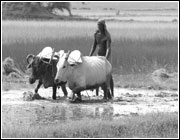 IN most of the poor countries, agriculture not only accounts for a large share of gross domestic product (GDP) but is also the primary source of employment, food and livelihood for the majority population. This is in contrast to the situation in the world’s two biggest agriculture exporters, the European Union (EU) and the United States (US), where agriculture employs a tiny percentage of population and makes only a small contribution to the economy.
In theory, developing countries should have comparative advantage in farm trade due to vast tracts of fertile land, abundance of labour and agriculture friendly climate. But agriculture trade remains by far the most distorted in international market.
Developed countries with their high per capita income subsidize their agriculture through a complex mechanism of policy measures such as, direct support to farmers that encourages higher production, consequently higher exports and dumping in world market. They provide exclusive support to agriculture exporters and high tariffs that protect their markets from agriculture imports.
In the Agreement on Agriculture (AoA) signed as a WTO package, there was an inbuilt agenda to re-negotiate the AoA in order to remove the distortions in agricultural trade. And in the Doha Round, members committed to comprehensive negotiations on each of the three pillars of the agreement. The Doha declaration called for (i) substantial improvements in market access (ii) reduction of all forms of export subsidies with a view to phase them out and (iii) substantial reduction in trade-distorting domestic support.
While nearly a decade has lapsed since the Uruguay Round, the goal remains a tall order for most of the developing countries. The supposed benefits to the poor developing countries have simply not materialized because the UR-AoA delivered a massively unbalanced deal in favour of rich nations and their trans-national corporations.
Post-Cancun scenario: After the failure of fifth WTO ministerial meeting at Cancun due to a wide gulf between developed and developing countries, active civil society role and unity of developing countries under the umbrella of G-20, the July 2004 framework brought back the negotiations on track by breaking the unity of G-20 in non-transparent and undemocratic manner and establishing Five Interested Parties (FIPs) which were joined by Brazil and India from G-20.
The “July framework” does not set out the parameters for a pro-active or comprehensive development round. All the key concerns of developing countries were subordinated to the industrial countries agenda of defending their high levels of agriculture subsidization.
The subject of market access deals with the tariff regime. It was decided that all the non-tariff barriers (quota, controls etc) would be converted into tariffs; all the tariffs would be bound and could not be increased. The developed countries have maintained tariff peaks on the commodities of export interest of developing countries. For instance out of 2727 tariff lines in agriculture and fishery, European Union maintains tariff peaks on 1273. Out of 1890 tariff lines in agriculture products, Japan maintains tariff peaks on 80 per cent products and similarly U.S. out of 1779 agriculture and fishery products keeps high tariff on 37 per cent products.
Tariff peaks and non-tariff barriers have restricted the market access of agriculture goods from developed countries to rich countries and thus hampered the global efforts to reduce poverty.
Domestic support: Subsidies are considered an important element of national agriculture policies to promote agriculture, rural development and food security. However, the structural adjustment programmes, other loans and fiscal constraints led developing countries to reduce the level of subsidies. Developed countries especially EU and USA provide huge subsidies to their farmers.
These subsidies have been trade distorting. The developing countries’ lack of resources do not allow them to provide subsidies to farmers. There have been several negative consequences of these policies such as:
* Dumping of products by developed countries’ farmers in developing countries’ markets.
* Producers of developing countries can not compete with highly subsidized goods.
* Detrimental effects on rural livelihood and food security in poor countries.
* Currently developed countries account for 88 per cent of total domestic support payments worldwide.
* Different commodities which are the export interest of developing countries receive high amount of subsidies, such as OECD countries provided averaged $17.3 billion per year during 1999-2001 to wheat producers.
* The OECD estimates that the value of support to its producers was a staggering $279 billion in 2004.
Developing countries have been also raising voice against this dual policy. This was the main reason of the failure of Cancun ministerial. The Blue Box under July framework has rather been strengthened which allows the developed countries to shift a large chunk of its agricultural subsidies (under the Green Box and Amber Box) to the Blue Box. Once again the developing countries lost their fight in July last year. Following are key current issues related to domestic support; phasing out all trade distorting subsidies; elimination of blue box subsidies; and review of green box.
The developing countries should demand elimination of all kinds of subsidies.
Export competition: The third component of AoA deals with export competition. Again the rich countries provide huge support for agriculture exports and export credit guarantees, making the developing countries less competitive in the international market. Though in July framework members agreed to eliminate all kinds of exports subsidies, several issues are yet to be resolved including concrete timetable for eliminating exports’ supports, issue like food aid and support to state trading enterprises.
Role of G-20: Developed countries want to conclude Doha Development Round in year or two and their strategy is to at least achieve the framework agreement in Hong Kong ministerial meeting due in December this year. In this context, the G-20 group has an essential role to play. In July 2004, members agreed to reduce agricultural tariffs through a tiered formula with high tariffs to be cut more than low tariffs.
Recently, G-20 has tabled a market access proposal for five bands of tariffs for developed country members and four for developing country members. The developing country members will cut less than 2/3 to be undertaken by developed countries. Developed countries also maintain high tariff on processed good which are called tariff escalation. G-20 proposal has suggested separate formula for reduction in tariff escalation. Proposal also suggests tariff caps of 100 per cent for developed countries and 150 per cent for developing countries.
In protecting the interests of the developing countries that the G20 represents, two premises are important. First, protecting their vulnerable farm economies. Second, the tariff-cutting should lead to substantial market access.
The G-20 market access proposal accepted by EU and USA to some extent serves the first objective but it had several flaws in pointing out the tariff escalation. For instance, in Japan, the bound tariff rate on raw sugar is 224 per cent and this climbs to as high as 328 per cent for refined sugar. Canada levies nine per cent on raw sugar and 107 per cent on refined sugar. The respective bound tariff rates for raw and refined sugar in the European Union (EU) are 135 per cent and 161 per cent respectively.
The G20 proposal that advocates a linear approach would lead to less reduction in tariffs as compared to the non-linear Swiss formula. It should instead have called for developed countries to undertake steep reduction in their tariff structures by adopting a non-linear approach embodied in the Swiss formula within the five bands.
In addition to suggesting linear approach for tariff reduction, the generous proposal for 100 per cent tariff cap for developed countries would also be problematic in smooth market access, because several developed countries have already maintained 100 per cent tariff on the commodities which are export interest of developing countries and thus proposal legitimizes these tariffs.





























