



 0
0

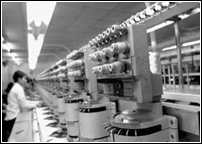 THE termination of the multi-fibre agreement (MFA) in 2004 presents a suitable opportunity for Pakistan’s textile producers to enhance their share in the international market on the basis of price and quality. This will facilitate efficient and low cost producers to enlarge their share in the North American and EU markets.
Pakistan will remain competitive in the international textile trade as it is a major producer of cotton and textiles which are relatively more labour-intensive. This confers price advantage. But, it would also faces chllenges in the post-quota global textile trade. Some of these are listed here:
* Quotas have ended but the importing countries are protecting their industry through tariff and non-tariff barriers.
* Exchange markets continue to be volatile and unpredictable.
* Severe competition may depress prices.
* Regional integration and blocs have already started to impact global ‘free trade’.
* Growing consumer markets/retail power have major implication on supply sources for prices quality and response time.
Despite these problems, the overall textile and clothing production and export trade would shift more to developing countries. The driving forces behind this shift to developing countries are:
* Production and marketing will depend upon value addition. The differences in cost and profits between textiles and other products e.g. derivative profit ratio in selling the shirts compared to computer.
* Difference in cost of production and natural resources viz. cost of energy, water, dyes chemical, cotton and MMF.
* Maximum utilization of cheap labour to balance the economy of scales.
Pakistan needs to adopt long-term policies to sustain and expand its export base. Better production processes, management techniques, innovation, constant up-gradation and better marketing are the primary factors for making a product competitive.
The impact of external factors like utilities cost, cost and quality of labour, taxation regimes, incentives for the export sector, macro-economic conditions coupled with social and political stability also determine the export competitiveness.
Factors influencing both internal and external trade need to be focussed/. Seeking “preferential arrangement” in trade other than quota would be:
Zero or lower import duties; GSP; MFN/LDC status; bilateral agreements; entering new or creating membership in existing trade blocs.
The global scenario after the end of quota is bound to lead to major changes in the global textile and clothing industry. Following assessments are based on the last ten years experience and statistics compiled during quota period: * Removal of quotas will unfreeze the existing pattern of production and market share
* gain in market share on the basis of their “international competitiveness.”
* Removal of scarcity (through quota restriction) and exclusivity (through quota allocation) is likely to lead to pressure for prices to fall. (The end of quotas means that countries like Hong Kong, Korea, Mauritius, Mexico and Caribbean countries will lose their preferential trump cards).
* China will be a big threat not only to developed countries but also to developing countries and under-developed countries. Its main strength being cheap labour, high skills, big volumes and nominal relation of export prices to true costs. * Free trade agreements may offer some advantage but being outside any meaningful trading block will impact negatively.
A national export strategy is vital to correct effective application of national resources to maximize trade and related investments. The objective of foreign trade is not only the generation of foreign exchange but also raising demand for goods and services that lead to increased diversification of value-added production.
The 04-05 turned out to be a buoyant year for textile industry and both production and exports showed positive growth.
In wake of the present requirements, the export target of 05-06 has been fixed at $17 billion with the main features as follows: * Reducing cost of doing business; increasing market access; assisting in technology and skills up-gradation; ensuring social, environmental and security compliance; also to enhance, create and promote export of services; provide focus to bi-lateral trade agreements; induce leverage to increase membership in trading blocs; encourage export-oriented FDI; upgrade country/business image; develop capacity building; identify and determine proper incentives for exporters and; add further value-to-value addition. .
Sustainable growth effort can well be gauged through 04-05 performance when the total textile export was $9,030 million as compared to $5.142 billion in 1998-99. Yet Pakistan’s share in the world textile trade was low and needed to be enhanced.
• Global trade……………………….$5 trillion
• Global Trade of Textile…………...$332bn
• Pakistan’s T&G exports…………...$9 bn (2004-2005)
The textile and clothing contributes 68 per cent of the total export, 46 per cent of the total manufacturing, 45 per cent of the total employment in the sector, 11 per cent of the total GDP, 31 per cent of the total investment. Salaries and wages now exceed Rs40 billion per annum and the contribution to R&D is Rs116 million per annum.
Pakistan’s largest asset proved to be two million tons of raw cotton, of which 1.7 million tons were converted to yarns, fabrics and finished products. Pakistan is established as a reliable, long-term supplier of textiles, apparel and home textiles.
The textile industry has made an investment of $4.5 billion during the period 1999-04. This investment has mainly gone for BMR as well as setting up of new units.
Pakistan’s textiles’ advantages and strengths are based on:
* Availability of raw material; marginal low labour costs;
increase in markets access after quota elimination in 2005;
comparative advantage through BMR in major sectors of textiles; and phasing out of subsidies.
However, certain grey areas need concerted efforts in upgrading. These areas are identified as: * Little or no branding; absence of internationally accepted testing labs; low productivity; lack of planned investment in new technology; more investments in R&D; lack of horizontal integration and; fire fighting to overcome cotton contamination.
The challenges facing our textile sectors are varied but the main issues are:
GSP as a source for gaining market access; MFN/LDC/zero duty structures under preferential trade arrangements within bilateral agreements; cheap and skilled labour under professional management; China to continue as a strong competitor in the garment manufacturing and exports followed by Pakistan, India, Turkey, Bangladesh and Vietnam and; the dependence on imported inputs would negatively impact the competitive advantage of products where value addition is low.
The other related issues need focussing are:
Planned product diversification to higher value added categories; market diversification other than to EU and USA; increasing share of women wears in the USA, EU and Japan and; up-gradation in skill level for production, design and marketing.




























