



 0
0

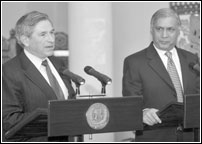 THE announcement by the World Bank President Paul Wolfowitz that that WB is increasing its aid to Pakistan from $950 million last fiscal to $1.5 billion for this financial year three days after the nation celebrated its 58th year of independence from British colonial rule.
What the nation forgot to celebrate was the importance given to our impoverished developing country- the arrival on the August 14, of Mr Wolfowitz, was the second visit by a president and the fourth visit by a senior official of the World Bank in the last eight months.
Another reason to jubilate seems to be that Mr Wolfowitz was “impressed” by Pakistan’s economic team and what they had managed to achieve.
Unfortunately, things are neither so simple, nor as straightforward. An increase in the World Bank’s lending to Pakistan almost certainly means an increase in the conditionalities of the loans. In all the previous aid packages, the conditions included the basic tenets of all SAPs such as a reduction of subsidies, fiscal austerity, privatization and liberalization.
All of these have backfired resulting in an increased import burden and worsening terms of trade, an adverse effect on the living standards of the poor most affected by the cuts in social spending, increase in the unemployment level from 3.5 per cent of labour force in the 1980s (when the first SAPs were introduced) to 7.69 per cent in 03-04 and a major food security concern.
The bank’s policies in other developing countries also serve as proof of their ‘effectiveness’ in dealing with problems afflicting the Third World. One of the best examples of such a country is Argentina. Since it started following the SAPs, Argentina has been on a socially regressive path. From the 1980s to 1999, unemployment rose from six to 15 per cent and poverty rate increased from seven to 37 per cent. In addition, Argentina that prided itself on having a thriving middle class, realized in due course that implementation of these policies had led to the phenomenon of the pauperization of the middle class.
And it was while the country was applying the neo-liberal formula of the bank that it was hit by the economic crisis of 2002, signalling how effective the bank policies really were. Other countries in Latin America like Brazil, Mexico, Colombia etc are suffering a similar fate, watching the demise of their economies at the hands of the bank conditionalities.
Exactly, the same results were witnessed in the countries of Africa where conditions for securing a loan from the World Bank included deregulation, trade liberalization and privatization. This led to the textile sector practically shutting down in Zambia, an almost collapse of the cashew industry in Mozambique and roughly identical effects all across the continent’s debtor countries. Perhaps, the most commonly accepted failure of the bank’s SAPs was seen in Thailand at the time of the Asian Crisis in 1997 where these policies exacerbated the crisis.
If countries across the globe have not proven how rudimentary the WB policies were in the development of their economies it might be perhaps be useful to consider those miserable countries that rejected the graciousness of Bretton Woods.
Malaysia is regarded today as the country that came out of the Asian crisis the fastest and perhaps even stronger than its counterparts. The reason being that it refused to let the WB in; in fact, it shunned the neo-liberal mantra of liberalization and privatization to set it’s economy on the recovery path.
Instead Malaysia stuck to capital controls (as opposed to liberalizing the capital market as suggested by the WB), increased fiscal spending (when the WB advocated austerity) and refused to put up public enterprises for sale and after one hard year (Malaysian economy contracted by 6.7 per cent in 1998) the economy started recording positive growth by 1999.
Venezuela too had been suffering from a two-year economic recession in 2003 when GDP growth declined by 9.3 per cent caused partly by the oil strike from December 2002 to February 2003. Here again the World Bank was eager to help (Venezuela had a large amount of debt piled up from previous governments) but the new government refused foreign assistance and implemented home grown policies. In 2004 Venezuela achieved a record high GDP growth of 16.4 per cent.
Cuba faced an almost identical situation. When the USSR collapsed in 1990 and Russian aid flows to Cuba stopped, their economy shrunk by 35 per cent in 1990 and for the next few years the growth in GDP was a negative figure.
However not having the option of WB aid, the country embarked upon there own economic reform. One of the first steps the government took when the magnitude of the crisis became clear was to increase social spending. Going against the fundamentals of neo-liberalism, Cuba undertook indigenous policies that yielded results by 1994 when the country recorded a GDP growth rate of 0.7 per cent indicating that Cuba was coming out of its economic nose dive.
The fact that there seems to be a positive-correlation between accepting World Bank aid packages and economic downslide or even some kind of association between rejecting the WB formula (and implementing home grown economic reform) and a healthy thriving economy, should make us look at the donor-recipient relations in a new light.
Does Pakistan really need the larger aid package? Since our economic team’s performance has been praised by the World Bank President (a protégé of President Bush) does Pakistan have to play the proverbial hare by accepting WB aid or should it be the slow and steady tortoise by following its own home grown policies.
Having broken the begging bowl, must we now work to put the pieces together so that we could dance to the old, familiar tune? Or is it the World Bank that really needs Pakistan to accept more aid? The day our country does not have a WB loan to turn to and it comes up with it’s own possible solutions to our economic woes is the day, the bank loses all control over what goes on in this country and its policy making.
Regrettably, Pakistan will accept the new loan package by Mr Wolfowitz. How else could the USA make sure that this “ally” doesn’t break from the web of neo-colonialism spun around it and many other developing nations across the world? And now that geo-politics have once again put Pakistan in a position where its submission to the issue of US security is guaranteed, it is but natural that so many bearers of good news and aid packages should visit us in such a little time.
Pakistan’s economic team would do better to pride itself for the pat on the back they just received by Mr Wolfowitz with a degree of scepticism. After all is he not the President of the same institution that told Mahatir Mohammed six weeks before the Asian crisis hit Malaysia that the country’s economy was based on solid fundamentals and it’s future looked very promising?




























