0
0

SRINAGAR, Aug 27: Muslim separatists vowed on Saturday to fight “tooth and nail” a ban by held Kashmir’s government on political speeches in most of the revolt-hit region’s main mosques and shrines.
Iftikhar Andrabi, chief executive officer of the government-regulated Waqf board, said the decision to enforce the ban aimed to prevent separatists and pro-India politicians from using religious sites to spread political beliefs.
“No one will be allowed to make such speeches,” he said in Srinagar, where a deadly insurgency has raged against New Delhi’s rule since 1989.
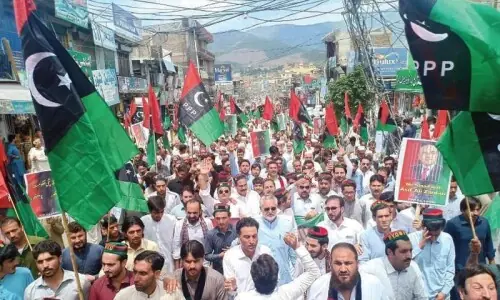
In recent months, separatist leaders have been making political speeches at mosques and then staging big rallies outside the Islamic houses of worship that have drawn huge crowds.
The rallies are intended as a show of strength to underline separatist calls for inclusion in an ongoing peace process between India and Pakistan aimed at settling their row over Kashmir.
The decision by the Waqf Board, made public late last week, has infuriated separatists who say that according to Islamic tradition religion and politics are intertwined.
“Islam allows us to discuss politics in mosques. How can the government dictate otherwise?” said Umar Farooq, head of the moderate faction of the region’s separatist alliance and chief cleric of Kashmir’s largest mosque.
“It’s a clear interference in our religious affairs, and we will fight it tooth and nail,” he told AFP.
Every Friday, Farooq delivers a sermon at the mosque in Srinagar. His mosque is the only large one excluded from the order as it comes under the control of his family, which has produced Kashmir’s chief clerics for generations.
Syed Ali Geelani, a key hardline separatist, also denounced the move.
“The government has no power to stop people making speeches in favour of freedom for Kashmir and the institution of Islamic law in shrines and mosques,” Geelani said.
“The mosques provide us with stages to voice our concerns. We will not allow the (ban) to happen.”
Political speeches at nearly 100 mosques and shrines managed by the Waqf Board were initially banned in 2003 but the order was never enforced.
The board gave no reason for the decision to implement the order, but a board official said religious sites were increasingly being used by separatists as venues to proclaim their views.—AFP