0
0

GULSHAN-i-Iqbal is one of the biggest towns of the city, with 13 union councils (UCs) and a total population estimated at 6,25,230. The town is primarily bordered by the Lyari River and the Malir and Faisal cantonments. Its UCs No. 4 (Essa Nagri) and 11 (Metroville Colony) are heavily populated because of large, crowded katchi abadis. Haphazard growth has made it impossible to bifurcate the katchi abadis, thereby resulting in wayward boundaries.
The old localities have been retained in their original shape but the area does not represent a compact interactive unit with respect to administrative convenience.
The UCs alongwith their population are as follows:
UC-1 Delhi Mercantile Society has a population of 46,565; UC-2 Civic Centre (58,726); UC-3 PIB Colony (37,687); UC-4 Essa Nagri (63,491); UC-5 Gulshan-i-Iqbal (41,663): UC-6 Gaylani railway station (57,696); UC-7 Shanti Nagar (43,711); UC-8 Jamali Colony (42,576); UC-9 Gulshan-i-Iqbal-2 (40,242); UC-10 Pehlwan Goth (42,837); UC-11 Metroville Colony (65,354); UC-12 Gulzar-i-Hijri (42,132) and UC-13 Safoora (42,550).
Gulshan Town limits starts beyond Shaheed Millat Road and one of its borders touches Jamshed Town and the other Gadap town as well as the Malir Cantonment Board area. Besides, its seven UCs — 3, 4, 5, 8, 9, 11 and 12 — run all along Lyari River beyond which the different UCs of Gulberg and Liaquatabad towns are situated.
A majority consists of Urdu speakers, but Memons, Punjabi, Sindhi and Baloch groups are interspersed. The Civic Centre is situated in the town’s boundaries, lending it an importance of its own in Karachi’s civic life. The town also houses the Expo Centre and Pakistan Television’s Karachi Centre, National Stadium and National Coaching and Training Centre.
The University of Karachi, NED University, the Urdu University of Science and Technology, Sir Syed University, the Aga Khan Hospital, the Liaquat National Hospital and the Safari Park are all part of the town, making it virtually the major hub of academic, health and recreation facilities.
The Karachi residences of political heavyweights such as former prime minister Mir Zafarullah Khan Jamali and Pir Pagaro are also located in the town.
One of the major problems is encroachment which has spread all along major thoroughfares and streets, octopus-like. Most footpaths, especially those in Gulshan-i-Iqbal and Gulistan-i-Jauhar, have been illegally occupied by shopkeepers, hotels and fast-food restaurants.
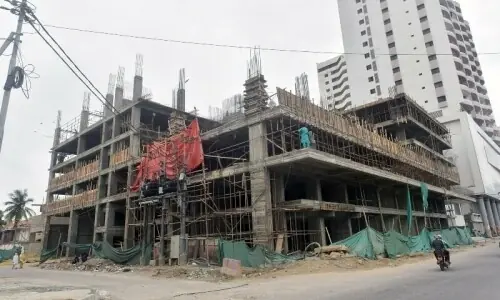
A large number of huge apartment buildings have come up and major housing complexes are planned around the already existing houses, and residents complain that their privacy is being violated by the high rises.
Four panels, backed respectively by the Muttahida Qaumi, the Jamaat-i-Islami, the People’s Party, and the PML-Q have put up candidates for union council polls. The main contest will be either between the candidates of Haq Parast and Al-Khidmat groups or between Haq Parast and candidates put up jointly by the Al-Khidmat and Awam Dost groups. The latter two have made seat arrangements with each other in some of the union councils of Gulshan Town.
Some observers believe that Haq Parast candidates may not have an easy sailing in at least eight out of the 13 union councils, pointing out that in the general elections in 2002, out of three provincial assembly seats, two had been won by Jamaat-i-Islami candidates — Nasrullah Shajji (also MMA’s deputy parliamentary leader in the Sindh Assembly) and Younus Barai — who had contested the election from the Muttahida Majlis-i-Ammal (MMA) platform. One seat was bagged by the MQM’s Faisal Sabzwari.
Besides, two National Assembly seats which overlap Gulshan Town with two adjacent towns were also won by the MMA (Mohammad Hussain Mehanti and Asadullah Bhutto) in the general elections.
The first local government polls held in 2001 after the introduction of the new local government system were boycotted by the Haq Parast group. Both the Nazim and Naib Nazim slots in Gulshan Town were won by Al-Khidmat group’s Abdul Wahab and Salim Azhar, who defeated Awam Dost candidates.
Four UC nazims posts had gone to Al-Khidmat, four to Awam Dost, two to PML-Q candidates and the remaining nazims belonged to independent groups.
VOTERS: In all there are 3,34,508 voters, including 1,44,813 women.
The total number of candidates for all the 13 UCs is 623 whereas the number of candidates who are contesting for nazim and naib nazim posts at is 122.
Union Council-I (Delhi Mercantile Society): Of the total 44 candidates who are contesting for the 13 seats of the UC, there are 10 candidates for nazim and naib nazim posts. The UC’s former Nazim Mohammad Junaid Mukati of Al-Khidmat group is seeking re-election. Haq Parast group’s candidate is Mohammad Haroon. Besides, four other candidates, including Ms Ayesha Abuzar (Independent) and Al-Khidmat group’s covering candidates, are also in the run.
UC-2 (Civic Centre): Former Nazim Mohammad Nasir Dawood Veerani is seeking re-election as an independent candidate. His rivals include Abdul Rasheed (Haq Parast) and Mohammad Hassan Raza Hassan (Al-Khidmat).
UC-3 (PIB Colony): The Haq Parast candidate for nazim is Syed Liaquat Ali, advocate, while his opponents include the Awam Dost group’s Ms Najma Saeed Chawla and Al-Khidmat group’s Umair Akram Nadeem, son of a former PML-N leader and an ex-minister of state, Zuhair Akram Nadim, who was murdered a coup of years back.
UC-4 (Essa Nagri): Syed Azmat Alam of Haq Parast group and Hafiz Mohammad Idrees of Al-Khidmat are pitched against each other for the nazim’s post. The other candidates for the post include A. Razzak Bandhani.
UC-5 (Gulshan-i-Iqbal-1): There are four candidates for the nazims posts — include Mohammad Nadim (Haq Parast), Syed Shahid Aliu (Al-Khidmat), Syed Aijaz Naveed and Umer Khan (independents) are also in the run.
UC-6 (Gaylani Railway Station): Al-Khidmat group’s Syed Khizar Baqi is contesting against Haq Parast group’s Mirza Azhar Baig for the post of Nazim. One Raja is also candidate for the nazim.
UC-7 (Shanti Nagar): Haq Parast group’s candidate for nazim is Mohammad Aslam while his opponent belonging to Al-Khidmat group is Mohammad Junaidi Zahidi. Former nazim Ghulam Akbar of PPP is seeking re-election.
UC-8 (Jamali Colony): Haq Parast’s candidate for nazim is Rehan Raees while Al-Khidmat group’s Syed Qutub is his opponent.
UC-9 (Gulshan-II): Al-Khidmat group’s Qazi Mohammad Rizwan is contesting for nazim’s post against his Haq Parast group’s candidate Sarfaraz.
UC-10 (Pehlwan Goth): Haq Parast group has fielded Humair Yar Khan for Nazim’s post while his rival candidate Qambar Ali Bangash has been put up jointly by Al-Khidmat and Awam Dost panel. Khushal Pakistan group has put up Ali Mohammad Mughal while JUP (S) backed group candidate Ahmed-ur-Rehman and one Ghulam Mustafa are also in the run.
UC-11 (Metroville Colony): The Haq Parast group has put up Mohibuddin Fatmi for the nazim’s slot while his opponent belonging to the Al-Khidmat group is Shahid Mehmood Siddiqui.
UC-12 (Gulzar-i-Hijri): Al-Khidmat group’s Sheikh Mohammad Sultan is pitched against former nazim Ibrahim Gabol who is said to be enjoying support of different groups.
UC-13 (Safoora): Former nazim Karim Bux Gabol, who is being supported by Al-Khidmat group is seeking re-election against Haq Parast group’s candidate Haji Zahid. Mohammad Ilyas who claims to enjoy the support of the Awam Dost group and Khushal Pakistan panel’s Gul Hassan Soomro are also in the run.