0
0

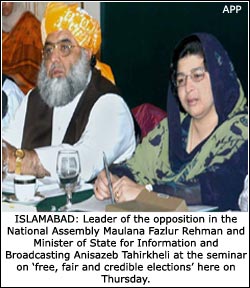 ISLAMABAD, June 30: Speakers at a seminar on “Regional dialogue; free, fair and credible elections; enhancing voters’ interest in elections” on Thursday agreed to the need of the confidence of common voters in their votes for a genuine democratic system in the country. Speaking at the final session of the two-day seminar, the Leader of Opposition in the National Assembly, Maulana Fazlur Rahman, attributed voters’ lack of interest to regular interventions by the establishment to break the tenure of every parliament and provincial assembly in the country.
Among the speakers were John Walls Cushnahan, former head of EU election observers mission; Telibert Laoc, senior programme manager, elections monitoring, national democratic institute, Afghanistan; K. M. Dilshad, secretary, Election Commission of Pakistan; Minister of State for Information Anisazeb Tahirkheli and Dr. Jayaprakash Narayan from India.
Maulana Fazl defended MMA’s support for the government in getting the 17th constitutional amendment passed and termed it a means to take the democratic process forward.
He said much had to be done to restore the confidence of the voter as he had to be convinced that vote would bring about a change in the system which would ultimately benefit the nation.
He said the establishment in Pakistan had become so powerful that it started deciding which government was ineffective and against the national interest and which party had to be brought into power in its place.
He said this attitude had tarnished the image and sanctity of vote and resulted in the fading confidence of the voter.
The MMA secretary general also criticized the media’s role in projecting or rejecting various political parties according to its likes or dislikes without considering what mistakes the party it was favouring had committed during its tenure in power.
He said that when the 1977 elections had been set aside because of rigging, the army took advantage and imposed martial law without giving political dialogue a chance to succeed.
He said that although the 1985 non-party polls were not accepted by certain political parties, the assemblies of 1988, 1990, 1993 and 1997 were not allowed to complete their tenure.
He said that the process of political dialogue must be encouraged so that the establishment did not take advantage of political polarization and wind up the constitutionally-elected governments in future.
He said elections must be held in a transparent manner so that the culture of non-acceptance of electoral results by losing parties ended once and for all.
To achieve the purpose of holding impartial, free and free elections, he said public pressure needed to be built to create conditions in which the constitution was respected.
He said the political parties must ensure that their decisions were driven by national instead of personal and individual interests.
Maulana Fazl called for exposing the “hidden hands” which negatively influence the electoral process.
He supported maximum participation of women in the electoral process, from contesting to casting of votes.
Sardar Assef Ahmed Ali, a former foreign minister and representative of PPP Parliamentarians, raised some basic questions about the sovereignty of parliament under present dispensation.
He said there were political tensions among the provinces, but no heed was paid to their problems.
He said that Pakistan had been “conquered four times by officials of our own army to use it for their personal interests”.
Mr Ali alleged that ISI majors and captains had been sent to districts and tehsils to interview people for offices in the forthcoming local council polls.
He said the majority of the Muslim population had created Pakistan by voting in its favour in an independent referendum but today polls were manipulated to get the desired results.
Minister of State Anisazeb Tahirkheli enumerated various reasons because of which womenfolk were hindered from casting their votes or were unable to turn up at polling stations in the NWFP.
Through his detailed report about transparency and monitoring of elections, John Cushnahan pointed out various in-built weaknesses of the election commission which failed to curb misuse of state resources in favour of certain political parties.
Senator Nisar Memon, however, contested the EU monitoring report alleging that its representatives engaged themselves more with the opposition parties rather than observing the election process independently.
Jayaprakash Narayan stressed that people at large were responsible for the continued blockade to a true democracy and unless they rose up to seek restoration of democracy it would never come their way.
He called for changing the rules of the game for the success of a true democratic system.