



 0
0

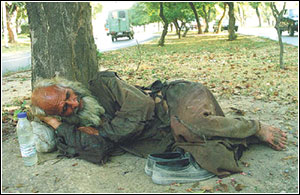 It is a rich man’s budget. To paraphrase a great quote, it is a budget for the rich, of the rich and by the rich. To be sure, the main author of the 2005-06 budget, Prime Minister Shaukat Aziz, according to his own public confession, is the richest man in Pakistan. That is what the declarations he had submitted along with his nomination papers for the National Assembly seats which he contested from Attock and Tharparkar constituencies in October last year say.
But then what is wrong with being a rich person or a rich nation? In 1992 when I was making an extended tour of China, my wonderment at the sea change in the social attitude of an staunchly socialists society was answered by a former socialist-cum-converted Chinese market economist with a clincher of a quote:” It is beautiful to be rich.”
Yes, it is indeed, ugly to be poor. Nobody takes any notice of you, nobody listens to you and you live and die in squalor without enjoying the rich bounties that God has bestowed on mankind.
Yes, of course, no poor man wants to spend his lifetime in perpetual poverty and no poor nation likes to live at the bottom of the ladder all its life.
So every person, every nation, every society spends their waking hours sweating to become rich and once they attain a modicum of prosperity they sweat further to protect their prosperity from the vagaries of nature and man.
Pakistan also has been trying to come out of its poverty since the day it came into being. Every annual budget that it has prepared for its nation and every medium term plan that has been launched since, had just one objective: to become a rich welfare state where no one will go to sleep hungry, no one will go without a roof over his/her head and no one will go around in tatters.
And the strategy to achieve this objective has remained the same all these years: capital formation; and the tactics: make the rich richer, the trickle down would take care of the poor.
So, from the very beginning the successive governments in Pakistan motivated not by any callous intent but driven by the higher ideals of a social welfare philosophy designed their economic policies in such a way that the rich kept on becoming richer with a generous helping hand from the public sector. By using the tax payers money, the government put up factories and then divested them among a handful of rich. They kept two rates of exchange, one for the rich and the other for the common man by introducing the bonus voucher scheme.
Through the import substitution policies, they allowed the industrialists to market low quality goods and rob the consumer white without the fear of competition and in the hope that eventually this would lead to industrial development. They allowed creation of horizontal and vertical monopolies. And they allowed these rich people to borrow from banks the resources mobilized from the nation at large for industrial ventures at 15:85 to 30:70 equity-debt ratio. The banks contributed the bulk of the funds while the sponsors would got back their investments of 15 to 30 per cent, mostly on paper, even before the factory would come on stream through over invoicing machinery imports.
Both those who under-invoiced their exports and those who over invoiced their imports stashed away their millions in foreign banks.
They never paid their utilities bills, evaded and avoided their tax dues. And by the end of 1960s, a handful families, estimated at that time to number 22, had become filthy rich. The top civil bureaucrats who implemented these policies shared the bounties with these rich families and later even the top generals that had become politically very powerful after the 1958 military takeovers also started sharing the loot. It was all being done in the name of achieving the objective of social welfare by creating a rich class. But in the process the rich were becoming richer and the poor, poorer. The decade of development that was celebrated in 1969 turned into a decade of dismemberment by 1971.
And by 1972 the pendulum had swung to the other extreme. Now it was the turn of the public sector to become the main vehicle of capital accumulation with the complete exclusion of the private sector. It was the time when even Western Europe led by France and Italy were taking to socialism to avert domestic upheavals in response to knocking on the doors by the East European socialists.
The UK and West Germany had become more social welfare countries than any socialist country, with their social welfare budgets accounting for more than 50 per cent of their GDPs. But even before Mrs. Thatcher of the UK and Mr. Reagan of the US came on the scene to change all this, Pakistan’s Army had taken care of Mr Z.A. Bhutto and the pubic sector which Mr Bhutto had used to launch so many huge infrastructure and industrial undertakings had by early 1980s become in the hands of the then finance minister Ghulam Ishaque Khan a hand maiden of the civil and military bureaucracy.
In the name of accumulating capital and establishing a social welfare state, the public sector minions were looting the nation with both hands and distributed this loot among themselves and at the same time brought the private sector back into the game of making money for themselves as well for the civil and military bureaucracy by investing the resources of the nation while the declared objective of the then military government had also remained the same: making the country rich so that it could become a genuine social welfare state.
With the advent of the so-called democracy, sans rule of law in the 1990s, the rich were back in the saddle as while the Army was pulling the strings from behind, largely curtailing the democratically elected governments’ political room to maneuver, the down and out economy thanks largely the profligacy of the Zia regime had let a highly sanctioned country fall into a very tight grip of IMF conditionalites which by this time had adopted the trickle down theory as a panacea for all the economic ills of the developing world.
Though today we are no more in the Fund’s grip thanks to the bounties associated with 9/11, our official economic managers seem still to be fascinated by the trickle down mantra, despite the experience of the past 58 years that this mantra has never worked at least in Pakistan. They don’t realize that unless you allow the poor a progressive share in expanding prosperity and at the same time make the rich share the pains of keep moving on this road to prosperity, you will only be creating an anarchic and disharmonious society in which each member is at the other’s throat trying to grab his liberty, life and property.
The budget for 2005-06 has been very rightly described as growth oriented and investment friendly. All the traditional manufacturing sectors led by textiles have been offered unprecedented incentives and concessions to save and invest and export at highly competitive prices. The country’s economic managers have used the massive fiscal room that has been created over the last three years due to the macroeconomic stability achieved as a result of massive international assistance following our willing participation in the war against world terrorism to design such a rich man friendly budget. But even when we had nothing to make our two ends meet, we had been pampering these very sectors in the hope that as they become rich they would lift the nation as well up out of its poverty. But nothing like this happened.
Those who own these sectors today virtually own Pakistan. Most of them have now expanded horizontally and vertically. Many even have their own banks. But since none of them have been true entrepreneurs who take risks and since all of them with the exception of a few, have acquired their riches by rent seeking, they have never shown any inclination to fulfil their responsibilities towards the society they live in.
Most of the companies listed on the stock exchange except the government owned are almost 100 per cent family properties. They do not believe in spreading their risks. They believe in cutting all kinds of corners to protect the basket from being invaded by the vagaries of market.
Most who have bought privatized industrial units have sold off the land and diverted their assets and closed down these factories or have downsized the workers’ population creating massive unemployment. Many don’t even feel responsible for the well being and future (education, food and shelter) of the families of their own household servants what to talk of establishing schools, hospitals and economic housing colonies for the under privileged at large. They do own costly hospitals and educational institutions which cater to the needs of only the rich.
So, the bottom line is to make economic policies which are growth oriented, and investment friendly while at the same time designed so as to create enabling circumstances for the poor to climb out of the bottomless pit of poverty.




























