



 0
0

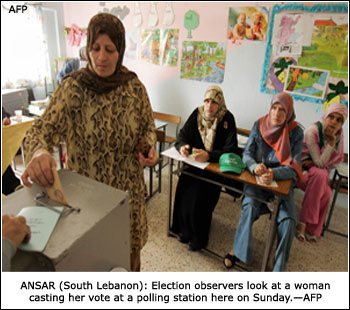 HOULA (Lebanon), June 5: Syria’s staunchest allies Hezbollah and Amal swept south Lebanon’s general elections on Sunday, in a crushing victory seen as a vote for anti-Israeli guerillas to keep their weapons. Official results were not due until Monday but the Amal-Hezbollah slate, dubbed the “steamroller”, claimed it had taken all 23 seats up for grabs in the south. Unofficial counts indicated the alliance had won more than 80 per cent of votes.
“I thank all my people in the great south for renewing their confidence in the list and for the victory of all its candidates,” Amal leader and Parliament Speaker Nabih Berri told a news conference in the south.
Many in the Shia heartland see a vote for Hezbollah as a vote for the group to retain its arms as a defence against neighbouring Israel, which occupied the south for 22 years until its 2000 pullout.
“The aim is to defend Lebanon, not the weapons of the resistance. But to defend Lebanon we must defend the weapons,” Sheikh Naeem Kassem, deputy head of Hezbollah, told reporters.
“Today, southerners said this and the international community must listen.”
Hundreds of supporters waving Amal flags celebrated outside Berri’s villa as results began to trickle out. Others drove through villages and towns, honking their horns and flying the two parties’ yellow and green flags.
Fireworks exploded above central Beirut as the celebrations spilled over to the capital.
Hezbollah, which Washington labels a terrorist group, and the more moderate Amal are the dominant forces among the Shias, Lebanon’s largest sect.
Lebanon’s first general elections since Syrian troops quit their smaller neighbour are being held region by region over four weekends until June 19.
In the south, the Amal-Hezbollah list won six seats before a single vote was cast, due to the lack of challengers.
Interior Ministry sources said turnout among the 675,000 eligible voters was 45 per cent.
Damascus backed both Amal and Hezbollah during and after the 1975-1990 civil war, and Shias largely stayed away from anti-Syrian street protests that swept Beirut after the Feb. 14 assassination of former Prime Minister Rafik al-Hariri.
Those protests, which united Christians, Sunnis and Druze, forced Syria to bow to world pressure and end its 29-year military presence in Lebanon in April.
The biggest challenges facing the new parliament include a UN resolution demanding Hezbollah disarm and demands by the anti-Syrian opposition for President Emile Lahoud to resign.
Both are divisive issues. Syrian-backed Lahoud vowed on Sunday to stay despite facing opposition blame for Hariri’s death and the killing of an anti-Syrian journalist last week.
At least five people were wounded in pre-election violence east of Beirut on Sunday when a gunbattle erupted between supporters of rival Druze parties armed with assault rifles.
It was not clear how the clash in the mountain resort of Sofar began, but the army said it had detained 20 troublemakers.
—Reuters





























