0
0

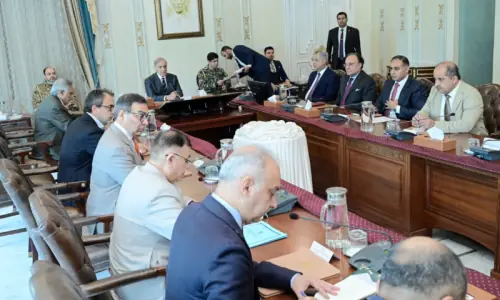
KARACHI, May 23: Sindh Finance Minister Syed Sardar Ahmad urged the legislators to take more interest in the budget making process. Speaking at a pre-budget consultation with the parliamentarians on “Women and macroeconomic issues with focus on PSDP”, organized by the Aurat Foundation, he advised the organizers of consultation meeting to hold such meetings at least two months before the budget so that the proposals could be reviewed and incorporated in the budget.
He said that at least twice he had requested the government’s parliamentarians to come and have a meeting regarding the budget proposals so that their ideas could also be incorporated, but the meeting had not yet been held. Similarly, he had received the proposals sent by the PPP, but when asked opposition leader Nisar Khuhro to come and discuss his proposals, he did not come. Such attitude on part of the legislators -– treasury as well as the opposition — showed their lack of interest in the budget making process, he added.
He stressed that an evaluation system should be developed to monitor the implementation of the projects so that misappropriation of funds and delays could be checked. He said that there was no doubt that the GDP had increased so had the foreign reserves, but its benefits had not reached the poor. There was a need to formulate a strategy to ensure that the inequality in income of people was minimized and poverty was reduced, which had not yet been achieved. He said presently the poor were becoming poorer and rich getting richer.
Sardar Ahmad said that he had serious reservations on the government’s spending huge amounts on higher education, which no doubt was important. However, he said, there was need to invest more on the basic education which still was in a bad shape and needed much attention.
He said that Sindh had serious reservations with the federal government on the distribution formula of the NFC award, and it was suggesting that rather than taking the population as the deciding factor for fund distribution a multiple criteria be adopted for distribution. In India, which had an almost similar system of government, between 20 and 30 per cent weight was given to population while poverty, backwardness, share in tax collection were also given due importance in distribution of federal funds to the provinces.
The finance minister said that on one hand devolution was being stressed by the federal government and on the other it was spending over 76 per cent of the development budget, while the provinces were given just around 24 per cent to spend. Keeping in view the government’s policy of devolution, he said that provinces’ share should be increased.
Earlier, PPP MPA Saifullah Dharejo demanded that spending on defence be curtailed and the funds thus saved be diverted to the social sector, particularly health and education development. He said that when East Pakistan was part of the country and majority of people lived there, funds were not distributed on the basis of population. However, he said, at present when Punjab had more population as compared to others it wanted that funds be shared on the basis of population.
Rejecting the government’s claims that economy had improved owing to its good economic policies, he said that improvement in the country’s finances was owing to the incident of 9/11.
PPP MPA Shazia Marri said that the role of legislators in budget making process was non-existing. She demanded that pre-budget meetings should be held and the time for the debate on budget must be increased. She said that the assembly should also quarterly review the implementation of budget/ projects.
Muttahida Qaumi Movement’s MPA Rehana Nasreen suggested that the women parliamentarians should meet and discuss before raising any gender issue in the assembly so that a joint and unified stand could be taken. She also suggested that more funds be allocated for social sector development.
An economist, Dr Ali Ercelawn, said that budget making was by and large an administrative process with the public representatives having a limited role. He demanded that priority in allocation of funds should be given to public security rather than state’s security.
Parven Rehman stressed that mapping of townships should be done as there could be no development without proper and accurate data was available. She also said that utilities – water, electricity, gas, etc – were not commodities to be sold out.
MPAs Gulzar Unnar, Shamsunnisa Leghari, journalist Navin Mangi, Nuzhat Shirin and others also spoke.
The parliamentarians’ interest in the budget consultation was clear from the fact that out of over 60 MPAs, who according to the organizers had confirmed their participation, just eight turned up at the meeting that had to start over an hour behind schedule as nobody, except the finance minister, had arrived on time. Three MPAs came two to three hours late and attended the meeting just for an hour or so.