0
0

Unjustified opposition
Given the huge military imbalance between Pakistan and India, it is surprising that New Delhi should react so strongly to modest arms purchases by Islamabad. Speaking in parliament on Wednesday, Indian Foreign Minister Natwar Singh said India had conveyed its concerns to the US at "very high levels".
He also said that if the US sold arms to Pakistan, his country could review the proposed cooperation with the US in missile defence. The arms deal with Pakistan could also have what he called "a negative impact" on Indo-US relations.
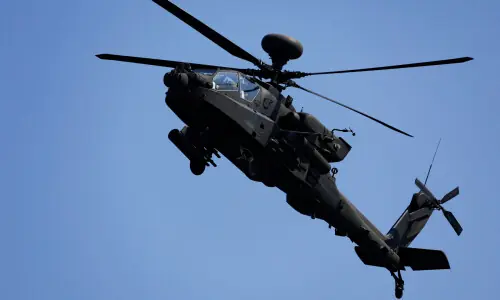
The Indian foreign minister was reacting to the proposed sale to Pakistan of US surveillance planes and anti-tank missiles, which it needs badly to fill the gap in its defence arsenal.
Pakistan has had no major arms deal with the US ever since the Pressler amendment went into effect in 1990. Such were the implications of the Pressler law that not only was all economic and military aid cut off; even the delivery of the F-16s Pakistan had paid for was stopped.
At one stage, Islamabad was getting neither the planes nor the money. Instead, it was asked to pay parking charges for the undelivered planes. Subsequently, after nearly a decade, the money was adjusted in the form of some other sales for the navy.
Under the changed relationship between Washington and Islamabad, the former has agreed to sell some arms to Pakistan as part of the three billion package decided in principle at Camp David.
Only half of this package is for military purposes, and there is no indication yet that the sales will include F-16s. That the Bush administration should show this hesitation towards a country which is playing a leading role in the war on terror and which has been given the status of a major non-Nato ally is indeed astonishing.
At the same time, the US is very keen to forge closer military ties with India. In fact, the purpose of Defence Secretary Donald Rumsfeld's visit to New Delhi is to strengthen the Indo-US military relationship and sell more arms to New Delhi irrespective of the consequences for Pakistan.
The Indian armed forces enjoy an all-round superiority in all departments. But in the air force their superiority over Pakistan is considerable. Islamabad has been unable to meet its legitimate needs for air defence for a long time, and China's ability to fill this gap is limited, especially with regard to sophisticated planes.
As against this, India has embarked on a major plan to increase its military capability. It is purchasing sophisticated arms from Russia, America, Britain and India's new ally, Israel, and it plans to have a three aircraft-carrier navy.
Pakistan has no aggressive designs against any country. With India, with which it has a long and troubled relationship, it is trying to improve relations. The steps taken by both sides have led to a major improvement in the geopolitical environment in South Asia, though more remains to be done.
Yet friendly relations with neighbours do not mean that Pakistan can ignore its legitimate defence needs. If and when America sells F-16s to Islamabad, the Indian air power will still enjoy an edge over Pakistan's air force.
Instead of going on an arms-buying spree, India should concentrate on further improving relations with Pakistan and try to find a solution to the Kashmir issue which has been the major cause of bad blood between the two countries.
NFC award stalemate
The assurance by Prime Minister Shaukat Aziz that an amicable settlement over the National Finance Commission award is being sought is encouraging. The resignation of a member of the NFC earlier this week and his comments on the working of the NFC bring into focus the arbitrary manner in which this body functions.
For example, the procedure adopted by the federal government in determining the allocations out of the divisible pool is seriously flawed. The centre should lead the way by agreeing to provincial demands on a number of issues.
At present, the share of the provinces in the divisible pool falls short of the provincial demand which is to raise their share to 50 per cent from the present 37.5 per cent. For their part, the provinces need to agree among themselves as to what share of the national pie they should each be allotted.
What is required is more debate on the issue. Punjab's insistence on population as the sole criterion for determining the share of each province in the divisible pool is as unfair as is Sindh's expectation for revenue collection to be accepted as a major determinant.
Then there is the question of providing weight age for under-development in the matter of allocation of funds for the provinces. Having accepted population as the principal criterion for resource sharing, other considerations such as the extent of poverty and under-development can be brought in to work out an agreed formula for resource allocation that will be acceptable to all the provinces.
The federal government could provide a lead in that direction by agreeing to a reasonable cut in its own share in the divisible pool and then expecting the provinces to show a spirit of compromise and conciliation needed to break the long-standing stalemate over a new NFC award.
A question of justice
One hopes that the Lahore High Court's decision to scrap the Juvenile Justice System Ordinance 2000 (JJSO) will not prove a regressive step at a time when Pakistan, at least on paper, has appeared to move forward on several fronts to ensure a better deal for its child population.
Calling it "unconstitutional, unreasonable and impracticable", a three-member judicial bench maintained that given the constitutional guarantees and laws already protecting the rights of children, the ordinance was unnecessary and had only created confusion.
Among other things, the judges held that the ordinance that had prohibited the death sentence for those under 18 years had led to an increase in crimes committed by juveniles and to corrupt practices such as falsification of certificates showing the accused as younger than their actual age.
The judges have abolished the juvenile courts and ordered that pending cases be tried in ordinary courts. While the judgment must have been delivered after careful deliberations, certain aspects of it cannot but be questioned.
For instance, with the abolition of juvenile courts, will cases involving child offenders now be lumped with those of adults? This would mean greater delay in the judicial process, where even those found innocent in the end, would have lost the formative years of their lives in prison. Even more crucial is the question of whether the death sentence would apply to children under 18 after the annulment of the JJSO.
As a signatory to the UN Convention on the Rights of the Child, Pakistan is obliged not to execute children. But in the absence of a specific law on the subject, there could well be a clash with the precepts of international justice.
Perhaps anomalies in the JJSO could have been eliminated and the law amended to make it less vulnerable to misuse. Hopefully, an appeal to the highest judiciary against the invalidation of the ordinance will result in a decision more in keeping with universal standards of the rights of child prisoners.