0
0

ISLAMABAD, Oct 6: The federal government on Wednesday decided to release in the market one million tons of imported wheat during November and October and to import another one million tons for price stabilization.
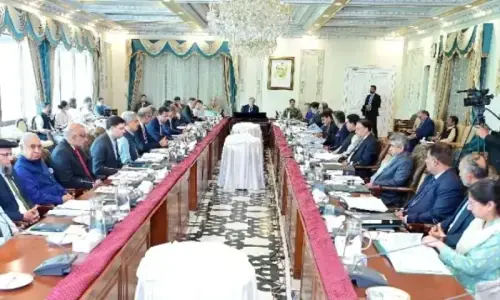
The decision to this effect was taken by the Economic Coordination Committee (ECC) of the cabinet, presided over by Prime Minister Shaukat Aziz. The meeting also constituted a cabinet committee comprising ministers of industries, water and power, petroleum and natural resources and SAFRON to monitor prices in provinces in consultation with chief ministers.
The ministry of food and agriculture presented the salient features of wheat policy relating to pricing, marketing and production. It was directed to prepare a comprehensive wheat policy in consultation with all the provincial governments as well as other stakeholders to enhance production and productivity of the commodity.
The prime minister directed looking into the aspects of marketing, availability of credit and extension services and seed policy to make the wheat policy a success. The ECC also reviewed the cotton crop position and felt confident that the target of cotton production will be achieved.
The prime minister noted with satisfaction the procurement of 100,000 bales of cotton by the Trading Corporation of Pakistan (TCP) and directed it to continue doing so without any upper ceiling to ensure that farmers got the intervention price of Rs925/- per 40kg. The prime minister also directed the TCP to explore the possibility of exporting cotton quickly.
The meeting also asked the Pakistan Telecommunication Authority (PTA) to provide a level-playing field to all cellular phone companies in Pakistan and that no company should be subjected to discrimination to ensure an investor-friendly climate in the country.
The ECC also reviewed the performance of tax collection by the CBR for the first quarter of current fiscal year. The ECC was informed that the CBR had collected Rs123.6 billion as against the target of Rs110 billion, registering a growth of 31 per cent over last year.
The ECC was also informed that direct tax collection increased by a record 54 per cent, while indirect taxes posted a rise of 23 per cent. Sales tax, customs duty and central excise duty (all indirect taxes) recorded a jump of 21 per cent, 25 per cent and 27 per cent, respectively.
The ECC appreciated the CBR efforts for collecting revenues more than the target and asked it to maintain this momentum. The ECC was also informed that exports during the first quarter of the current financial year grew by 16.9 per cent.
The State Bank of Pakistan's deputy governor informed the ECC that the country's foreign exchange reserves remained at $12.3 billion despite a significant increase in the total payments made during the first quarter of the fiscal year.
Meanwhile, the four-member cabinet committee constituted by the ECC to ensure stability in the prices of essential consumer items finalized its strategy to achieve the objective in close coordination with the provincial and district governments.
The committee would take immediate steps through the provincial and district governments to ensure that prices of essential items remained stable, particularly during the holy month of Ramazan.
The committee observed that the government was keeping a close vigil on prices and would not let them go beyond the purchasing power of consumers. It noted that the prices of POL had gone up to $52 per barrel but the government had not increased them for domestic consumer and was paying a substantial subsidy instead.
Had the POL prices been increased in keeping with the international market trend, the prices would have gone up by 45 per cent, causing a great burden on consumers, it said.