0
0

Disarmament begins at home
Those who are well tuned into the cost of nuclear programmes of the US would have sensed that something was amiss in the initially reported figure of Rs184 trillion, which Pakistan was said to have spent on its nuclear programme during the last 32 years.
This figure works out to about $3 trillion according to present day exchange rates, whereas the US, who has the largest nuclear stockpile in the world, is known to have spent $5.5 trillion on nuclear weapon programmes over a 56-year period from 1940-1996.
A clarification by the authorities concerned the next day pointed out that the correct figure of Pakistan's nuclear programme expenditure so far was Rs184 billion, and not Rs184 trillion.
The mistake aside, it was perhaps no coincidence that the revelation about Pakistan's nuclear programme expenditure came immediately after news surfaced that India had third-tested its nuclear capable surface-to-surface missile, Agni II. It was also revealed that India was planning to test the Agni III missile, whose range is over 3,000 km, as compared to Agni II's 2,000- 2,500 km.
Widespread support within Pakistan and India for a policy of maintaining a nuclear capability had been created and sustained by the political leadership in both countries since 1970s, despite the pervasive poverty in both countries and the general lack of success by their governments to address it.
Recent calls for nuclear disarmament, peace and social justice have apparently done little to dent the public support in both countries for maintaining their respective nuclear deterrents.
Little wonder why. The desire of countries to first start and then improve on their nuclear capability is a chain reaction: Pakistan's nuclear programme is a response to India's nuclear capability; India's nuclear facility is basically a reaction to its rival in Asia, China's nuclear ambitions; and China's nuclear programme is in turn a response to other big powers' nuclear capability, particularly that of the US.
What had encouraged even further some countries to develop nuclear weapons programmes was the feeling that the "privileged five" were only keen to maintain their monopoly rights and not on genuine disarmament as such. The "unarmed" or "lesser armed" felt that the Non-Proliferation Treaty was disarming them rather than encouraging a genuine global nuclear disarmament.
So until and unless the recognized nuclear weapons states, beginning with the US, make a real effort to disarm their nuclear arsenals, there is unlikely to be any significant progress in convincing Pakistan and India to scale down their nuclear weapons programme, notwithstanding the fact that Pakistan's nuclear arsenal is no match to India's, India's is no match to China's, and China's for that matter is no match to the US.
The country which holds the key to world nuclear disarmament is the US. But despite the end of the Cold War and the crumbling of the Soviet nuclear threat, the US is moving towards greater nuclear armament rather than disarmament. The apparent excuse: nuclear ambitious "rogue regimes", existing and potential. But nuclear arming to the teeth against the latter is like arming with tanks to defend against a couple of mice.
The US, with a 12,500 nuclear warhead stockpile, is already far superior in nuclear strength compared to the other nuclear states, while the military threat from Russia has been effectively neutralized. Yet, the US is pouring money into nuclear weapons programmes as if the Cold War still raged.
It spent $6.5 billion in fiscal 2004 on nuclear weapons research and production. The American budget next year for nuclear weapons projects is $6.8 billion, and its intended budget for modernizing the nuclear weapons stockpile and laboratory production over the next five years is $36.6 billion.
This includes $485 million to develop, test and begin production of a new and controversial nuclear warhead called the Robust Nuclear Earth Penetrator, or nuclear bunker buster, which as the name suggests is aimed at destroying underground bunkers.
This nuclear militarization not only contravenes pledges made under the Non-Proliferation Treaty in taking steps towards disarmament, it also starkly contrasts with US demands that other nations should forgo their nuclear arms.
A nuclear disarmament movement does exist within the US, whose members include a former head of the US Strategic Command and other retired generals. It supports the elimination of nuclear weapons and is against the current levels of spending on nuclear weapons. But it has not been successful in overriding the prevailing opinion that a strong and overbearing US nuclear capability is important to preserving US status and influence in the world and thus, in making the world "safer".
Fears have already been expressed internationally that the development of a new generation of nuclear weapons by the US could restart an international arms race with other countries like China and Russia jumping back in, and consequently India, and hence Pakistan.
Can all the world's nuclear arsenals ever hope to resolve the major conflicts in the world like Palestine, Kashmir, Chechnya and Iraq, and thus make the world safer?
To really make the world safer, the US should try working on a unilateral nuclear disarmament at home first so that this can help kick off a reverse chain reaction world wide. Only then can the US hope to effect a genuine nuclear disarmament of South Asia and the 'rogue regimes'.
Who is afraid of A.B. Vajpayee?
OF his visit to Karachi on July 25, 1953, Jawaharlal Nehru wrote: "The outstanding impressions of the visit were the excessive anxiety of the government there to arrive at a settlement with India on various matters, and more especially the Kashmir matter.
In fact, it was repeatedly stated that if Kashmir is solved, everything else follows immediately. The other impression was the popular welcome that I got from the people generally. This was remarkable and I rather doubt if any Pakistani leader ever gets anything like it. This was evidently spontaneous and not organized."
Half a century later, little seems to have changed on the Kashmir standoff. But in 1996, India got its first rightwing government, headed by Mr Atal Bihari Vajpayee and it was seen as a tectonic departure from the Nehruvian dream.
Given the traditional Muslim-baiting pathology of the new establishment, it should have made for just the wrong equation for seeking rapport with Pakistan. And yet Mr Vajpayee ended a six-year innings as a leader who was perhaps more popular in Pakistan than he was at home.
Last week, the presence of a cross-section of Pakistani MPs in New Delhi gave an opportunity to probe this long pending mystery - the strange affinity that a dominant section of the Pakistani public opinion nurtures for Mr Vajpayee, and to an extent also towards his religious revivalist Bharatiya Janata Party.
This acceptance of the BJP seems to accompany a perceptible aloofness, bordering on a degree of distrust towards the ruling Congress Party, a far cry from the adulation that Nehru experienced. At least that's the impression we get from a cursory scan of public opinion in Pakistan, as also by talking to a group of readily available MPs.
There were a few interesting ideas proffered by the deputies about Mr Vajpayee's evident popularity. The probe of course was prompted by the assumption that he shouldn't be so much liked at all, at least not in Pakistan.
From the answers that came it was clear his 1978 visit to Islamabad, as foreign minister, was a clincher. He had won many hearts it seems, by seeking closer ties with Pakistan, and by offering an easing of visa restrictions.
Other reasons given for the soft spot for Mr Vajpayee related to his Lahore visit astride a bus in February 1999. He had visited Minar-i-Pakistan, the first Indian prime minister to do so, thereby symbolically accepting once and for all a separate, sovereign identity for Pakistan.
This was seen as a departure from the BJP's dream of an Akhand Bharat, an undivided India, once the centrepiece of the Hindutva ideology. So that was reassuring for Pakistanis.
The latest adulation showered on Mr Vajpayee, came from Pakistan's new Prime Minister, Mr Shaukat Aziz. He shot off a letter to the former premier in which he praised his statesmanship, among other qualities.
This was of a piece with his other admirers. When Mr Vajpayee looked invincible in the saddle, there were newspaper headlines about a Pakistani tailor planning to stitch a handsome 'sherwani' for him.
By contrast, Pakistanis seem to warily scour the Congress-led United Progressive Alliance government as they search for a trustworthy interlocutor. Was the mistrust prompted by the new Foreign Minister Natwar Singh's reported stress on the Shimla Agreement to the apparent exclusion of Lahore and January 6 agreements as the roadmap to peace?
If this was the case, why did Mr Singh deny it? And why did he include all the old pacts in the talks that followed? In fact he also re-inducted reference to the United Nations in the Khokhar- Shashank foreign secretary-level dialogue held in New Delhi in June.
There are misgivings also about the new National Security Adviser Jyotindra Nath Dixit, often seen as a tough-talking, occasionally pugnacious negotiator. But consider what Mr Dixit had said in Islamabad on New Years Day in 1994. "Anyone who says that the Shimla Pact does not recognize Kashmir as an outstanding dispute is not looking at things objectively."
For those who care to note, Mr Dixit used the forbidden 'D' word for Kashmir. In September 1993, he had with equal candour characterized the Aksai Chin and Arunachal Pradesh as "disputed" areas - a formulation India had so far rejected.
On the other hand, on May 6, 2000, Mr Jaswant Singh, Mr Vajpayee's closest adviser, met a visiting group of Pakistan's human rights activists, who slammed India's record in Kashmir as they did Pakistan's. He blithely asked why Pakistan was so interested in the problems in Kashmir, forgetting that he had expressed similar worries for Indians in Fiji.
Need we also consider the dangerous U-turns that Mr Vajpayee took on his way to the April 18, 2003 'hand of friendship' remarks in Srinagar? Was it statesman-like to explode nuclear bombs, which any previous government could have done just as easily but didn't? And what was so sagacious in threatening to cross the Line of Control after massing half million troops on Pakistan's border thereby raising prospects of an all-out nuclear exchange?
Yet, perhaps what many Pakistanis see in Mr Vajpayee is worthy of their admiration for him? This lot may not have to feel low for too long. According to a Hindu soothsayer, Mr Vajpayee will be back as prime minister by next month. So what if the crystal gazer did not prophesy whether that was good news for Pakistan. That could hardly ever be a consideration with Mr Vajpayee's Pakistani admirers.
* * * * *
If history does indeed repeat itself, then a few Indian editors will be a nervous lot. Foreign Minister Khurshid Mehmood Kasuri has invited a dozen of them over for coffee on Wednesday morning. Those who have accepted the invitation will be seeking to ensure there are no TV cameras recording the discussions.
They have too much at stake. The last time they met President Musharraf at breakfast in Agra, their meeting was blamed for ruining the summit, along with the reputation of quite a few of the hacks.
Police inquiry raises more questions
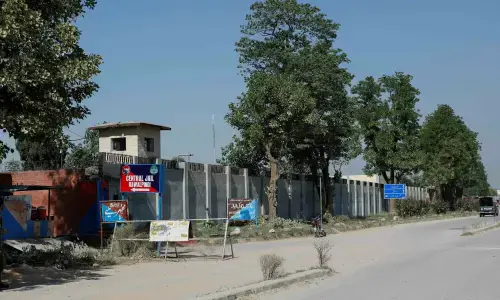
The inquiry report into the incident in a Karachi lock-up last month in which two suspects suffered burn injuries and later died explains little. It is being seen as another effort by the police to protect their own.
The internal inquiry was conducted by a three-member committee headed by an SSP. It concluded that the two suspected robbers detained in the lock-up took their own lives by setting themselves on fire.
According to the Sindh IG, the suspects did this thinking "someone would rescue them" or to "avoid police remand and be sent to jail custody". This seems to be a tacit admission that for the two men the extreme step of setting themselves on fire was preferable to being in police custody.
The report itself is unable to give any possible motive as to why the two suspects would take their own lives (and it says this quite clearly). Besides, the way in which the so-called suicide is said to have taken place seems suspect given that the police insist that it happened after the two men obtained petrol from a motorcycle parked inside the lock-up, although what a motorcycle was doing in a cell is not explained.
The report does establish the fact that the two who died were part of a gang of robbers led by a serving police constable who paid several visits to the lock-up while the two were in custody.
Reports immediately after their detention also suggested that the two men wanted to expose who their patrons and benefactors were, with one victim saying that if he went to jail this time he would not go alone.
But the report does not go into the role of the constable concerned. It is not clear either as to whether or not the views of the family members of the deceased were taken into account, especially on how the two managed to get matches and petrol inside the lock-up. The police's assertion that the families passed these on was denied by the latter who said that all items were handed to the staff at the police station.
In addition, one of the victims is said to have made a "dying declaration" in which he said that staff of the police station set him and the other suspicious on fire after failing to get a confession out of them.
Did the report consider the views of the two men before they died? It did interview one of the burn victims, Saleem Khan, who "point-blank" told the committee that the police at the Gizri police station had burned him and the other suspect. However, the report believes that the accusation sounded suspect because circumstantial evidence seemed to suggest that he was lying about where and how he came to be burnt.
To quote the report (its own words): "When asked where he [Saleem Khan] was set alight, the accused claimed that he was set alight in the outermost room and thereafter never left the room. However, the smoke of the fire was discovered by the committee in the toilet.
Also one half-burnt matchbox was found at the entrance of the toilet and one plastic utensil was also found half-burnt in the toilet. Thus there is a discrepancy in his statement and the ground reality as discovered by the inquiry team."
Wouldn't a considerable amount of time have elapsed between the time the two men were said to have set themselves alight (the report says this happened at 8.30 am on August 23) and the time the inquiry team inspected the lock-up? How could the inquiry team still have found smoke from the incident? Isn't it possible that somebody deliberately lit the fire in the toilet to throw off the inquiry?
Then, while the inquiry officers interviewed a total of 20 people, for some reason they did not interview any member of the victims' families. They also do not appear to have spoken to any of the doctors who treated the two men or with the medical superintendent of the Civil Hospital who disallowed a fact- finding team of the Human Rights Commission of Pakistan from meeting and interviewing the two burn victims.
The HRCP has said its team was refused access on the grounds that the two victims were in no position to meet anyone (though their families did meet them the same day).
Interestingly, the report does prove the contention of the victims' families that the two men had been in custody well before their formal arrest was shown. In fact, the two men, the report says, were arrested nine days prior to the date shown in the police station's roznamcha and that "third-degree methods" were used by the police staff.
However, the report says, medical reports showed no serious injuries. So, if "third-degree methods" were indeed used, it would seem a bit surprising that there was no evidence of any serious injury.
As far as one can tell, no statements were taken on record, in the presence of a magistrate, of either of the two men. It is also not clear whether a post-mortem was carried out and if it was what were its findings.
The investigation conducted on the orders of the Sindh IG thus raises more questions than it answers. There was a case last year where a 13-year-old boy was sexually assaulted by two policemen on duty at a picket in Shah Faisal Colony after which he committed suicide.
No charges were ever filed against the policemen and in fact the police official investigating the case was accused by the boy's family of deliberately distorting the facts and ignoring crucial evidence, including a statement that the boy made in hospital before he died. Nothing came of it, and one fears nothing will come of this, unless the Sindh government now steps in and orders a judicial inquiry.
Changing airport scene
Not too long ago, a visitor coming out of the airport terminal was greeted by a horde of taxi drivers, all of them asking him to get into their vehicles.
Policemen used to look the other way because they got their pound of flesh once the taxi was hired. It became quite embarrassing when one went to receive foreign guests. But now things have changed - and changed for the better. The taxis are parked outside the Jinnah Terminal building and they take turns to get passengers.
The policemen give the passengers receipts with the taxi's registration number so that if you have any complaint you can refer to the police department. Once the taxi moves towards Sharae Faisal, the driver tries to gain your sympathy by asking for extra payment, explaining that he has to grease the palms of the constables to be allowed to wait for passengers.
"I have been waiting for two hours and have hardly made money today" is the refrain, and in many cases it's correct. "But that's not my fault" is the normal reply given by those who don't like to be taken for a ride.
Things have further improved with the introduction of cabs which can be called by phone if you have to go to the airport, and you can also hire a cab from the booth at the airport to be dropped anywhere in the city.
Compared to the normal taxis, these four-wheelers are comfortable and their rates are fixed. What is more, they are airconditioned, so you are cut off from the heat and dust outside. Now there is more than one company which has a fleet of cars. However, what one needs is a coach service, which would be more economical.
Those who travel to Islamabad and are back before midnight usually leave their car in the carpark. But there is one section in the carpark where you can keep your car in safe custody for three or four days. But not many people feel comfortable doing that.
One cut too many
Gone are the days when traffic in a one-way street ran in only one direction; now you can never be sure when you may bump into a car coming from the opposite direction.
Sarwar Shaheed Road is a one-way street, with traffic running from what used to be the Goethe Institute toward Zainab Market. Yet, one sees vehicles of all sorts going in the wrong direction.
See also the position on Zebunnisa Street and Abdullah Haroon Road after 9pm. There is anarchy and motorcyclists drive both ways. As for a pedestrian crossing a street, tell him not to look just to his right. That could prove to be risky, for he might as well be hit by a vehicle coming from his left.
Motorcyclists, for instance, do not bother to take the trouble of driving for another half a kilometre or so for a break in the median footpath; instead, most of them drive the wrong side so as to use the nearest "cut". The result is that, while a pedestrian may be looking toward right, he or she may be hit by a vehicle coming from the left side.
The road most dangerous from this point of view is Dr Ziauddin Ahmad Road. There is a forlorn dirt road adjacent to the Government Commerce College. This road leads to a katchi abadi.
If a driver follows traffic rules, he must come from the PIDC side, and then take an easy left turn into this dirt road. However, what actually happens is bizarre: vehicles coming from Shaheen Complex do not bother to go the PIDC traffic signal to take a U-turn.
Instead, opposite to the Bagh-i-Quaid-i-Azam, there is a "cut" in the median footpath. Cars and motorcyclists make use of this gap, drive the wrong side - often close to the footpath so as to avoid bumping into the traffic coming form the PIDC side - and then turn right into the dirt lane.
Should there be so many cuts on the main road? Point for the police to ponder.
Documentaries on Pakistan
Obaidullah Baig knows the geography of Pakistan like the back of his hand. Thanks to his prodigious memory, there is no river, no pass, no gorge and no mountain in the country that he is unaware of.
In the early 1970s, he made 38 documentaries for PTV. Titled Sailani key saath, the documentaries showed the rural landscape of what were then East and West Pakistan and were very popular with lovers of nature.
In the 1970s, he filmed the forests of Pakistan and made documentaries called Forests of Sindh, Forests of Balochistan and Forests of Punjab. His 25-minute-long, black-and-white documentary Lakes of Sindh won him the prestigious Wildscreen Festival award.
Mr Baig, who has over 300 documentaries to his credit, is now making seven documentaries for the government. Over the next eight months, he will travel the length and breadth of Pakistan, making two documentaries on Punjab, one each on Sindh, Balochistan, the NWFP, Azad Kashmir and the capital.
email: karachi_notebook@hotmail.com.