0
0

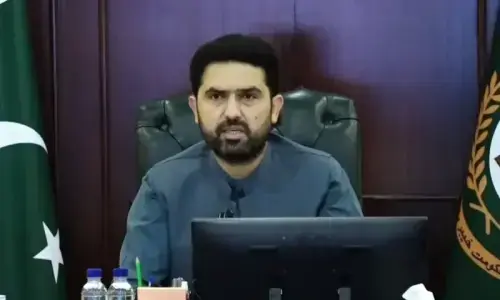
NEW DELHI, Sept 4: Foreign Minister Khurshid Mehmood Kasuri arrived here on Saturday to hold 'critical' talks with his Indian counterpart on a range of issues in their structured composite dialogue that includes the Kashmir dispute.
In his arrival statement Mr Kasuri said there was a need for the two countries to listen to their people who wanted peace. "It is better that governments of the two countries be guided by what people want. People want peace," he told reporters.
"India and Pakistan need to live in peace. But for peace, it is necessary that efforts be made to solve all problems between the two countries. I will make a serious effort in this direction. Let us live up to the world's expectations," said Mr Kasuri.
Indian Foreign Secretary Shyam Saran and Indian High Commissioner to Pakistan Shiv Shankar Menon along with Foreign Secretary Riaz Khokhar and Pakistan's High Commissioner to India Aziz Ahmed Khan received him.
On Sunday, Mr Kasuri and Indian External Affairs Minister Kunwar Natwar Singh will hold one-to-one talks as well as meet each other with their delegations. Mr Kasuri will also meet Prime Minister Manmohan Singh, members of the Kashmir resistance and Indian opposition leaders.
Pakistani officials said the talks so far had neither shown a breakthrough nor any signs of a breakdown.
"The foreign ministers will review the progress or lack thereof in the eight rounds of consultations that have been held so far as part of the composite dialogue," foreign office spokesman Masood Khan told Dawn.
He said they would also "look for the space for making further progress on the issues which are complex and require political intercession."
The two ministers would also make preparations for the likely meeting between President Pervez Musharraf and Prime Minister Singh in New York, he said.
Earlier, Mr Khan told a news conference that talks between the two sides had entered a 'very critical phase' for the continuity of the composite dialogue.
Meanwhile, the foreign secretaries of India and Pakistan, Mr Saran and Mr Khokhar, met to review the progress in composite dialogue.
A joint statement said that they "assessed positively the discussions held on the eight subjects in the composite dialogue." These issues are: peace and security, Jammu and Kashmir, Siachen, Sir Creek, Wullar Barrage/Tulbul navigation project, terrorism and drug trafficking, economic and commercial cooperation, and promotion of friendly exchanges in various fields.
"The foreign secretaries agreed that the discussions had been productive and had taken place in a cordial and constructive atmosphere. Several useful ideas and suggestions were made by both sides," the statement said.
"In their meeting today, the foreign secretaries discussed the ways of taking the process forward. They would be reporting to the foreign ministers with the recommendation that the composite dialogue should be continued with a view to further deepening and broadening the engagement between the two sides," the joint statement concluded.
Ashraf Mumtaz adds from Lahore: Talking briefly to reporters at Lahore airport and in a written statement issued before he flew to Delhi, Mr Kasuri said: "I will engage my counterpart on all issues. This is not the time for tall promises, but for investment of our time and energy in solving problems, which I do not find intractable. Yes - I can say confidently that Kashmir is not an intractable problem. It only requires political will for its solution".
Expressing his desire that the talks should be made meaningful, the foreign minister said: "Our dialogue should be guided by the compass of results. We must know where we are going. And as we press ahead, we should manage our time well and relate it to our goals. It is time that we refuse to go through the motions, and through the familiar cyclical pattern of peaks and troughs, dialogue and conflict. It is time to fix things".
Refuting the impression that Kashmiris were holding the two countries hostage, he said in fact, "by denying them their rights, we have kept their future in limbo, and ours in a state of perpetual tension".
The minister said it was regrettable that the two countries had not been able to resolve the Jammu and Kashmir dispute. "We should give the Kashmiris the choice to determine their own future. This choice should have been given to them in August 1947. But, 57 years later, we are still at the starting line".
In reply to a question, he said he had met the Kashmiri leaders and taken them into confidence.
"I want to assure Kashmiris that they would not be marginalized. We want to persuade India to associate them with our dialogue. Their association would add substance and meaning to the dialogue. A resolution of the Kashmir dispute alone will guarantee peace and security in South Asia," he said.
Peace, the minister said, was an ideal that the people of the region wished to pursue. "It is not a daydream, but a vision for the people of Pakistan, India and Kashmir. Given the history of our relations, we have to work hard to translate this vision into reality," he said.