0
0

ISLAMABAD, Aug 26: The second formal meeting of the technical committee on water resources (TCWR) constituted by the president in August last year has been convened on Sept 4, 2004 , to finalize water availability data for ascertaining the feasibility of new water reservoirs.
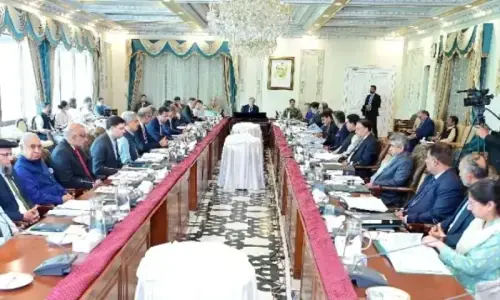
To be presided over by TCWR chairman ANG Abbasi, the meeting would be attended by the committee members, senior officials of the Planning Commission, Wapda, Chief Engineering Organisation and Indus River System Authority (Irsa), Dawn has learnt.
The Planning Commission and Wapda have been asked to give presentations on water needs, availability figures and surplus situation for the new reservoirs. Informed sources said the Planning Commission has also confirmed to give presentation on the directive of the president secretariat unlike the previous occasion when it had refused to provide its data to the technical committee and respond to various questions raised by Mr Abbasi on various irrigation-related planning issues.
Mr Abbasi had also raised some questions like on what data and projections the Planning Commission had approved certain water sector projects without pre-feasibility studies, and whether required water availability situation was properly analyzed. The Planning Commission did not respond to those queries.
The Planning Commission had told the committee that, technically, it was not under any obligation to brief the technical committee. This had led to the resignation of ANG Abbasi early last month as head of the technical committee. His resignation was not accepted by the presidency.
The committee has gathered position papers from almost all the relevant organizations and members of the technical committee since its first meeting a few months ago.
The sources said that some members of the technical committee had challenged the Wapda figures about total water availability in the country as they estimated negative availability of eight million acre feet (MAF) of water, which meant that no new dam would be feasible.
Wapda estimates that there is sufficient water available in the country which is going waste and demands that this should be utilized \through construction of at least two big dams without delay.
The committee wants Wapda to give a detailed briefing on river Kabul and its expected usage by Afghanistan and either prove 13 MAF availability in Eastern rivers or delete it from its projections.
These members criticize Wapda for presenting four different figures at different forums. Wapda had presented water availability of 142 MAF to Pakistan Development Forum (PDF) conference a few months back and 156 MAF to the Nisar Committee.
The figures provided to the water and power ministry by Wapda are 138 MAF based on 1977-2000 data which have been re-estimated at 140 MAF on the basis of 1977-2003. It also claims that big dams are feasible at 50 per cent probability.
Wapda includes five MAF water in its estimates being used by the NWFP above rim station and claims only five MAF requirement downstream Kotri. Wapda also claims that Afghanistan would not use more than 0.5 MAF of water from river Kabul and about eight MAF would be available to Pakistan from that river.
Moreover, it estimates that India would not use five MAF from Eastern rivers - Ravi, Sutlej and Beas - while there is another eight MAF of water being generated by these dams after entering Pakistan and as such total availability is 156 MAF.
The Sindh government has been contending that former water and power minister Farooq Leghari in the ZA Bhutto cabinet had set the principle of dam feasibility at 80 per cent probability in four out of five years. Hence Wapda's 50 per cent probability should not be given weight.
It also calls for not accounting for five MAF water used by the NWFP above rim station because calculations are always based on below rim station. Sindh also argues that the federal government's 10-year perspective plan and all other planning are based on data from 1922 onwards, so its estimates based on 1977 onwards are illogical.
The province also denies that Eastern Rivers are generating eight MAF of water and even if this is accepted, it questions why these have not been included in the 1991 Water Accord.
Sindh says there is no guarantee that India would continue to spare five MAF that it is not utilizing at the moment from its Western rivers and hence cannot be included for estimates to build dams.
It also says that Afghanistan is planning to build a dam on river Kabul and there is no guarantee that eight MAF would be available to Pakistan without a water treaty with the neighbouring country.
It also argues that Wapda had not indicated as to how to spare water for Thal and other canals and Mangla's upraised capacity. It is of the view that total availability of water is about 138 MAF, of which 10 MAF has to be left for downstream Kotri.
Of the remaining 128 MAF, 117 MAF is being distributed among provinces under the 1991 Water Accord. After deleting five MAF India is currently sparing in Beas, Ravi and Sutlej, which cannot be relied upon for long because India still has more than 500,000 acres of virgin land in that area.
This leaves only five MAF spare water but Sindh claims that system losses are consuming about eight MAF of water and hence there is negative availability of eight MAF. As such, there is no room for a big dam, Sindh contends.