0
0

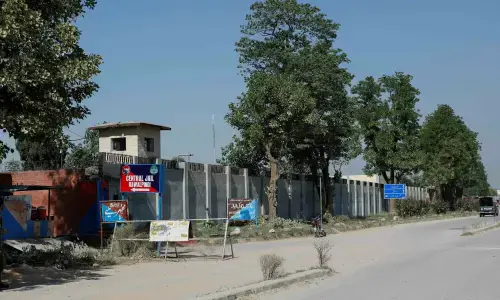
PESHAWAR, Aug 22: Two tribesmen are serving 42-year-prison term under the colonial-era law of Frontier Crimes Regulations, 1901, in Dera Ismail Khan's central prison.
They were sentenced by the assistant political agent (APA) of Upper Kurram, who also fined them Rs150,000. In case of default they had to serve a further term of 12 years.
As they are poor people and not in a position to pay the fine, they would undergo 54 years of imprisonment. They have already spent 14 years in the jail. The prisoners, Tahir Khan and Nabi Hussain Bangash, were charged with carrying explosives.
They were convicted by the APA on June 30, 1990, and were sentenced under section 11 of the FCR read with three different sections of the Pakistan Penal Code. The tribal administration had ordered that their sentences should run consecutively.
Normally, in settled areas different sentences in the same case run concurrently and not consecutively. At the time of the incident in 1990, Tahir Khan was about 18, and Nabi Hussain 24. Both of them claimed that they were innocent and falsely implicated in the case.
In an appeal sent to the Voice of Prisoners, an organization dealing with rights of prisoners and destitute persons, they said that they had spent precious parts of their lives inside the prison and would continue to remain there for four decades.
The tribal administration had claimed that on June 9, 1990, it recieved information that some miscreants would bring explosives to the Sada bazaar for carrying out explosions there and killing innocent people.
It was added that on June 10 they spotted a donkey in the bazaar and on search they found a time bomb concealed in the saddle. The officials claimed that they arrested Tahir on the spot, whereas Nabi Hussain tried to escape from the scene but was apprehended.
Under the Kurram Riwaj (custom), the administration referred the matter to a jirga, which observed that both of them were involved in the offence. On the basis of the findings of the jirga, the APA pronounced different sentences which included: 14 years rigorous imprisonment under section 121-A CrPC (conspiracy against state) and 11 FCR; 14 years rigorous imprisonment under section 124-A CrPC (sedition) and 11 FCR; and, 14 years under section 436 CrPC (mischief by explosive substance), section 511 CrPC (attempt to commit offence punishable with life in prison) and 11 FCR.
They were also fined Rs50,000 on three counts in default of which they have to undergo four years imprisonment. The two have now to spend 54 years in prison as they have no legal remedy available.
Normally, the superior courts also do not entertain such cases on the ground of maintainability as under article 247 of the Constitution the superior courts could not exercise any jurisdiction in the Federally Administered Tribal Areas (Fata).
Legal experts told Dawn that in September last year a two-member bench of the Peshawar High Court had dismissed a writ petition of a prisoner in almost identical case.
In that case, petitioner Dildar Hussain was convicted by the APA Upper Kurram in 1988 and was sentenced to 14 years imprisonment on three counts. The APA had ordered that his sentence would run consecutively.
The bench, comprising Justice Tallat Qayyum Qureshi and Justice Ijazul Hassan, observed that under article 247(7) of the Constitution the high court could not exercise jurisdiction in the tribal areas.
The chairman of the Voice of Prisoners, advocate Noor Alam, told Dawn that under section 35 of the Criminal Procedure Code, sentence in cases of conviction of several offences at one trial should not exceed 25 years imprisonment.
He added that the law was applicable to settled areas whereas in Fata the political agents acted in accordance with their whims. He said that it was inhuman to imprison a person for five decades. The NWFP governor, he stressed, should take notice of all such cases and issue appropriate orders so that their sentences could run concurrently and not consecutively.