0
0

Primacy of consensus
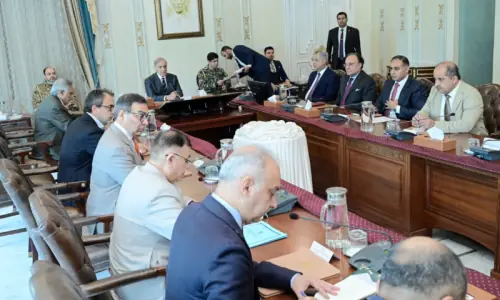
Even if one detects a bit of over-optimism in President Pervez Musharraf's claim that Pakistan is winning the war on terror, he may have reasons for sounding as confident as he did in his interview with Dawn yesterday.
Recently, Pakistani security agencies have met with some successes in arresting a couple of high-profile foreign terrorists. These successes have come in the wake of the killing in June of Nek Mohammad, a leading tribal militant, who had earlier surrendered to the authorities but later reneged on his promises.
Further progress in detecting terrorist networks has not been divulged, but there is no doubt that the government is determined to continue its hunt for foreigners and their local accomplices.
The operation seems to have run into serious problems in Wana, as a result of a mixture of political mishandling of the situation and unexpected resistance from the tribesmen. Nevertheless, the government has continued with the operation. In the process, it has incurred much criticism.
While foreign leaders and media have accused the government of not doing enough, politicians at home have accused it of succumbing to foreign pressure. The president said he was not the kind of person to give in to pressure, but, at the same time, he admitted that the drive against terrorists and extremists could cause a backlash. It has already led to several devastating attacks.
In his interview, the president dwelt upon a number of other issues, ranging from the Kashmir time-frame controversy and troops for Iraq to the need for changes in the curricula and the Hudood and blasphemy laws.
On several issues, he defended his position. For instance, he denied that the military had from day one fraternized with the MMA or contributed to its electoral success with a view to sidelining the PML-N and the PPP.
The denial will obviously be viewed with scepticism by close observers of the political scene. Today, these two mainstream parties stand sidelined, and the government has made every attempt to win over their MNAs and MPAs to its side.
This may give the ruling coalition a short-term advantage in the form of a comfortable majority in the National Assembly. But this would hardly serve the country's long-term political and democratic interests.
These interests can best be served by evolving a national consensus. The president himself said he had no animus against a particular party. He should, then, seek to draw in all parties to cooperate in tackling all the major problems that beset us.
For instance, Gen. Musharraf seemed categorical about big dams and said a decision was expected soon. There are sharp divisions on the issue among the provinces, and there is a strong view in three provinces that they do not need another Tarbela.
A dam built without a national consensus would hardly serve the cause of national integration. So also in the case of terrorism - a curse that Pakistan must get rid of in its own interests.
But the point to stress is that the war on terror can achieve better results if it is carried out with the backing of political parties and civil society. The MMA's ambiguous position on the operations in Wana - something to which the president himself referred - and the reservations voiced by the PML-N and the PPP point to the absence of a national consensus on an operation which seeks to penetrate the hitherto largely no-go areas and which, some fear, could well set the stage for similar action in Balochistan with grave repercussions.
The government will be stronger, not weaker, if it has broad national and parliamentary support for the objectives it has set before itself - and there will be lesser risk of de-stabilization of our polity and society.
Tackling Darfur
Pakistan's special envoy who met the Sudanese president on Wednesday has confirmed Khartoum's willingness to implement UN Security Council and African Union resolutions seeking an end to the humanitarian crisis in Darfur.
However, President Omer Hassan Ahmed El Bashir has expressed reservations about his country's ability to meet the 30-day deadline given to it by the UNSC under its July 30 resolution.
He has argued that a clean-up in the troubled region is not possible within the stipulated timeframe, saying that the 18-month-old crisis began as a rebellion against his government.
While the UN resolution demands that Sudan disarm and bring to justice members of the Arab-supremacist Janjaweed militiamen, it makes no mention of disarming the African rebels. Clearly, there are complex political problems at the root of this crisis that need to be sorted out.
But while political issues take time to get resolved, the worsening humanitarian situation in Darfur cannot be left to fester. Khartoum will have to take into account the international community's concerns in this regard.
Sudan should welcome the offer made last week by the African Union to provide a 2,000-strong peacekeeping force to help protect and rehabilitate over one million people forced out of their homes by the crisis.
The West, for its part, should encourage an inter-African mechanism rather than threatening Sudan with sanctions or military intervention. The Ethiopian and Rwandan experiences in the 1990s have shown that an approach based on persuasion and humanitarian considerations works better in ending such ethnic conflicts as opposed to one based on military force, which failed miserably in Somalia in the 1980s.
With the adventure in Iraq having gone awry, Palestine still bleeding, Afghanistan unstable and Al Qaeda flexing its muscle, the world can ill-afford another Arab/Islamic flash point in the heart of Africa. Any international response to the crisis in Sudan must take stock of all these factors.
Fate of PIA planetarium
The PIA planetarium in Karachi, which has been functioning at its present site for the past two decades, is now in danger of being closed down. The Export Promotion Bureau (EPB) says that the land on which the planetarium has been built is its property and that it needs the plot for the second phase of its expo-centre project.
There it plans to build a five-star hotel, airline offices, banks, fast food outlets and other facilities. For its part, the PIA management says that the land was given to it by then president General Ziaul Haq under a presidential order. Any change in the planetarium's location is bound to prove unsettling for this facility and may even threaten its very existence.
The planetarium has enthralled thousands of Pakistanis, mostly students, who come here to learn more about the solar system. Owing to its non-commercial nature, PIA offers students this facility at subsidized rates so that a maximum number of them can benefit from what is essentially an educational service.
The PIA management says that it is not possible now to shift the planetarium to a new site because it does not have alternative land for this purpose. It would be best to allow the planetarium to stay at its present location and expect the EPB to find an alternative site for its exhibition and other projects.