



 0
0

Fruits are valued as protective food. These are rich in minerals, vitamin A, B and C, and provide more energy per unit weight than the cereals. Pakistan's wide range of agro-climatic conditions allow production of a variety of tropical and sub-tropical fruits.
These not only prevent scurvy but also increase resistance to infection and facilitate absorption of non-heme iron, along with providing dietary fibre. Yellow fruits are additionally rich in beta-carotene.
Fruits and vegetables consumption is steadily increasing in Pakistan. As economies develop, consumers need high value and quality products. There, also, is an emerging demand for organic fruits. Though, high in prices, consumption pattern here is similar to that in the most developing countries, but with very low per capita consumption.
Upper income group consumes well above average, while the bulk rural population and a large percentage of poor urbans consume less fruits. The estimates of per capita consumption of fruit are about 33kg/year which is below the minimum level necessary for basic nutrition.
However, the family income in Pakistan is growing which is expected to increase fruit demand, likewise. Consumption pattern of selected fruits has been examined and described below. Historically, population and income have been two major resources of growth in consumption.
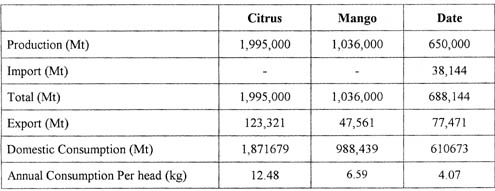
The number of people determines the total need of fruits whereas incomes determine their ability to pay for different varieties. Total production, import, export, domestic consumption and annual per capita consumption of citrus, mango and dates in Pakistan is shown in Table 1.
Table 1: Fruits production and consumption in Pakistan during 2001-02
Citrus: Among major fruits, citrus occupies the top position in terms of area and production. It's cultivation on about 194,000 hectares produced 1,995,000 tons during 2001-02. Orange, the most common citrus fruit, is widely grown in warm climates having a sweet-sour taste.
Its juice is widely used. Orange has thick bitter rind that is normally discarded, but can be used in cooking. The outer-most layer of the rind is called orange zest, and it has a similar flavour to the inner part of the orange. The white part of the rind is almost always discarded. In the past, oranges were primarily eaten fresh, out-of-hand, and many are so consumed in warm climates.
Today in homes, oranges are peeled, segmented and utilized in fruit cups, salads, gelatins and desserts, and as garnishes on cakes, meats and poultry dishes. Orange slices and orange peels are candied as confections. Grated peel is used in flavoring.
The outer layer of peel is used commercially in foods, soft-drinks, candy flavours and for other purposes. Pectin uses in fruit preservatives is derived from the white inner layer of peel. Its pulp has become a by-product.
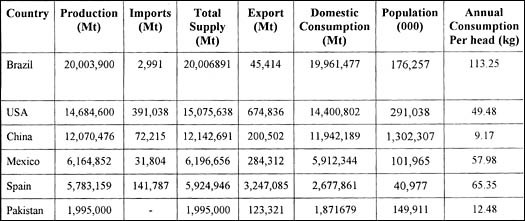
Dried to a moisture content of less than 10 per cent, it is used as emulsifier and binder in food and beverage industries. Citrus consumption in 2001-2002 is shown in Table 2.
Table 2: Citrus consumption of major Citrus producing countries in 2001-2002
Mango: Among major fruits, mango ranks second in terms of area and production. It is cultivated on about 99,000 hectares with total production of 1,036,000 tons during 2000-01. Grown in Punjab and Sindh, it is available in abundance from May to September.
The fruit is rich in Vitamin A, C and D and other antioxidants. Mango has more carotenoids which help in reducing cancer risks and heart diseases. Pakistani mangoes are high in fibre, and contain a small amount of carbohydrates, calcium, iron, potassium and a little protein.
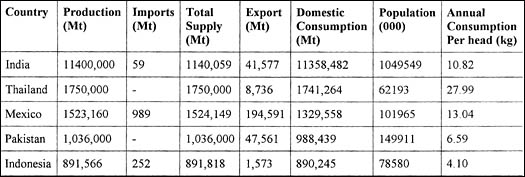
Mangoes are also used in juices, squashes, jellies and jams. Raw ones are used in chutney and pickles, as well as chips. Consumption in 2001-2002, of the five largest mango producing countries in the world is shown in Table 3.
Table 3: Mango consumption in major producing countries during 2001-02
Sources: FAO Year Book, 2004
Date: Date occupies third position in terms of area and production. It was cultivated on about 79,000 hectares with a total production 650,000 tons during 2001-02.
Dates have great importance as a staple food, and as dessert and are health food. Dates have found way into sweets, confectionery, chocolates, bakery products, preservatives, salads, sauces, and breakfast cereals. It is also used in bulk, in industries.
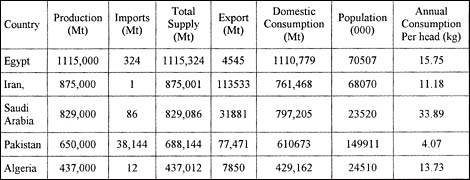
With advancement in food technology, new products are being developed with dates. The level of consumption in 2001-2002, of the five largest date producing countries in the world is shown in Table 4.
Table 4:Date consumpution in major date producing countries in 2001-02
Sources: FAO Year Book, 2004





























