0
0

Complexities of population issue
The world population day was observed on July 11 and all the leaders involved with the population programme in Pakistan one way or the other expressed their concern at the country's demographic profile on this occasion. The official voices which were raised this year were somewhat louder than before.
The president sent a message calling for a balance between population and resources. More importantly, he emphasized a close link between population and the social development of the people especially in the areas of health, education and women's development.
This was no revelation but coming from the highest quarters this message was most welcome for it indicated that they have at least begun to understand the complexities of the population question.
Barely a week later, the UNDP released its annual Human Development Report 2004. Its findings should have come as an eye-opener for our policy makers. It clearly confirmed the link President Musharraf had spoken about.
Significantly, Pakistan which showed quite a phenomenal growth in its population, also saw its HDI value fall from 0.499 in the 2003 report to 0.497 this year.
But its rank rose to 142 from 144 in 2003 in the human development index. The social sectors that are the key determinants in the demographic growth of a country were also in poor shape.
With an annual population growth rate of 2.4 per cent the number of people living in this country was 149.9 million in 2002 - more than double of what it was in 1975 - and is expected to jump up to 204.5 million in another eleven years when Pakistan will be the fifth most populous state in the world after China, India, the US and Indonesia.
But the quality of life of the majority of the 150 million or so souls in this country is appalling. Only 41.5 per cent are literate, less than half have access to affordable essential drugs and the status of women is so poor that the country ranks a low 120 out of 144 in the gender development index.
What does one make out of this big mass of statistics which runs into 112 pages of the UNDP report and is a mine of information on 177 countries? A major characteristic of the "low human development countries" - 36 in all beginning with Pakistan - is that they have a relatively high population growth rate, low contraceptive prevalence, low literacy rate especially for women, gender imbalance in every sector of life, and rampant poverty.
In such conditions the small family norm doesn't make much sense. The male offspring provide economic security in more ways than one. Even before they outgrow their childhood they can be sent to work to earn for the family - swelling the ranks of child labour in Pakistan.
And when the parents grow old, they find their sons to be a source of economic security for them. For the poor, the call for a balance between resources and population in the macro context is meaningless.
If the argument once was that a burgeoning population adds to the government's education and health budgets, and upsets its planning, this no longer holds true now. After all, the government has been shedding its responsibility of educating the citizens and providing them much health care, irrespective of their numbers.
The private sector has stepped in to fill the vacuum created and the people themselves, including the poor, have been required to pay for their children's education. They pay to get them treated when they fall ill and they find a job for them - even if it is on exploitative terms - when they are ready to join the workforce.
At the individual level, a small family norm should technically appeal to the poor. It should cut down the wage earner's household expenditure with fewer mouths to feed.
But the logic doesn't always work that way. There are many factors that work in favour of having many children who also add to the family income once they are old enough to go out and work..
Hence, it is plain that social development will have to be taken care of and the curse of poverty alleviated simultaneously if the population growth rate has to be radically scaled down.
There is also a political dimension to the population problem, which is generally overlooked. A rapidly growing population pre-empts the development of a stable society which successfully manages and mitigates conflict over religion, language, culture and ethnicity.
This defeats the purpose of a modern civilized state - to protect human rights and deepen democracy. The UNDP administrator lists these as major goals of development in the 2004 report, which focuses on cultural liberty in today's diverse world.
The report says: "If the world is to reach the millennium development goals and ultimately eradicate poverty, it must first successfully confront the challenge of how to build inclusive culturally diverse societies."
It may be added here that this is not possible in states with galloping population growth rates. If the growth is also uneven, that is, one ethnic/racial group is growing faster than the others, it can destabilize the state. Massive numbers lacking an awareness of their rights and unequipped with education to use the tools of power do not go into the making of a democratic culture
Amartya Sen, the Nobel laureate, who has contributed the first chapter of the 2004 report stresses the importance of equity in the pursuit of freedom. He writes, "The freedoms of different people are involved, and focusing on freedom requires that attention be paid to the freedoms of all - and this connects with consideration of equity."
The fact is that all these aspects - political and economic freedom, equity, social development, stable and moderate population growth rate, alleviation of poverty - are interrelated. One is not possible without the other. When the state fails to provide one, it creates a vicious cycle which negatively affects all the others.
Hence the need is to work on all fronts. If the recognition of this fact has dawned on our policy makers, one can hope that they will now move to translate their words into actions before the next world population day comes along.
A state, where the majority of population is mired in backwardness, ill-health, ignorance and poverty and its number keeps growing rapidly, possesses all the ingredients of social and political conflict, crime and instability. Regrettably, Pakistan has them all.
Dealing with warlords
Following up on his interview with the New York Times on July 12, in which he had identified the warlords and their militias as the principal threat to security in Afghanistan and to the holding of fair elections President Karzai issued on the July 14 a decree calling for immediate disarmament.
The disarmament decree, announced on Kabul Television, said collecting weapons and integrating armed groups into the ministry of national defence are fundamental conditions for peace and economic recovery.
It went on to say that, "Anyone who refuses to disarm or who remains allied with a private militia "will be considered disloyal and rebellious and, in accordance with the law of the country, will face the severest of punishments.
It also warned that any armed group that remained outside the defence ministry, continued to recruit and arm people, or attempted to reinstate those already disbanded, would be punished. Any demobilized soldiers who try to rejoin their old units, or any units or individuals who try to retain heavy weapons would also be punished, it said.
President Karzai faces daunting odds created by the divisions within the country's body politic, by the gap between the rhetoric of the international community and the tardy delivery on their promises, by the continuing opposition from the Taliban, by the continued interference in Afghanistan by its neighbours some unintentional and some carefully planned, by the abject failure of the narcotics elimination campaign and the use of narcotic money by the warlords and the Taliban etc.
Many of these problems can be laid at the door of the warlords and in almost equal measure on the international community's unwillingness or inability to help the Karzai government to enforce its authority throughout the country.
It is fair to say that had the Americans or the ISAF (and preferably both) insisted on the observance in letter and spirit of the Bonn agreement on the de-weaponization of Kabul and the removal of all militia from the city, many of these problems would not have arisen.
Certainly the disarming of the warlords in the north and west would not have posed a problem and in all probability the Taliban would not have been able to retain any substantial measure of support in the south and south-east of the country.
Carrying further the might-have-beens had President Bush not diverted attention and material and manpower resources to Iraq the problems in Afghanistan would not have acquired their present proportions.
One assumes that President Karzai's present decree has been issued not on the strength of his fledgling army but on the strength of assurances from the Americans that they would provide the force needed to bring recalcitrant warlords in line.
As a well wisher of Afghanistan and as an admiring observer of President Karzai's efforts to bring a semblance of order to his country one can only welcome and applaud this decree.
But this applause and endorsement is conditional on whether the decree is really aimed at disarming all warlords and securing the deweaponization of Kabul. This question arises because there are certain disquieting facets in statements made by Ambassador Khalilzade and in the decree itself.
It has been the accepted conventional wisdom based on observations by western correspondents and on statements by Afghan officials that the total number of militia under the control of warlords was 100,000.
Ambassador Khalilzade a couple of weeks ago while conceding that only a small proportion of this militia had been disarmed and demobilized went on to state that the total number was exaggerated.
He estimated that the total strength of warlord forces was not more than 40,000. Since then this figure or a figure of 50,000 has been repeated by most western media sources even while stating accurately that the total number of demobilised militia members was about 10,000.
There have been two notable exceptions. The Christian Science Monitor reported on July 13 that no less a person than the defence minister, Marshal Fahim, had estimated that the warlords' militia was 100,000 strong.
The second was the New York Times which in a July 15 editorial entitled "A Threatened Afghanistan" called for the disarming of the warlords before the elections and mentioned in this context that the militia commanded by Marshal Fahim by itself numbered 50,000.
The New York Times does not get its figures wrong nor should there be any doubt about the authenticity of the figure that the Christian Science Monitor obtained from the defence minister.
How then should one interpret the figure given by Ambassador Khalilzade and subsequently used by unsuspecting reporters? The strong suspicion arises that Zalmay Khalilzade has excluded the militia of Marshal Fahim - the Shura-i-Nazar - and regards this as a regular force under the command of the ministry of defence.
A similar suspicion is aroused by the reference in the decree to the offending militias being "any armed group that remained outside the defence ministry" and to the assertion in the decree that "integrating armed groups into the ministry of national defence" is a fundamental condition for the restoration of harmony and economic recovery.
Such suspicions are further reinforced by the fact that the decree makes no mention of the demilitarization of Kabul. This was a fundamental requirement of the Bonn Agreement and has not been implemented despite the lapse of more than two years.
The last ISAF commander was quite categorical in asserting that the blame for ISAF's failure to achieve this was to be laid squarely at the door of the defence ministry and Marshal Fahim.
Earlier there had been reports that President Karzai was negotiating with the Northern Alliance warlords and in return for their support in the elections was promising them both high office in his government and a large measure of autonomy in the areas they controlled.
President Karzai had not denied these meetings but had denied making any such deals. If, however, the foregoing interpretation of the Khalilzade statement and the language of the decree is correct it would seem that deals have indeed been made, and worse still, that they have been made under American pressure or with American blessings.
There are other disquieting features about events in Afghanistan. Deputy Secretary Armitage is usually kept very well briefed about Afghan developments, more so when he is visiting the region.
Yet while he was in Pakistan he spoke of the fact that 6.5 million Afghans had been registered for voting out of a potential total of 10 million. Yet, twenty-four hours later he was told and he repeated the figure that over seven million voters had been registered.
How did this happen when the UN is still short of funds and when its registration drive has been slowed in the south and southeast by renewed Taliban attacks on election officials and voters? Second, while I do not have province-wise figures it is reasonable to assume that much of the registration of voters in the relatively peaceful north had been completed at least a couple of weeks ago.
The mind boggles at accepting the fact that the current rapid accretion in figures is occurring in the south and southeast. It boggles further at accepting that the percentage of registered women voters has risen from 39 per cent to 40 per cent, when it is known that the Pushtun more so than the Tajik or Uzbek would try and keep women from registering.
I fear that, a lot of fictitious persons are being registered in the north. If this is carried further as some of the Tajik leaders would no doubt like the final count of registered voters may see the Pushtuns being replaced by the Tajiks as the plurality in Afghanistan. This is not fanciful exaggeration but, I believe, a reasonable extrapolation.
The American administration is looking for a foreign policy success. Perhaps it believes that the shenanigans of this nature will ensure that there is a peaceful presidential election in Afghanistan and this can be trumpeted in the American election campaign as the bringing of Afghanistan into the comity of democratic nations with a democratically elected president.
Even if this objective is achieved and it is hard to see how the Pushtun plurality if not majority will allow an election to be peaceful in these circumstances. The aftermath will be a disaster for the unity of Afghanistan.
One can only hope that this is not the case. Admittedly President Bush is under the gun for his Iraq policy. Admittedly he needs some foreign policy success to offset the scathing criticism to which he is now being subjected. But a cooked election in Afghanistan will bring him only a marginal advantage if any. The game is not worth the candle.
Statesmanship and the battle against terrorism, by which President Bush theoretically lays so much store, require a more sagacious approach. President Karzai's decree must be made applicable to all militia including the militia of Marshal Fahim, Sayaf, Atta Mohammad, Dostum, Ismail, Daud, Hazrat Ali and others. The decree must recognize as forces of the Afghan defence ministry only the 12000 odd men that comprise the Afghan army.
The Americans must assure the ISAF that it would have their full cooperation for the demilitarization of Kabul. Nato must also be told that it is unacceptable for Nato to say that it will send troops for only eight weeks to assist in the peaceful completion of elections and that it would leave the battle against the warlords and the narcotics traffickers to the Afghan army.
There is a feeling in Nato circles that the Americans do not really want actions against the warlords and are not concerned about narcotics. This must not be allowed to stand.
If this approach requires the postponement of elections then let it be so. President Bush would probably derive more political advantage from initiating a successful campaign against the Afghan warlords than he would from a dubious Afghan presidential election. Even if he does not, he must eschew what will be a small political advantage and do what is right for the long suffering Afghan people.
The writer is a former foreign secretary.
Children in jails
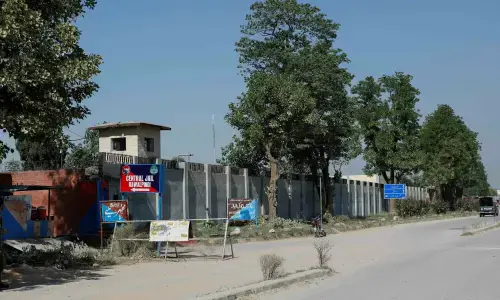
One of the most painful facts of life with regard to young people is the presence of children in the country's prisons. Equally painful is the question (to which I don't know if anyone has the answer) about the reasons for their being in jail.
Why do little boys and girls have to commit crimes that take them to these terrible institutions? I say little boys because the youngest of the jail inmates in Pakistan is just nine years old.
I am sure nobody will dispute the use of the adjective "terrible" for our penitentiaries. I wish there were someone to say, "No, things are not as bad as this word makes them out to be."
Even jail officials do not say that - they just make excuses for conditions in their place of work by blaming either the law, the jail rules or society, or end up by saying, "where else, in which government department, will you find only angels? Prisons are only as bad as other official agencies."
The public too is not fully aware of the situation about child convicts and under-trials. For instance, how many of our educated people know that while the main purpose of the adult justice system is to punish the guilty, the primary purpose of juvenile procedures is protection and rehabilitation? The UN Convention on the Rights of the Child (the CRC) places great emphasis on the criminally inclined children's early re-integration into the community, and that too in a way that protects their fundamental rights and promotes in them a sense of self-worth.
Reports of children committing crimes capture headlines, but far less attention is given to these children's background, the factors that bring them into conflict with the law, and the treatment and prison conditions they encounter after arrest.
The world accepts the thesis that offenders are not born but are created by society. In Pakistan, common characteristics of such children are poverty, illiteracy, unstable family lives, large families without adequate means and criminal tendency in the family.
After arrest their plight is worsened by ignorance of their rights, lack of counselling services, special juvenile homes and legal representation. While there is a large district jail in every district HQ and numerous sub-jails for adult prisoners, there are only three Borstal Institutions in the entire country for corrective treatment of juvenile offenders.
Money is always there for the shenanigans of cabinet ministers and protection of VIPs but not enough to open more institutions, or even to equip the existing ones adequately. Children committing crimes are in a world by themselves of which the rest of Pakistan is woefully unaware.
In the rather bleak scenario of the law coming down heavily on criminals of tender age a bright ray of hope was provided in the year 2002 when the Juvenile Justice System Ordinance (JJSO) was promulgated, providing for Juvenile Courts and defining for the first time a child as a person who has not attained the age of 18 years.
If a question about age arises the court is required to record a finding after a medical report. But before I say more about the JJSO, I must tell you about a booklet called "Waiting for the Sunrise", published by the Society for the Protection of the Rights of the Child (SPARC) based in Islamabad.
SPARC is an independent NGO working since 1992 exclusively on child-related issues, drawing inspiration from the UN's CRC. It is an advocacy group for child rights, focusing on child labour, breastfeeding, education, violence against children and juvenile justice.
A significant feature of its latter activity is that it works directly with children in prisons in Punjab and the Frontier, not an easy task when you keep bureaucratic attitudes in mind.
"Waiting for the Sunrise" tells you everything that you could ever want to know about juvenile justice and children in custody. It is the result of two researches conducted by SPARC.
For the first one, the Society's Zafar Iqbal travelled all over the country on a limited budget to collect data about the state of our prisons and their inmates. For the second indepth interviews were held with 42 children between the age of six and 17 years in five jails in Sindh, the Frontier and Punjab.
The research is very revealing despite the fact that the interviews were not conducted in a free atmosphere, as even the juveniles were selected by the authorities.
At the end of 2002, according to prison authorities, the number of juveniles serving sentences was 936, but the biggest misfortune of all is that the number of undertrials was 4,043.
The 936 who had been convicted at least knew what their fate was, but, considering the delays at courts, no undertrial can say how long he will be in suspense before his case is decided.
Although the Juvenile Justice System lays stress on early trials, that is easily said than done, and a child might have to remain in prison for months, and even a couple of years, before he is either found guilty or set free. Can you imagine anything more traumatic?
Promulgation of the JJSO was the first major step taken by Pakistan in this field, although it had ratified the UN Convention on the Rights of the Child, with regard to making national laws on the subject, 13 years earlier. But better late than never.
The ordinance lays down procedures for arrest of a juvenile, informing his family immediately about the juvenile court where he will be produced, easy bail, designating a probation officer, and other connected matters.
If the offence is non-bailable, the child must be produced before the court within 24 hours. There is considerable ground for improvement in the ordinance. The provinces have formulated their own, more or less similar, rules under the ordinance, though, surprisingly, the Balochistan rules are the only ones that include the facility of parole.
The separation of juveniles from adult prisoners is mandatory, but is not totally observed. In some prisons in the interior of Sindh there is no separation. The evil practice is so well entrenched that an attempt in Sukkur jail some years ago to separate the children led to riots by adult prisoners. You can imagine the implications of this incident.
It is not possible for me to cull all the salient points from 'Waiting for the Sunrise'. Interested readers may obtain a copy from SPARC, P.O. Box 301, Islamabad, for Rs 100.
Children in prison is such a pathetic subject that I must quote a few words from the UN Convention that need to be dinned into everyone in Pakistan, including the government: "In all actions concerning children, whether undertaken by public or private social welfare institutions, courts of law, administrative authorities or legislative bodies, the best interest of the child shall be the primary consideration."
Blockbuster breeds contempt
The week after Michael Moore's Fahrenheit 9/11 established new British box office records for a documentary, Tony Blair's party lost a "safe" Labour parliamentary seat in Leicester and came within a hair's breadth of losing another in Birmingham.
Any attempt to establish a causal connection between the movie and the by election results would involve the sort of arguments that Blair and other leaders relied upon to justify the war against Iraq. That is, extremely tenuous ones. But that doesn't mean a casual connection can be ruled out.
What is beyond dispute is that the British Labour Party attracted the wrath of voters in Leicester and Birmingham (where its 11,618 majority at the last election dwindled to 460 votes) because over the past couple of years the Blair regime has repeatedly and consistently insulted the public's intelligence.
Speaking of which, it's worth noting that the Butler report, released on the day before the byelections, concluded that the intelligence used in building the case for war was deeply flawed, and that it was dished out in a manner that ignored all the crucial caveats, all the ifs and buts that suggested there was no solid evidence for the suspicion that Saddam Hussein was sitting on lethal arsenals of chemical or biological weapons.
Somewhat predictably, Lord Butler also concluded that the Blair regime had acted in good faith in helping to unleash the dogs of war. The byelection results suggest that a substantial proportion of the British public does not concur.
From Blair's point of view, Butler could hardly have done any better. The intelligence agencies and their workings are not in the public eye, so it's convenient to let them absorb the blame for spurious claims.
So what if a dossier released by the government suggested that Baghdad would require no more than 45 minutes to set up means of delivering chemical weapons? And so what if that absurd claim has been sourced to Iyad Allawi, the puppet prime minister of occupied Iraq?
At the weekend, The Sydney Morning Herald's usually reliable Baghdad correspondent accused Allawi - on the basis of two separate, unrelated eyewitness accounts - of personally having executed half a dozen resistance suspects days before he took over as prime minister.
Allawi has denied the charge, but his reputation as a CIA-sponsored thug and, before that, as a Baath operative casts doubt on his denials. Should the charge be verified, the United States may find itself obliged to come up before long with a less violent puppet.
In the meanwhile, to Blair's exaggerations must be added the assertion that "400,000 bodies have been found in Iraqi mass graves". The British prime minister's claims, made and repeated during November and December last year, were widely quoted, not least in the US.
The truth, however, is that only 5000 corpses have so far been discovered - considerably less than the number of Iraqi civilians slain during the invasion. And at the weekend Downing Street admitted to The Observer that Blair's claim had no foundation in fact.
In electoral terms, the beneficiary of Labour's woes hasn't been the Conservative Party, which was reduced to third place in both Leicester and Birmingham, but the Liberal Democrats.
And none of the foregoing is intended to suggest that Labour will be routed at the next general election. But it would do well to contemplate more seriously a change in leadership.
That happens to be a luxury the ruling Republican Party in the US can ill afford. A challenge to George W. Bush's candidacy for the November presidential election would prove disastrous for the GOP, and none has arisen. But the problem of trust can no longer be relegated to the periphery. And it has indubitably been exacerbated by Fahrenheit 9/11.
Michael Moore's film, denied distribution by Disney, became the first documentary to top the charts in the US. Its detractors had predicted that it would be viewed mainly by the converted. Evidently, that has not proved to be the case - it has already raked in more at the box office than any previous documentary.
Reports suggest it could even be projected at US military bases. In the event, substantial numbers of soldiers may be disinclined to vote for their commander-in-chief.
Because it will be extremely difficult for anyone who absorbs Moore's documentary to even dream of reinvigorating the status quo. Its thoroughly effective, no-holds-barred excoriation of the Bush regime makes it a potent political force in an election year.
Some of the charges and arguments it contains may not seem particularly novel to audiences outside the US, but its impact on the average American, accustomed to a rather different media diet, should not - to use a Bushism - be "mis underestimated".
At the same time, it is peppered with intriguing images that ring few bells anywhere. Does anyone, for example, remember seeing Bush's limousine being pelted with eggs by protesters on its way to the inauguration ceremony on a gloomy Washington morning?
Then there's arresting footage of a joint session of Congress, presided over by Al Gore, where members of the Black Caucus fail to ignite a debate on the stolen election of 2000 because not a single senator is prepared to endorse their motions.
And at a later stage in the movie, the use of napalm by American forces in Iraq is mentioned in passing. Despite having followed the conflict closely, I was unaware of this particular parallel with Vietnam.
One of the more devastating images in Fahrenheit 9/11 is previously unseen footage of Bush in the minutes after he was told, during a photo-op at a primary school in Florida, that a second plane had crashed into the twin towers.
Wearing an inscrutable expression, the president of the world's most powerful nation just sat there, pretending to read a children's book, for seven minutes after learning his country was under attack.
In a droll voiceover, Moore engages in conjecture about Bush's thought processes as the minutes tick by. The purpose of the segment is to demonstrate that, in the absence of someone telling him what to do, the president was clueless in the face of a national emergency.
This device of allowing Bush and leading members of his team to demonstrate their own demerits is deployed time and again, usually to good effect. There's a scene in which the president, his brow furrowed in concentration, is delivering a mini-tirade against terrorism.
Having had his say, his expression becomes more relaxed as he steps back from the cameras and we see that he is armed - with a golf club. "Now watch this drive," he intones as he whacks a golf ball into the distance. Apparently, all the television networks had this footage, but decided to edit out the frivolity.
Moore's film, which won the Palme d'Or at this year's Cannes film festival, has attracted rave reviews as well as a fair amount of criticism, mostly from the right but also from the left.
A festival of films devoted to debunking his claims and challenging his methodology is in the works, and its centrepiece is likely to be a documentary titled Michael Moore Hates America. Add to that the recently published book Michael Moore is a Big Fat Stupid White Man - the title is a reference to Moore's best-selling Stupid White Men and an earlier invective, Rush Limbaugh is a Big Fat Idiot.
The birth of a veritable anti-Moore industry testifies to the threat perceived by the right in his polemics in print and on celluloid (the anti-gun Bowling For Columbine won the Academy Award for best documentary last year).
Fahrenheit 9/11 has been attacked on the grounds that some of its contentions - particularly in relation to the Bush family's connections with Saudis, including the Osama bin Laden clan - are untrue or vastly exaggerated.
But Moore has succeeded in pre-empting such criticism by employing a team of fact-checkers, and detailed refutations of most accusations can be found on www.michaelmoore.com.
Segments of the left have charged Moore with concentrating too hard on Bush and his administration, ignoring the broader American drift towards empire-building, which is essentially a bipartisan project. The criticism isn't ill-founded, but Moore could reasonably respond that the spectacular dangers posed by the present regime make its relegation a priority.
A more valid objection to the picture Moore paints lies in Israel's absence from the scene of the crime, even though it is hardly a secret that the neoconservative plot to invade Iraq was driven to a considerable extent by concern for Israeli interests.
The film-maker might argue that he had enough angles to worry about without introducing the Israeli aspect. It's more likely, though, that he decided not to run the risk of alienating the Jewish community.
Fahrenheit 9/11 may be imperfect, but its value as an incendiary piece of propaganda effortlessly outweighs its flaws. It makes you laugh, it makes you cry. It makes you cringe (not least at the sight of Paul Wolfowitz substituting saliva for Brylcreem). It also makes you very, very angry.
The big question, of course, is whether enough Americans will be sufficiently infuriated to make a difference in November. There may never be a conclusive answer, but this unlikely blockbuster will have served a worthy purpose if it can motivate even a small proportion of its American audiences to register as voters.
Pirated copies of the film are reportedly already in circulation, so watch it. You will, at the very least, be entertained. And watch out also for a related title - Robert Greenwald's Outfoxed: Rupert Murdoch's War on Journalism.
mahirali2@netscape.net.