0
0

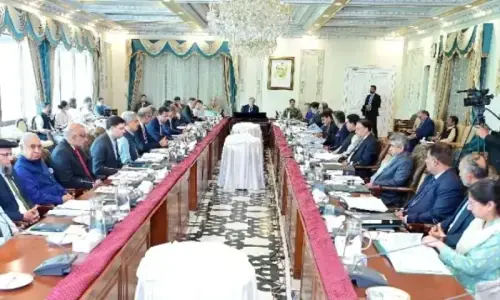
ISLAMABAD, July 18: The 30th session of the Saarc Standing Committee comprising foreign secretaries of the seven member states opened here on Sunday, advocating project-approach and greater cooperation in the energy sector.
The current chairman of the standing committee, Foreign Secretary Riaz Khokhar, opened the session and would conduct the two-day proceedings of the committee. "Saarc foreign secretaries emphasized that they want to see the organization in motion and mark a shift from words to action, from meetings to projects.
Thus there was a lot of emphasis on efficient and effective implementation of Saarc programmes," Foreign Office spokesman Masood Khan told journalists at a special Saarc briefing in the afternoon.
The briefing was held at a local hotel where a media centre has been set up for regional and foreign journalists who have arrived here to cover the event. The spokesman said: "There was discussion on fostering greater regional connectivity in the field of energy."
Noting that energy was a very strategic sector, he hoped that there would be consensus among member states to work for its optimal utilization. In this context, he said Pakistan had proposed the establishment of a ministerial forum on energy and a Saarc energy centre, both of which it had also offered to host.
The concept of South Asian energy ring was approved by the 12th Saarc Summit in Islamabad this January and subsequently a study on creating a South Asian energy cooperation was conducted by a working group on energy.
Summing up the tenor of Sunday's meeting, the spokesman said: "Today's deliberations were guided by the collective vision and decisions of Saarc leaders who met at the 12th Summit in Islamabad."
Besides Mr Khokhar, the foreign secretaries who are attending the standing committee's meeting are Mr Shamsher Chowdhury of Bangladesh, Ms Neten Zangmo of Bhutan, Mr Shashank of India, Mr Hussain Shihab of Maldives, Mr Madhu Raman Acharya of Nepal and Mr H.M.G.S. Palihakkara of Sri Lanka.
Indian foreign-secretary-designate Shyam Saran is also attending the meeting which is to finalize the agenda for the meeting of the Saarc council of ministers. In his opening remarks, Mr Khokhar underlined the commitment of South Asian nations to strengthen and deepen regional cooperation, the spokesman said.
Giving details of the first round of the meeting, he said Saarc Secretary-General Q.A.M.A. Rahim presented to the committee a comprehensive report on the progress made by the association since the 12th summit.
A proposal for establishing a business leaders forum along the lines of the World Economic Forum, mooted by the Saarc Chambers of Commerce, was in principle welcomed by the member states.
The standing committee also discussed the problems of economic migrants from South Asia and the need to evolve a labour policy, he said. The meeting also reviewed the report of the Committee of Experts on Safta Treaty Agreement, the spokesman said, pointing out that more work on technical aspects was required for implementation of Safta for which there were certain benchmarks and deadlines.
"Four residual issues pertaining to rules of origin, sensitive lists, technical assistance to LDCs and a mechanism to compensate loss of revenue to the LDCs are being addressed," he added.
The meeting also focused on the implementation of Saarc Social Charter and there was a consensus among the participants that poverty alleviation was an overarching goal for the regional body.
Other items on the standing committee's agenda included a review of environment; investment; standardization; and cooperation in the areas of customs, transport and statistics.
The spokesman said the foreign secretaries would also review the progress on interaction of Saarc with other regional and international organizations, notably ADB, World Bank, UNDP, Unicef, Unifem, UNEP, Unido, and Asean. "They (the foreign secretaries) would also look at the progress made so far in obtaining an observer status for Saarc with the UN," he added.
Answering a question regarding the possible expansion of the regional body, the spokesman said there was no discussion on it as such, adding that the association at the moment was trying to consolidate itself.
He, however, said the standing committee in general welcomed the fact that other organizations and countries wanted to associate themselves with Saarc. He did not name the interested countries or organizations.
When questioned about the status of the Saarc-Japan Special Fund that was suspended by the Japanese government more than a year ago, his brief response was: "It remains suspended."
The spokesman faced a number of questions on the peace and security aspect of the association and on whether there was discussion on modifying the Saarc charter to include resolution of bilateral political disputes.
He said the leader of the Pakistani delegation, Mr Salman Bashir, did raise the issue of peace and security and discussed it briefly. In response to a question, he said in the preliminary discussions Pakistan emphasized the need for confidence-building, preventive diplomacy and peaceful resolution of disputes, reiterating Islamabad's position on including resolution of political disputes in the Saarc charter.
To a related question, the spokesman said further discussion on this question was expected at the ministerial meeting on Tuesday. He disagreed with an Indian journalist's insinuation that Pakistan would "push this concept" at the foreign ministers' meeting, saying that such a decision could only be taken by the leadership of Saarc.
Making it clear that modifying the Saarc charter was not part of the current agenda, the spokesman declared: "The priority right now for all Saarc member states is economic cooperation."
He, however, noted that sooner or later the Saarc member states would have to move in this direction (of including resolution of bilateral disputes in the Saarc charter). In reply to a question, he underlined that political will was a prerequisite for efficient implementation of Saarc programmes.
The spokesman confirmed that Pakistani and Indian foreign secretaries and foreign ministers would meet on the sidelines of the Saarc ministerial meeting to discuss issues of mutual interest. He said in the bilateral meetings they would also review the progress made on the composite dialogue so far.