0
0

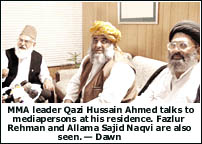
ISLAMABAD, June 2: Federal Minister for Religious Affairs Ijazul Haq met Muttahida Majlis-i-Amal Secretary-General Maulana Fazlur Rahman and MMA Vice-President Allama Sajid Naqvi on Wednesday to persuade them to withdraw the strike call for Friday and to seek their cooperation in bringing sectarian harmony to Karachi.
The MMA leaders, however, refused to withdraw the strike call. Maulana Fazlur Rahman told the minister that the situation could only be improved by bringing about basic changes in the Sindh set-up and mere administrative reshuffle would not help restore order.
He also made it clear that the MMA had reservations over the manner in which the government handled this crisis, which he said, was not that simple. The MMA leaders said that 11 people were killed in Karachi in just one day on May 12 on the occasion of by-elections, while in India not so much deaths occurred during its entire election process.
They said some body had to take the responsibility of what was happening in Karachi. The MMA leaders maintained that the alliance had given its strike call for June 4 to express resentment over killings in a peaceful manner.
The MMA leaders told the minister that the recent incidents in Karachi had nothing to do with sectarianism and claimed that people belonging to different communities forged unity in their ranks after the acts of terrorism.
Ijazul Haq said that he was holding meetings with religious leaders on the directive of President Pervez Musharraf in an effort to restore peace in Karachi. Meanwhile, Maulana Fazlur Rahman and Hafiz Hussain Ahmed called on MMA chief Qazi Hussain Ahmed who had just returned from abroad.
Maulana FAzlur Rahman also received political secretary of UK High Commission John Thatcher and discussed with him situation in the Middle East and prevailing political scenario in Pakistan.
The MMA leader told the UK diplomat that the MMA had demonstrated that it was a moderate opposition. Discussing the Wana operation, the MMA leader said that the government had embarked upon a policy which had never worked even during the British rule.