0
0

ISLAMABAD, May 31: The National Economic Council (NEC) is expected to approve on Tuesday a Rs202 billion Public Sector Development Programme (PSDP) for 2004-05 recommended by the federal government , which is more than 26 per cent higher than the current year's Rs160 billion development allocations, Finance Ministry sources told Dawn on Monday.
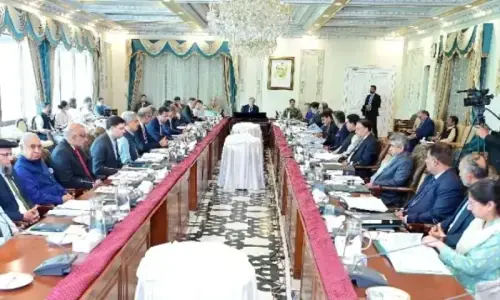
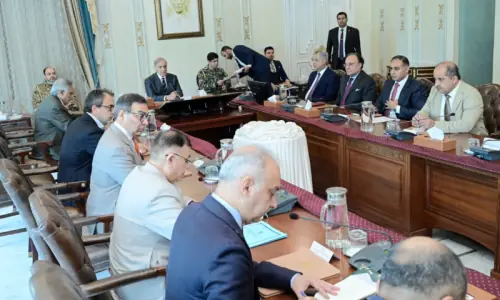
The meeting of the NEC, to be presided over by Prime Minister Mir Zafarullah Khan Jamali, would also review the annual plan for the year 2003-04, and approve the annual plan for the next year. All the four chief ministers and finance ministers, prime minister of Azad Kashmir, governor of NWFP and economic minister of the federal government would also attend the meeting.
The highest economic decision-making body of the country would also review the status of various projects approved by the Executive Committee of the National Economic Council (ECNEC) and the Central Development Working Party (CDWP) during the current year.
NEC documents obtained from the Finance Ministry suggest the Rs202 billion PSDP would also include a foreign aid component of Rs56.4 billion. This would comprise Rs148 billion in allocations for federal development projects, up by about 31 per cent from the current year's Rs113 billion, and Rs54 billion for provincial projects, about 14.9 per cent higher than current year's Rs47 billion.
The annual plan for the year 2004-05 projects the Gross Domestic Product to grow by 6.6 per cent owing to a rise in investments to 19.3 per cent of GDP, exports and imports going up by eight per cent and 12 per cent respectively and inflation is expected to be higher at 4.5 per cent, while national savings is projected to drop to 18.2 per cent of GDP as against 19.8 per cent during the current year.
The PSDP has been finalised keeping in mind the recommendations of the Annual Plan Coordination Committee (APCC) meeting on May 22 and another meeting presided over by President Gen Pervez Musharraf last week.
The prime minister was briefed by the Ministry of Finance and the Planning Commission on Monday at a pre-NEC meeting about the salient features of the PSDP. However, minor adjustments could still be made by the NEC, these sources said.
The Rs202 billion PSDP has been prepared keeping in mind the broad policy objective of reducing poverty, ensuring good governance, generating employment and raising the quality of social services. As such, the programme aims at laying a basis for enhanced future growth through investments in infrastructure and human resources.
Thus, an amount of Rs87.19 billion or 58.9 per cent of the total Rs148 billion federal programme has been allocated for infrastructure, followed by Rs33.57 billion or 22.7 per cent for social sectors and remaining Rs27.24 billion or 18.4 per cent for other sectors.
The various federal ministries and agencies had demanded a total of Rs308 billion for the development programme which had to be adjusted within the proposed size of Rs148 billion "as increase beyond this level was considered untenable owing to lack of fiscal space."
However, almost all the on-going projects have been included in the PSDP and the commitment for major projects like Chashma Nuclear Power Plant, raising of Mangla Dam, lining of water courses, important communication projects, Gwadar Port and area development requirements as well as social sector projects have been catered for.
The PSDP allocations including Rs97.4 billion for federal ministries, Rs10.552 billion for special areas, Rs8.9 billion for special programmes like Sasti Basti and Tameer-e-Pakistan and Rs31 billion for various corporations.
IMPORTANT FEATURES: To complete major water projects, the allocation for water has been increased by 43 per cent and now stands at over 14 per cent of total PSDP against 13 per cent previously during 2003-04. This is aimed at accelerating agricultural growth and promoting construction-related jobs.
An investment of Rs4 billion has been allocated for the improvement of water courses so as to enable the productive use of scarce water resources. Gwadar Port and its road linkages to up-country destinations have been given priority so that it may contribute to a better investment climate and trade facilitation.
The allocation for education and training has been increased by 55 per cent, with higher education being given an increase of 84 per cent to provide the knowledge and qualified manpower required in a competitive world.
The allocation for the health sector has been increased by 37 per cent reflecting continuing emphasis on maximising the productivity of human capital. The IT and science & technology sectors have received increased allocation of 37 per cent and 68 per cent respectively to spur research and development.
MINISTRIES: The water sector would get Rs21 billion, power sector Rs14.35 billion, Pakistan Atomic Energy Commission Rs4.8 billion, petroleum and natural resources Rs484 million, communication sector Rs23.5 billion, railways Rs9.3 billion, finance division Rs7.8 billion, education Rs3.4 billion, higher education Rs9.2 billion and health Rs5.840 billion.
Similarly, population welfare division would get Rs2.6 billion, womens' development Rs1.17 billion, labour ministry Rs90 million, KANA and Safron Rs10.6 billion, IT and Telecoms Rs2.8 billion, Science & Technology Rs1.9 billion, minorities and youth affairs Rs631 million, works Rs925 million, defence Rs963 million, food and agriculture Rs7.4 billion, interior Rs5 billion and law and justice Rs2.4 billion.
Sabihuddin Ghausi adds from Karachi: A two-member NFC negotiating team of Sindh was given a mandate, by a special meeting of the provincial cabinet, on Monday "not to accept any resource distribution award which is not based on multiple criteria including revenue collection."
Sindh's Senior Minister Syed Sardar Ahmad, who holds the charge of finance and Abdul Karim Lodhi, a private member to represent Sindh on the NFC, briefed the cabinet meeting on the position taken by them on the resources distribution formula.
The cabinet gave them a mandate to make a fresh proposal for resources distribution among the provinces. Under this formula, 91 per cent of the divisible pool will be distributed on the basis of population.
Of the remaining 9 per cent, 3 per cent share will be for resources collection, 3 per cent for the inverse population ratio and 3 per cent for backwardness. The cabinet expressed complete confidence in President Pervez Musharraf and said it believed that he would take care of the interests of all the provinces, including Sindh.