0
0

Inflation on the rise again
Our economic chiefs including finance minister Shaukat Aziz have been maintaining that inflation in the current financial year would be under four per cent-- certainly not above five per cent.
Official figures claim that the inflation during the last four years has been below five per cent, in fact below four per cent, save for one year when it was 4.4 per cent.
That is in keeping with the world trend of low inflation following sharp reduction in interest rates and heavy cuts in taxation so as to sustain the revival of the economy, recovering from varied scales of recession.
But during the first seven months of the current financial year ending January 30, the Federal Bureau of Statistics says inflation (consumer price index) was 3.38 per cent, while the Sensitive Price Index, which covers largely food items, was 4.78 per cent and the wholesale price index 6.43 per cent.
If the prevailing price push continues, as seems likely, the consumer price index may cross the 4 per cent barrier soon and move to a far higher figure. And if the continuing massive unemployment is aggravated by rising inflation, particularly of essential items, the hardships of the people can be enormous.
The State Bank of Pakistan has promised to take steps to counter the inflation or contain it. But they are likely to be mostly monetary measures, primarily through reducing the money supply or currency in circulation.
It will suck up the excess money in the market by offering better yields, as it had done recently in the case of the six-monthly treasury hills. It sold such bills for Rs. 29.5 billion instead of the Rs 15 billion it had originally sought and at a yield of 1.72 per cent instead of a lower percentage it had offered earlier. It may do more of the same hereafter to reduce the money supply.
But such a remedy may not be very effective in an informal economy in which the money afloat outside the control of the banks is very large and its pressure on demand is very heavy.
In addition, between, July 1 and January 31 the currency in circulation had shot up by Rs 88 billion and the net private sector credit had a record offtake of Rs 206 billion. Quite a large part of this credit was not used for production but as consumer banking, particularly to buy imported luxuries or consumer durables, like cars.
While the official figures of inflation has risen far above the official projection and continues to do so, the people do not accept the official figures. They find that the cold market reality belies them and the rate of inflation is far higher.
When wheat prices rise by 25 per cent following the rise in official support prices and it is short in supply in many areas, the food prices are bound to shoot up.
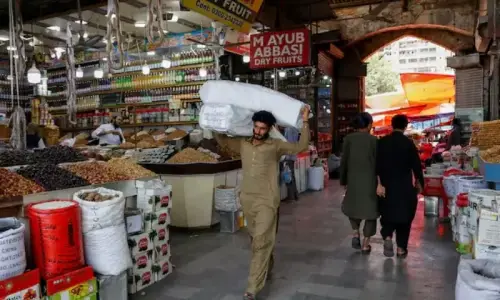
Along with that when the meat prices have shot up, far exceeding the previous record of Rs 200 a kilo and the onion prices have risen high, inflation in food prices is bound to be heavy. The traders are always ready to exploit shortages or create shortages and push up the prices unconscionably.
Petrol and other oil prices have been rising every fortnight for long and that pushes up freight rates and transport costs. All these have a multiplier effect on prices.
If along with that electricity and other energy prices rise pushing up the cost of industrial production and transportation, it is a free for all for the profiteers. Along with that, the rent in the urban areas also rise substantially.
The finance officials argue that if the meat or fish prices rise in Karachi that does not mean the same kind of increase has taken place in Gujranwala or Sialkot.
Hence that rise is not fully reflected in the varied national indices. But surely the rise in the POL prices, electricity rates, wheat prices, etc does affect all the consumers.
Unwittingly, the finance officers are making out a case for separate price indices for the urban and rural areas. But the fact is that if agricultural prices are low in the rural areas, the prices of manufactures are higher there. So are the prices of medicines which do not have uniform sale prices or even a uniform quality because of adulteration.
Can consumer resistance bring down prices? To begin with there cannot be such resistance for long in the areas of basic food, not luxuries, like fine coffee, which the Americans resisted consuming when the prices shot up abnormally. Secondly, there is little hope that the government will intervene and help the consumers because of its corrupt enforcement machinery.
One of the causes of inflation in Pakistan has been external inflation imported in the country since the oil price boom of 1973. That pushed up electricity prices and the cost of our own gas as the World Bank and the Asian Development Bank wanted the gas exploring companies to be paid on par with world oil prices, or near about them, to reward and encourage gas exploration.
But since 9/11 the exchange rate of the dollar has come down by over 10 per cent, and yet the prices of the imported goods did not reflect the fall in their prices, except when they are imported from East Asia, like China.
The prides of many imported industrial raw materials have also come down and yet the prices of many of the local manufactures using them do not show the low prices, particularly in the case of medicines.
Pakistan, like other oil importing countries pay the prices of the POL in dollars and that should make oil less expensive in rupees; but that has not been our experience.
When industrial production of consumer goods go up substantially in a continuous process, the prices should come down instead of going up. But that is not the experience after the industrial production of 39 items have gone up by 13.56 per cent in the first half of this financial year ending December.
Car and jeep production has gone up by 70.70 per cent-- the car production by 69.65 per cent and the jeep production by 132.12 per cent. Motorcycle production went up by 63 per cent and tractor output by 47.67 per cent.
Sugar production rose by 23.53 per cent, Cotton cloth production went up by 17.50 per cent. Cigarette output rose by 11.48 per cent, cement by 16.66 per cent, jute goods by 21.54 per cent and paper and board by 9.21 per cent.
Such an all round increase in production by an average of 13.56 per cent should have held down the prices, not raised them further. That has not been our experience.
Money in circulation through the banking channels has also declined marginally as the deposits of banks with the State Bank dropped by Rs. 4.73 billion at Rs. 150 billion.
A vibrant economy and a strong defence are a must for the security of the country, says President Musharraf. But the people should have a sense of participation in that "vibrant economy" and not feel as its victims or its ill-used instruments.
Poverty reduction is not a mere matter of economic growth, says the World Bank. Pakistan has to dovetail that growth with fair income distribution, and each country has to find its own unique policy prescriptions.
In Pakistan we are trying to combine or harmonize poverty at the bottom with Islamic slogans to assuage the grief of the people, while the mullahs have a large share of political power and economic clout, along with religious authority even when they are at odds with each other vehemently, Clearly the policy prescription which Mir Zafarullah Jamali as a feudal chief is trying to devise in practice is not working.
And we need a new radical policy prescription instead of borrowing more and more from the world Bank previously for development and now professedly for growth and poverty reduction.
Economic growth seem to confront us with new problems and grave challenges. We may produce almost four million tonnes of sugar this year, over the very large surplus we already have.
And we have no way of selling it to the world. The Trading Corporation of Pakistan has been authorized to sell it but it has not been able to do that except in small quantities.
And we cannot pay the kind of very large subsidies which the exporters demand. Our growth pains in the sugar industry ae indeed excruciating. And we have not been able to find a way out.
When sugar cane output hits the peak, leaving the growers and the millowners, who have been asked to pay higher prices unhappy, the cotton output to feed our textile mills this year may be 3.6 per cent less and touch only 8.869 million bales We should have striven hard to produce 13 to 15 million bales of dust-free and pest-free cotton to feed our textile mills before the critical textile quota system comes to an end by the end of this year.
We have failed to do that, and that is a critical failure if we want to expand the textile industry in a big way and make it far more competitive in quality and price.
The solution to our problems lies not in aggravating inflation, raising interest rates for lending, borrowing more and more from the World Bank and the Asian Development Bank for reducing poverty and dumping more of our goods abroad at low prices and incurring the wrath of our importers abroad.
Such solutions have not paid dividends in the past, and they will not pay now in the world of WTO and increasing emphasis on quality for boosting world trade.
The solution lies in improving the productivity of our industries and exporting more of the value-added, and earning more per unit of export. We have to become a brand name exporter for our goods abroad instead of only foreign companies making their brands more popular here through high pressure advertising through the numerous TV channels.
We are told that when the world economic activity increases and more major countries become vibrant, like Japan has at last, the global interest rates will go up, including the Federal Reserve Bank's current one per cent or the European Central Bank's two per cent interest. At that time the interest rates in Pakistan, too, will go up.
What is happening now is that while most depositors hardly get any return on their deposits and are penalised for keeping low deposits, some bank chiefs are being paid fabulous salaries along with luxurious perquisites.
While the salaries of chief executives in the West are going down they are going up and up in Pakistan. This is totally unjustified. Their rank and file staff in the banks deserve a better deal and not only the top figures as a result of various linkages. Let them set a good example for their juniors instead of pyramiding their own remuneration sky- high.
The tendency politically and economically appears to be to reward the top figures handsomely and neglect others. This is not fair. It breeds discontent and corruption.
Prime Minister Jamali talks of fighting corruption from the top after identifying that as the major problem. Let him ensure that it happens in the political setup and elsewhere in the corporate sector as well.
Not all the corporate chiefs are rewarding themselves over-generously. Some of the private sector chiefs are pretty modest in their claims on the income and other remuneration. Let us not disregard the world trend in this area based on painful experience.
Increasing debt obligations
BY all accounts Pakistan's return to international capital markets after a gap of seven years has been a resounding success and a ringing endorsement of the policies of the government.
The market's response to the government's five-year US $ 500 million Euro Bond offer has been inspiring, reflecting the greater confidence in Pakistan's economy and recognition of the improvement in the country's key economic indicators, due partly to better financial management and in large measure to a turnaround in our fortunes arising from the events of September 11.
The bond has been heavily over-subscribed, the bids in the order book totalling over four times the amount offered for subscription.
The international capital markets are ostensibly being tapped to test their reaction to Pakistan's re-entry after the ill-fated first attempt in the late 1990s (when the bonds issue of that time had to be rescheduled in 2001/02), to diversify the government's sources of funding and to reduce dependence on multilateral lending agencies for financing.
The raising of Moodys and Standard and Poors ratings by a notch and the impressive launch is also expected to facilitate Pakistan's reappearance on the radar screens of investors, thereby working up investor appetite for Pakistan's debt instruments, enabling the country to become a regular visitor to international capital markets in the future.
It is being hoped that these developments will not only serve as good indicators for attracting private direct foreign investment, but also help in lowering the interest rates on which Pakistan will henceforth be able to borrow from these markets.
However, despite the above stated reasons for accessing capital markets it is difficult to discern the economic and financial justification that underlay this move. Obviously, the need for liquidity or for settling immediate obligations cannot have driven this decision.
As it is, the country has foreign exchange reserves close to $12 billion, the bulk of them in the form of a non-interest bearing asset, cash. With the government struggling to find ways of utilizing this mountain of reserves one is at a loss to understand what it wants to, or can, do with the additional $ 500 million raised at 6.75 per cent.
It would, at best, earn a relatively nominal return from its investment in other income earning instruments. The overall outcome of such a transaction would be a net capital outflow, since the servicing cost of the bond would be higher than the income stream from the proceeds of the bond sales.
Moreover, just a few days ago the government retired expensive Asian Development Bank loans of $ 1.2 billion and even paid a penalty for prepaying them (details of the interest rates on the credits and the penalties levied by ADB for early redemption are not available).
It is, therefore, puzzling that it has chosen to raise fresh debt at interest rates higher than those that would be applicable on commercial loans from Asian Development Bank and World Bank.
The government needs to present its case defending the financial and economic rationale for the decision to float bonds at such a high interest rate, and at a time when the interest rates on loans in international markets are the lowest in recent memory.
In the opinion of this writer the government's efforts would be better spent removing the remaining impediments to the creation of a more friendly environment for investment, instead of expending its energies in areas that will increase the country's liabilities for uncertain gains.
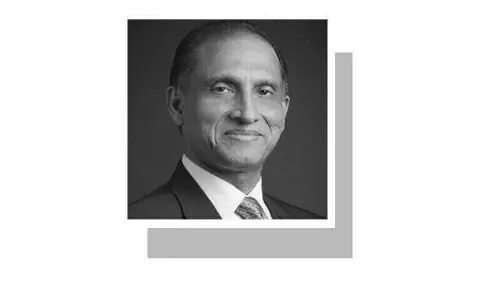
The writer is a former finance minister of Punjab.
The taste of grass
History is growing old. It is losing its short-term memory. It is beginning to forget things. It has forgotten the 200,000 souls or more evaporated in the atomic holocaust at Hiroshima and Nagasaki in 1945.
It has forgotten the furore that attended Pakistan's acquisition of nuclear technology in the 1980s. It has forgotten the avuncular accommodation shown by President Reagan's administration because Pakistan was a frontline state in the surrogate war in Afghanistan between the Russians and the Americans, and it has forgotten the subsequent volte face when that war ended.
It has forgotten when the Indian journalist Kuldip Nayar was taken by Mushahid Hussain to visit Dr Qadeer Khan so that the news of our new-found nuclear capability could be conveyed to the Indian government, after which a long silence followed during which it was suspected that this scoop was itself being peddled for cash, just as the forbidden know-how was to be later by Dr Khan.
It has forgotten the assurances our governments gave us and to others that our nuclear assets were in safe hands and under the strictest vigilant control.
Who was in fact in command of them? That question is as difficult to answer as it was once to identify who actually headed the Russian KGB or the Indian RAW or our own ISI? Those who knew would not tell; those who did not know could never be sure.
Similarly the control of our nuclear assets was presumed to be in the hands at the highest level of the President - Ziaul Haq, after him his chosen civilian second-in-command Ghulam Ishaq Khan, and after him someone else.
Quite clearly, not any elected prime minister. Benazir Bhutto and Nawaz Sharif frequently complained that they were kept out of the loop on such sensitive matters.
The expectation was that the faceless, nameless person charged with the ultimate responsibility for defending our motherland would knew which weapons were where to deploy when and wherever necessary.
In 1999, soon after taking over, General Musharraf was seen reviewing a parade of Pakistan Rangers at Lahore. Standing behind him on the jeep was a soldier carrying what looked like an unpainted car radiator but what was in fact the command black box.
There was a similar tradition in Ancient Rome but with a different function. The man deputed to stand behind the returning hero during a triumphal procession whispered to him periodically: 'Remember, you are mortal.' The soldier standing behind General Musharraf appeared to symbolize the message: Remember, you are in command.'
President Musharraf's belated assumption of command from Dr Qadeer Khan came through during the press conference the president gave recently.
That press conference was reminiscent of another equally important press conference, should history care to remember, when President Yahya Khan, in April 1971, following the army action in East Pakistan, chose to meet the international networks and deflected each question with similar aplomb.
No one listening to President Musharraf - from the Oval Office downwards - could do anything other than empathize with his predicament at having to choose between national security interests and an aberrant national hero. As US President Lyndon Baines Johnson once commented: 'Doing what is right is not the problem. It's knowing what is right.'
By rights, President Musharraf appearance on television before a Pakistani audience should have been followed rather than preceded by Dr Qadeer Khan's confessional.
Yet, for reasons on which the Pakistani public will forever remain divided, Dr Qadeer Khan was given the unprecedented opportunity to explain himself through the safety of a one-way television screen.
Dr Qadeer's sanitized statement has passed into the annals of Pakistan's history for at least three reasons: for its contents - he answered before a public audience charges that had not yet been framed by any public prosecutor; for its magnanimity - he absolved his superiors and exonerated his subordinates; and for its detachment - he held out, as if he still enjoyed the power of enforcement, that 'such activities will never take place in the future'.
In the closing paragraph of the statement that he read in a less than contrite voice, he asked for the nation's pardon without specifying exactly how the public could convey its forgiveness collectively.
It was obvious that the statement read out by Dr Qadeer Khan had not been written by him. The only words he had added to the ready-made text, we are told, were the disclaimer 'in good faith', and they were significant for it was precisely 'faith' that the entire country had reposed in Dr Qadeer Khan and his team of accomplices. It was given unasked; it remained unquestioned and it was in the end unrequited.
Within twenty-four hours of that self-scouring broadcast, President Musharraf obliged by giving Dr Khan a pardon, but not before referring the confession Dr Qadeer had made to him days earlier first to the National Command Authority, which in turn passed it to the Federal Cabinet which equally swiftly handed the radioactive crisis back to the president.
Did the president, recognizing the highest degree of sensitivity and national vulnerability, have any option? Perhaps not, but the government apparatus certainly did.
It could have acted. Although Dr Qadeer Khan may have never boasted about the parallel in public, privately he must have seen himself as Pakistan's equivalent to the US scientist J. Robert Oppenheimer, the father of the American nuclear programme.
After successfully testing the bomb, in December 1953, fifty years ago, even Oppenheimer came under suspicion for 'un-American activities'. Before these could be proven, his security clearance was immediately suspended and his association with the American Atomic Energy Commission terminated.
His achievements remained under a mushroom cloud of suspicion until his rehabilitation by President Johnson a decade later.
Dr Qadeer did not have to wait that long for exoneration. It happened in less than a day. Unlike Oppenheimer, Dr Khan may choose not to remain within the country, now that he has admitted having squirrelled away assets in that most unlikely of financial havens - Timbuktu.
If he is allowed to leave, he will be following a pattern of other purloiners of public wealth who are enjoying their wealth in countries that have no extradition treaties with Pakistan.
How can the country forget the money that changed hands during the euphoria to encourage Independent Power Producers under the guise of providing cheap power to consumers? History may forget that the avowed aim of our nuclear programme had been 'for peaceful purposes', to overcome our power shortage. Consumers cannot. They are reminded of it every time they flick a switch to turn on a light or a fan.
Today, the sympathetic attitude of the Bush administration towards President General Musharraf is conditioned by two factors - a mature sense of real politik, and a reluctance to muddy the waters further.
Their charity extends to the person of the president, as Nixon's now famous instructions in April 1971 to his staff did during the East Pakistan crisis: 'To all hands. Don't squeeze Yahya at this time.'
At this moment of national trauma, as in 1971, Pakistanis are confronted by a crisis - a crisis of confidence, a crisis of credibility, a crisis of faith. They wonder whether, in the altered circumstances of our confessed trade in nuclear proliferation, we will be allowed the sovereign prerogative to retain complete control over our nuclear assets, to deploy in whichever manner we choose? Only time and history and the latent possibility of future sanctions will tell.
Many years ago, Zulfikar Ali Bhutto (now miraculously rehabilitated) promised the Pakistani public that it would become a nuclear power - even if it meant having to eat grass. Pakistanis, particularly the thirty per cent living below the poverty line, can already taste the grass.