0
0

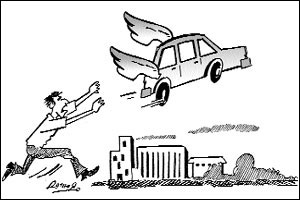 The State Bank of Pakistan (SBP) has again come out with some can did remarks on the car industry’s performance regarding slow achievement of deletion targets by the local assemblers.
“The level of deletion achieved in automobiles is particularly low: given that as the industry has been enjoying the most protected status, the pace of deletion should have been more,” the SBP’s annual report of 2002-2003 reveals.
Interestingly, although the deletion targets are linked to the industry’s sales volumes — even those targets set during the last two years do not reflect the increased volumes.
The deletion levels have surpassed 80 per cent mark only in some categories of motorcycles and tractors, whereas in cars, 60.3 per cent and in commercial vehicles 50.1 per cent indeginization has taken place, the report says.
The government has already started phasing out the deletion programme in electronics and apparatus through tariff restructuring in view of the WTO Agreements on Trims. The elimination of Trims means the number of countries would not be able to impose such restrictions that bind manufacturers to use certain proportions of locally-manufactured inputs and require certain products to be locally manufactured.
“Although the government has applied for a two-year extension — the current pace of deletion in automobiles suggests that the industry will take much longer to completely indigenize the production of parts and industry,” the SBP’s report says.
Pakistan had been pursuing the indigenization policy in engineering industries through deletion programmes since 1987. However, in 1995, the deletion programme was reviewed in view of the WTO agreements on Trims that gave the developing countries a period of five years to phase out the deletion programmes. Therefore, the deletion programme was converted into the Industry Specific Deletion Programme (ISDP) on the recommendation of the Deletion Committee of the Engineering Development Board (EDB).
Automobiles and home electronics were major industries targeted under the ISDP. Deletion targets were fixed with the consultation of manufacturers, linking to the sale volumes of the industries. The auto industry was provided heavy protection in order to encourage deletion. The government imposed 100-250 per cent customs duty on the import of cars, besides discouraging the import of used cars. Furthermore,, import of parts, components and assembling machinery were allowed at the concessionary rate of duty from zero per cent to maximum 35 per cent ad valorum since various SROs issued in 1995 till date.
The State Bank says that it is true that the auto industry has contributed significantly to the economy in terms of investments, tax revenues and employment. It should be clear that the windfall gains to the auto sector stem directly from the protective tariff policy. Clearly, manufacturers should share some of their windfall gains with the consumers, who eventually pay the price for their market protections. In addition, the usurious early delivery premium charged by the dealers/investors needs to be addressed.
This is the second time that the SBP has revealed some startling disclosures about the local industry’s performance. On January 2003, the State Bank, in its first quarter report for 2002-2003 had pointed out as to how the local makers made windfalls and denied benefits to the consumers.
Not only the State Bank, Commerce Minister Humayun Akhtar Khan had also said in a big businessmen gathering few months back that the European Union and the International Monetary Fund (IMF) have already raised objections over higher tariff protection being enjoyed by the local car industry, asking the government to take back such enormous protection from local auto makers.
These observations made by the SBP, the EU and the IMF over heavy protection, being enjoyed by the industry, are clear signals that the government is outrightly protecting the car industry instead of protecting the rights of the consumers who are bound to pay higher prices for locally assembled cars.
The 2002-2003 annual report of the central bank has arrived at a time when the Task Force, set up by the government in September to monitor issues like high car prices, elevated street premium of locally-assembled cars and late car deliveries to the consumers, has submitted its recommendations last month, urging the government to cut import duty on cars by 35-50 per cent on various capacity engines.
More than a month is gone — the government has not come out with any official word whether it has accepted the Task Force’s recommendations or has put the recommendations in the cold storage, by continuing supporting the industry to fleece the consumers on the back of heavy tariff protection.
The dilly-dallying by the government in taking any decision in the light of Task Force’s recommendation is causing anxiety among the car dealers, as well as the consumers. However, delay on the part of the government has been proving beneficial for the industry who is still applying full pressure on the government to swallow the Task Force’s proposal for the future survival and betterment of the industry.
Market people say that the decision on car imports, which was expected in November after setting up of a task force, now hangs in balance as the government is reported to have given some more time to car makers to further cut car delivery period and address the problems of premiums through frequent and rising car productions.
Despite over 60 per cent car production — the issue of premium lingers on, causing shivers among the genuine buyers who cannot dream of buying a car either through booking on or cash basis. The delivery period of cars still ranges between three to six months and many dealers are giving delivery timing of eight months depending on the model.
The local industry claims to have overcome the premium and late delivery issues hopefully by January as the rising production has somewhat tackled the issues. In case the industry succeeds in addressing such issues in a month or two — then the government is likely to skip the idea of allowing import of new cars.
Many market analysts believe that this is the right time for the government to allow import of cars in order to provide an open market competition to local assemblers before 2005 when many countries will be bound to open their borders for open competition.
An analyst says that a temporary cut in import duties on cars is not a correct solution. The government needs to have a long- term platform regarding import duties on the automobiles. The government should concentrate on formulating a road map for gradually phasing out these duties (especially when the WTO is nearing). He said in case the import duties are cut — there will be a negative impact on the economic health of auto and vendor industry, besides causing massive job losses, freezing of future investment plans by car makers and loss of the government’s revenues.
Meanwhile, car production and sales in October jumped by 73 and 71 per cent followed by 61.5 and 66 per cent in the same categories during July-October 2003 as compared to the corresponding period of 2002. Production and sales of cars in October 2003 surged to 7,730 and 7,918 units as compared to 4,672 and 4,626 units in October 2002. Similarly, total production and sales in July-October 2003 reached to 28,138 and 28,862 units from 17,417 and 17,351 units.