



 0
0

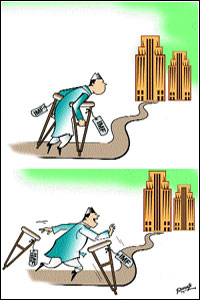 The IMF-Pakistan relationship is undergoing a qualitative change. “Given the strong improvement in external and fiscal prospects”, the IMF has agreed to biannual approvals, instead of quarterly releases of remaining tranches of the PRGF facility.
It may bring some relief for policy makers with the IMF officials breathing over their necks all the time. On the request from Islamabad,a sum of $247.54 million was approved on October 27 by the IMF Executive Board after completion of sixth and seventh quarter reviews of economic performance.
Quarterly reviews will not cease but these would not go to the IMF board. It would mean a little less hassle that will provide some breathing space to the officials to make up for any slippage on targets in any quarter in the following six monthly review. The next IMF review mission is due on December 5.
It is in sharp contrast to the tough conditionalities of the costly Standby Arrangement (SBA) signed in November 2000 and described by Finance Minister Shaukat Aziz as,” humiliating.” The State Bank says it was negotiated, “from a position of weakness”.”It was a stringent stabilisation programme with upfront conditionalities,” far in excess of normal SBA mandate. In the backdrop of a chequered relationship in the 1990s, the IMF acted with a vengeance. But the economic managers accepted the challenge and lived up to their commitments.
For a variety of reasons, the IMF reforms could not be fully implemented in the 1990s. These included nuclear blast, multi-layers economic sanctions, suspension of the IMF programmes, quick changes in elected governments and lack of consensus on IMF agreements signed by care-takers. The reforms contradicted the mandate of the elected government received from their electorate. Pakistan was thus labelled as “one-tranche country.”
But, the economic managers of a military regime , neither responsible to the parliament nor to the electorate worked tirelessly to execute fully the SBA and have successfully implemented so far the three-year PRGF programme ending in December 2004. Some of the PRGF targets particularly on the external sector have been exceeded.
The IMF comes to the assistance of countries hit by unmanageable balance of payments problems. Once the fiscal and current account deficits are reduced to sustainable levels, the IMF assistance is not required.
“ External debt”, says the IMF review report, appears to be somewhat more vulnerable to adverse shocks (than domestic debts), though none of the sensitivity tests leads to a significant deterioration in the debt path.” Both public and external debt are projected to decline significantly over the medium term. Public debt appears to be on solid downward trend, IMF officials say.
Plans are being finalized to retire $4.5 billion expensive debt in the next five years, of which one billion dollar would be prepaid in the current fiscal, to the World Bank, the ADB and the IMF. The fund wants this to happen quickly.
Closely linked to the balance of payments problem is the budget deficit issue.The overall consolidated fiscal deficit has been reduced to 4.4 per cent of the GDP in fiscal 2002-2003. “ It will be contained to four per cent of the GDP, with additional outlay upto 0.5 per cent re-capitalization of the two public sector banks to cover costs incurred in their privatization or liquidation. Defence spending is projected to decline from 4 per cent to 3.6 per cent.Interest payments and subsidies to Wapda and the KESC will be trimmed. The fiscal deficits, targeted at European Union’s level of 3 per cent, are to be contained by the fiscal responsibility law.
With fiscal and external accounts vastly improved, Pakistan has informed the IMF that it would not need any new loan after the current PRGF arrangement is completed.The country’s economic managers would however like to benefit from IMF expertise on policy matters.
“ They (authorities) agreed that the key issues where the Fund could give support were strengthening of institutions in the financial, public sector and statistical areas, as well as macroeconomic policy advice,” says the IMF report.
It would mean that Pakistan would come out of the IMF crutches as far as the IMF credits are concerned. Experts, with intricate knowledge of IMF working, reckon that the support could come in the form of technical assistance for improvement in areas like securities or specialized banking. For this, the IMF officials could make short visits to study problems and suggest remedial measures. Secondly, the IMF carries out periodical review in case of all Fund members,both borrowers and non-borrowers. In the review, the IMF could make some suggestions and offer advice on macro-economic issues.
While experience of other nations and foreign advice should be generally welcomed, we must be cautious not to depend heavily on borrowed ideas, money and technology as we have been doing. First, the relevance of foreign ideas, at various points of time, should be critically examined. The sequence and timing of any policy and programme are critical for their success. Whereas some principles are universally applicable, there are problems when these are put to test in the specific national cultural milieu.
Secondly, the success stories in other countries are second hand experiences and merely following them would amount to trailing behind the nations that have gained first hand experience. It is for this reason that the USA is trying to create the most fertile and attractive environment for innovation. The US Council for Competitiveness is setting up a ‘national innovative initiative’ to create a strategic policy agenda and a framework of innovative leadership. Here we have something to learn from.
Some experts are of the strong opinion that the IMF’s monitoring and supervisory presence kept the officials on toes for executing the PRGF agenda. Their absence may be felt in the efficiency levels in pursuit of second generation of reforms. The IMF loans are comparable in costs to soft World Bank/ADB loans. The Fund has better expertise in macro-economic policies and in this area the World Bank and Asian Bank take a lead from the IMF.The World Bank and Asian Bank have no less stiff conditionalities. So getting the IMF off the back, may not be such a wise decision.
In a certain context, these experts may be right. But the best performing Asian economies, China, India and Malaysia, did not seek IMF” crutches.” They have adopted an independent approach and reaped its full benefits.
The IMF provides oxygen tent to ailing economies under fiscal distress and foreign investors normally are not tempted to to look at countries under Fund programme.
The IMF agenda and the route for globalization widens the gulf between rich and poor nations and between the rich and poor within a nation state. The pro-poor approach to macro-economic stablization is ignored.
There is a backlash against big powers and IMF-led globalization.The European Social Forum is meeting in Paris to seek an alternative to capital-led globalization. The exchange rate flexibility has led to speculative trading in currency which is treated not as medium of exchange but as a commodity. This has evoked criticism from former Malaysian Prime Minister Mahathir Mohamad. In the backdrop of corruption in Russia’s leading oil company Yukos, Izvestia is “predicting that foreign investment could be welcome only under strict state control as in China”when Putin gets his second term of office after elections.
The IMF has a dogmatic approach towards privatization different from the way China is moving. Chinese expanded the market economy by encouraging private investment and creating new productive capacities and not by wholesale privatization. Mao expanded the public sector to dwarf the private sector before nationalization.
Our domestic private sector remained stifled under colonial rule before 1947. Before independence, there were a few industrial units that could be counted on finger tips.Now, despite gross macro-economic mismanagement, the country has industralized rapidly. Private sector is energised and driven by nationalism.
The latest evidence is the Iraqi war. The world’s flashlight has shifted from US-led globalization to Iraq’s sovereignty. Tough and successful Iraqi national resistance to US occupation has imparted further strength to the third world’s economic muscle to stand up to big powers at Cancun.It has implications for the future of a more equitable world order. Short-term IMF assistance may or may not be desirable, but long-term dependence on outsiders could be counter-productive.




























