0
0

The ebb and tide of it
PAKISTAN’s relations with Iran were cordial until the advent of the Islamic Republic in 1979. They went downhill during the next twenty years. Efforts are now being made to revive their earlier closeness. I propose to take a quick look at the stages through which these relations have passed, and then see which way, and how far, they may reasonably be expected to go.
In 1955 Iran and Pakistan, along with Iraq and Turkey, entered an American-sponsored anti-communist alliance called the Baghdad Pact, renamed as the Central Treaty Organization (Cento) after Iraq’s withdrawal from it in 1958. Cento was disbanded after Pakistan’s dismemberment in 1971. Iran and Pakistan were also linked in organizations established to promote economic cooperation between members (RCD and later Eco).
When Pakistan and India went to war in 1971, Iran offered Pakistan access to its air bases in case Pakistan wanted to place its combat aircraft beyond the reach of India’s striking capability. Following the secession of East Pakistan, the Shah began to speak and act as if the remaining Pakistan had become his special responsibility to protect. He declared that he would send his forces to assist Pakistan in case it was invaded again.
Iranian helicopters helped the Pakistan army in combating the Baloch insurrection that erupted after Prime Minister Bhutto’s ill-conceived dismissal of Ataullah Mengal’s government in that province in the spring of 1973. Iran gave Pakistan a loan of $580 million in 1974, and another loan of $150 million, at a modest interest rate of 2.5 per cent, to relieve its balance of payments deficits. It also agreed to fund some development projects in Balochistan.
Relations between Iran and Pakistan began to slide after the Shah’s ouster. Riding the high horse of ideological zeal, Ayatollah Khomeini called upon the Muslims in Pakistan and elsewhere to overthrow their corrupt governments. Needless to say, this call annoyed Ziaul Haq, for it implied that his claims to Islamic virtue were fake.
In September 1979 Iraq launched an unprovoked invasion of Iran. The ensuing war lasted more than eight years and wrought enormous destruction on both countries. Pakistan, like other members of the OIC, urged the parties to stop fighting. But not once during this long war did Ziaul Haq’s government (or, for that matter, any Muslim government other than those of Syria and Libya) even condemn the undisguised Iraqi aggression, not to speak of sending aid to the victim.
Iranian-Pakistani relations began to take a turn for the worse following the Soviet withdrawal and the onset of a war between rival factions in Afghanistan. Policy makers in Islamabad believed that their need for “depth” in defence would be best served if the Pushto-speaking Afghans (Pukhtoons), kin of Pakistan’s own Pukhtoons in NWFP, dominated the new government in Kabul. Those in Tehran favoured the Farsi-speaking and/or Shia tribes in western and northern Afghanistan. Iran recognized an Afghan government headed by Burhanuddin Rabbani but Pakistan did not accept it as legitimate.
Taliban, raised and trained in seminaries run by Islamic fundamentalists in Pakistan, emerged as an effective fighting force in 1995, expelled Rabbani’s government from Kabul, and by 1998 they had taken all of Afghanistan except the Panjshir valley. These developments took place with Pakistan’s approval and assistance. But they disconcerted the Iranian government.
Taliban represented a version of Sunni Islam that is extremist, exclusivist, and militant. They killed more than 8,000 Shia Uzbeks (and some Iranian diplomats) in Mazar-i-Sharif, and their cohorts have been killing Shias in Pakistan. No wonder then that the Iranians were dismayed by the support Pakistan gave them. They have also been aggravated by the Pakistan government’s failure to apprehend and prosecute the killers of Iranian officials and citizens on its soil.
All of this changed overnight following the events of 9/11. Once regarded as freedom fighters, Taliban came to be seen as terrorists. Under pressure Gen Musharraf’s government agreed to support the American drive to eradicate them in Afghanistan and elsewhere. Their government in Kabul has been disbanded, they have been chased out, and such of them as remain are being hunted down in their hiding places in Afghanistan and Pakistan — all with the help of Pakistan.
This change in Pakistan’s posture has removed a major irritant in its relations with Iran. Music of brotherhood can once again be heard at higher volumes in Islamabad and Tehran. During his visit to Pakistan in December 2002, the Iranian president, Sayed Mohammad Khatami, declared that our two countries had the same “soul” and they were parts of the same body. Let us see if any substantive improvement in relations between the two countries is accompanying their rhetoric of solidarity.
Harmless, and inconsequential, declarations of intent to cooperate in unifying the Muslim Ummah, returning sovereignty and governance in Iraq to its own people, and the political and economic reconstruction of Afghanistan can be set aside. Neither one of our two countries has the capability of making a significant contribution to the accomplishment of these objectives.
During President Khatami’s visit to Islamabad and during Prime Minister Jamali’s visit to Tehran last October, numerous agreements and understandings were reached, providing for expansion and diversification of trade between the two countries and cooperation in the fields of education, science and technology, gas and oil, agriculture, and plant quarantine It is hard to say how these agreements will fare; similar accords made previously have not been fully implemented.
The scope of exchanges between Iran and Pakistan is inherently limited. They are not capable of producing machines or even high quality durable goods (e.g., automobiles, refrigerators, etc.). Pakistan can sell relatively small quantities of wheat, rice, citrus fruit, mangoes, carpets, fabrics, and light weapons. Iran exports oil, petroleum products, and carpets for the most part.
Pakistan does not need Iranian carpets, it buys oil and petroleum products from Saudi Arabia and Kuwait at discounted prices, and it will probably want to stay with these suppliers. It follows that the volume of commercial transactions between Iran and Pakistan is likely to remain modest, and no amount of exhortation will change that basic reality.
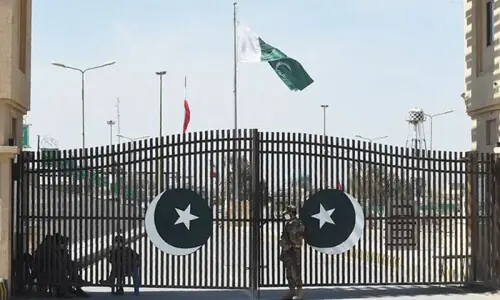
Some additional avenues of cooperation are, however, being broached. Two new exit and entry points may be established at the border towns of Panjgur and Sarawan in Balochistan for the movement of persons and goods between the two countries. Iran is offering to supply electricity to two Pakistani border towns in Balochistan. This would be a less expensive alternative to supplying these towns from Pakistan’s own grids.
Then there is the huge project of laying a pipeline to carry Iranian natural gas, running through Pakistan, to India. Iran has a lot of gas to sell and India wants it because it would cost a lot less than liquefied gas. The pipeline from the Iranian deposits to the Indo-Pakistan border is estimated to cost between three and four billion dollars. Estimates of the transit fee that will accrue to Pakistan range between four hundred and six hundred million US dollars.
Pakistan, on its part, will also be able to buy gas from the same source at a price lower than the going rate. Already the demand for natural gas in the country exceeds the supply from its own reserves. According to one estimate, the deficit will reach about 500 million cfpd (cubic feet per day) by 2010 and it will be twice as much by 2020.
The gas pipeline project was first broached some fifteen years ago. It has been discussed by officials from Iran and India, and by those from Iran and Pakistan, several times since then. The bad state of Indo-Pakistan relations has been the main impediment to its implementation. Pakistan is not anxious to be a facilitator of advantages to India without a political quid pro quo.
India is understandably apprehensive that Pakistani hostility makes the uninterrupted passage of gas to its destination uncertain. During Prime Minister Jamali’s recent visit to Tehran, the two governments constituted a joint committee of experts to further study the project. It remains to be seen whether this committee will be any more productive than its predecessors.
Relations between Iran and Pakistan are inhibited by the latter’s antagonistic relations with India and its status as a client of the United States. Iran and India have recently concluded a pact that will allow the Indian navy access to Iranian ports in the event of a war with Pakistan. In a recent statement (August 19) Mr Khurshid Kasuri maintained that Indo-Iranian defence cooperation posed no threat to Pakistan. This was surely a weird statement, for word of this “cooperation” came as a shock to many politically aware Pakistanis, who saw it as an anti-Pakistan move. On the other hand, Pakistan’s reluctance to let Iranian gas go to India is bound to annoy Iran inasmuch as it keeps Iran from earning substantial profits from this deal.
American officials have been accusing the Iranian government of supporting international terrorism, operating a tyranny within the country, and preparing to produce weapons of mass destruction. They regard Iran as a part of an “axis of evil.” The late Ayatollah Khomeini called America the “Great Satan” and, in their recent meetings with Gen Musharraf and Prime Minister Jamali, his successors have designated America as an enemy of Islam and as an instigator of discord between Muslim nations. They have asked the Muslims to move against American machinations.
It is clear that in these circumstances Pakistan’s open-ended pledge of cooperation with the United States is liable to strain its ties with Iran, and Pakistani measures calculated to develop any real closeness with Iran will be unwelcome in Washington.
If I may borrow a metaphor from Governor Caumo of New York, speeches over good food and drink in presidential palaces can be “poetry,” but the actual practice in foreign politics, as in statecraft generally, has to be unadorned, even sobering, “prose.” This insight deserves to be kept in mind while interpreting the Iranian and Pakistani declarations of mutual affinity and eternal affection.
The writer is professor emeritus of political science at the University of Massachusetts at Amherst, USA.
e-mail: ssyed@cox.net
Groping in the wilderness
THE president and the prime minister alternately assure themselves that parliament is in existence, the government is working, the frontiers are guarded and there is no crisis. The people are much less complacent.
The National Assembly indeed has been in existence for a year at a cost of, along with the Senate, a billion rupees. The speaker marked the end of the year with a feast which, like the proceedings, was boycotted by the opposition. More appropriately he should have informed the people what their representatives had done in the course of the year to benefit them or, at least, to mitigate their sufferings.
The members on their part felt they had done more than enough to double their salaries. The banter and the threats on the occasion only poured salt over the wounds of the people and added to their anxiety. They view the prospect of street protest by the combined opposition more seriously than the prime minister does. It is flippant to “welcome” public agitation which in our political culture invariably leads to violence and disruption of economic activity.
Even if the agitation doesn’t succeed, as the prime minister feels it will not — for, he says, the opposition has neither a cause nor popular support — the absence of its members will continue to hamper the proceedings of parliament and also impair whatever little representative character it has. The deadlock, however prolonged, wouldn’t hurt the members on either side but practically disenfranchise the people. They will continue to enjoy their pay and privileges as if parliament was created only to employ them.
How and when the differences, apparently irreconcilable, will result in a working agreement, is a question that can be answered only by political pundits and not by the legal experts nor by plain-thinking citizens. The deadlock is built into the scheme of elections (disqualifications and alleged rigging) through which parliament has come into being, divided itself into the treasury and opposition benches (horse trading) and then a large cabinet was put together which, temptingly, remains open to expansion.
The argument and protest now is all about the survival or recognition of political cadres and their leaders for which the Legal Framework Order has become a rallying point. Almost every party — and the president himself — has shown willingness to negotiate a compromise on its various ingredients. At one stage the government and the alliance of the religious parties (MMA) were reported to have all but agreed on the substance of the changes, but no longer.
It may turn out to be a stroke of good luck for the country though Chaudhry Shujaat, the new-found messiah of Pakistan’s politics, continues to insist that his Muslim League and the MMA are natural and inseparable allies. Some ascension and dumping, thus, may be in the offing.
Even if a deal is made with the MMA or any other party or alliance, parliament and consequently the government will remain unstable as the political parties which sustain and run a parliamentary system have splintered into many bits without any programme or direction. Ours is a strange parliament in which the members elected from the platform of one party are now working for another party and yet continue to profess allegiance to their own party. All of them want to keep their position of power and yet not close their option to return to the fold of the original party whenever expedient.
From the look of things and attitude of parliamentarians it is unlikely that the factions forming the government will ever coalesce into one party or even a coalition with a common programme. The complexion of the opposition is also likely to be similar. It will thus remain an a’la carte parliament as long as it lasts.
Policies and plans will continue to emanate as they did in the first three years from the president and his advisers who may or may not be ministers. That may be a negation of democracy but should not hamper internal administration and development.
It is at the stage of execution of policies and projects that the real and serious difficulty is arising. In the provinces not the legislature alone, but the implementation machinery is fragmented and lacks direction.
The duality of control travels from the governor/chief minister down to the lowest level. The tussle over jurisdiction and powers between the provincial and district governments remains a cause of waste and delay. Particularly neglected are the executive and quasi-judicial functions where the bureaucratic heads have been abolished but the commissions, authorities and ombudsmen that were to take their place have either not come into being or are still-born. The new system is thus working neither at the top nor at the grassroots.
Pakistan’s fragile political structure poses not only a threat to internal order but also raises many international concerns. Doubts are expressed about the will and ability of the government to curb the extremists (a euphemism for religious militants or killers) because it needs their political support. The Indian accusation against Pakistan on this score is well known. Now Afghanistan is lending credence to it. Both countries may have their own failings and biases against Pakistan but not our good and great friend China, which also fears Pakistan’s armed zealotry making inroads into the neighbouring Xinjiang region.
Such reputation, or mere suspicions, have lost Pakistan whatever little support or sympathy it commanded in the international community for a just solution of the Kashmir dispute. The government’s spokesman Sheikh Rashid too recently conceded in Delhi that the hope for a settlement with India now lies only in the statesmanship of Vajpayee — not in the freedom fighters, UN resolutions, our allies or OIC. No country can afford to antagonize India which has long been recognized as the world’s largest democracy and has now also become its second fastest growing economy. Pakistan, on the other hand, is seen as teetering on the verge of either bankruptcy or anarchy.
Many possible solutions to the current crisis could emerge once General Musharraf recognizes that a crisis does exist and the present parliament is not a solution to it, and the opposition too realizes that street protest wouldn’t produce one either.
Whatever Musharraf may choose to do, he should not let the country remain hostage to a bargaining parliament for four more years and, secondly, he should not become president of the Q League on the goading of Sheikh Rashid. Ayub Khan had succumbed to a similar plea from his sycophant information minister. That decision proved fatal both for him and for the Muslim League.
The uses of science
FOR an example of the problems caused by the politicization of science, look no further than the Missouri River, where a legal battle has been raging for years.
On one side stands the Army Corps of Engineers, as well as a clutch of Missouri politicians who want to keep water levels in the river high so that it remains navigable.
On the other side stands a clutch of environmentalists, a few South Dakota politicians who want to protect their recreational fishing industry and the US Fish and Wildlife Service, whose scientists have until now agreed that the Corps should allow the river to flow more naturally — high in the spring and low in the summer — so that birds and fish living on the river, among them several endangered species, can live and breed normally.
Last summer, the decade-long standoff seemed to have been decided in the favour of birds, fish and fishermen, when a judge ruled that the Corps should lower the level of the river in summer to protect sandbars, where birds build their nests.
Now, some suspect that the terms of engagement have suddenly changed. Arguing that it is legally required to conduct a “reconsultation,” the Fish and Wildlife Service appointed a team of scientists to conduct a new investigation.
—The Washington Post
Does US understand its enemy?
THE news that a Chinook had been brought down by a missile, killing 16 soldiers (including two women) on their way home, was bad enough for the United States, but I submit that there was worse to follow. The really bad news was that the story of a second helicopter, a Black Hawk, being downed, this time near Tikrit, killing six US troops, was carried on an inside page by so many newspapers. It is the inside page which should worry Washington. It shows that the world is getting inured to a rising death toll.
The Pentagon (whether with the approval of the White House, or without — but does that make a difference?) immediately ensured that the story reached the top of every page one by unleashing artillery and air attacks on Tikrit, from where the second helicopter had been targeted and hit. This was, in part, institutional anger; Chinooks have been driven from daylight skies, and there are now 25 to 30 attacks on American forces every day.
In October 33 Americans were killed in Iraq, more than twice the toll of September; and November has begun ominously. In seven days of November, 35 American troops have been killed in widespread, and effective, guerrilla warfare. The American death toll is nearing 400. Artillery and F-16s are back in operation, for the first time since George Bush announced ‘Mission Accomplished’ on May 1. Those were the days when Donald Rumsfeld’s face did a victory jig each time it found a television camera in its vicinity.
But the shelling and bombardment of the city of Tikrit is also vengeance against the people, for the sin of being in the birthplace of Saddam Hussein, the man two generations of Bush set out to destroy but who still remains elusive. Those with an ear attuned to history will already have begun to hear echoes. One is from Vietnam, where the Pentagon, consistently and sometimes barbarically, took revenge on civilians for punishment inflicted upon its military.
In Iraq, the Americans face no visible army, and have thus concluded that the whole of Tikrit is their target. If their purpose is still to “shock and awe”, then they have learnt nothing from their many months in Iraq. With each such whiplash, the Pentagon converts uncertain civilians into a certain enemy. It is the worst possible option, a medieval response that destroys what little goodwill an occupying force carries with it. (Exchange between Nic Robertson, reporting from the spot, and Shihab Rittansi, CNN anchor: Robertson reports that there were no specific targets of American shelling. Shihab replies, tongue firmly in cheek: “So no specific targets — just to win over hearts and minds?”)
An American think tank, the project on defence alternatives, has done extensive surveys to provide an estimate of the number of Iraqis killed since the launch of the “shock and awe” campaign and the fall of Baghdad: between 10,800 and 15,100 troops and between 3,200 and 4,300 civilians. The army has disappeared, disbanded, thanks to a thoughtless decision when serenades were floating through the corridors of power in the Pentagon and the White House. The second count has now resumed.
There is another echo as well. The first European occupation of Iraq took place in the First World War when the British defeated the Turks to reach Baghdad via Basra. The British forces were not very British, actually; it was really a victory of the Indian army, led by both British and Indian officers: some 21,000 Indians paid the ultimate price. (One of the generals in that Indian army was our present finance minister Jaswant Singh’s grandfather.)
The local Arabs had been led to believe that they were being liberated from the Turks. When the British denied the Arabs self-rule, explaining that they had no desire to surrender control of all that oil, the whole of Iraq rose against British rule. There was no sophistication in either the arms or the organization of the rebels, but the British had to use the RAF and chemical gas before they “stabilized” the region sufficiently to hand over power to a nominated scion of the Hashemite family, Feisal, and attempt by indirect rule what they had not managed through direct rule. Do not be too surprised if further parallels pop up. Already there are whispers that it might be a good idea to make the Hashemite Prince Hasan, who could not succeed his brother King Hussein in Jordan, a “reliable” king of Iraq. We will see what we will see.
What we have already seen was never envisaged, and it is likely that the improbable will continue to become the evolving reality of Iraq. One reason why it was not foreseen was because the “neo-cons” who shaped Iraq policy for Bush had barely concealed contempt for the Arabs, both the people and their governments. Comparisons to Vietnam are inappropriate, but there is at least one thing in common: America did not understand its enemy in Vietnam, and it does not understand who or what it is fighting in Iraq. It thought it was fighting the “Red” sweep in Vietnam. No one in Washington was told that if the Vietnamese had one nation that they distrusted utterly, it was China. The Americans realized this only after they got out.
Today’s American wars are fought against an enemy called, in shorthand, Al Qaeda. Everything is attributed to Al Qaeda. As I write a warning is issued in America that Al Qaeda “might be planning” to hijack cargo planes. The American embassy in Saudi Arabia is being closed down, at least temporarily, because of Al Qaeda. Every US mission in the world is a modern fortress. Freedoms in the land of freedom are being curtailed. Even the Congress is being denied proper information for fear of Al Qaeda. The culture of secrecy is turning into paranoia.
But what is the Al Qaeda? It is beyond belief that an organization led by a man hiding in the mountains of either Afghanistan or Pakistan, who cannot be discovered by the most sophisticated technology devised by the most powerful nation in history, can become such a functioning international network that can threaten America both across continents, and in the heart of America itself. How does Osama bin Laden communicate with such a huge, sprawling shadow army, when any contact with a technical device could be picked by American technology and reveal his presence? How can Osama mastermind the hijacking of cargo planes in the United States today? Absurd. Osama is not even instrumental in the low-level but continuing conflict against American forces in Afghanistan.
Al Qaeda no longer represents a fact, but it does represent an idea. It has become a code for a reality that should worry America far more than Osama ever did. Just as the Russian invasion of Afghanistan energized disparate, unconnected Muslim groups, or Muslim individuals, into choosing Afghanistan as their battleground, the American occupation of Iraq has confirmed for an equally large number of Muslims that the threat to the independence of Islamic countries now comes from America. At a mass level this translates to resentment, evident in either conversation or journalism. But it takes only one man in a hundred to believe in violence for a shadow army to form, a network of independent cells that are part of the same ideological hive. And so in a thousand different places, a thousand different groups work towards the same end. There is no mastermind. But there develops a master-objective.
One of the most astonishing revelations of this year has been that George Bush was stunned to learn on his last foreign tour that Muslims were angry with him. He must be sanitized from information. He cannot possibly be reading any newspaper. News must be fed to him in clippings, and courtiers always take care to hide uncomfortable analysis. The secret service now has orders to keep even demonstrators away from Bush, so that they may not disturb his serenity.
You are told that $87 billion has finally been allocated for Iraq. Bush cronies have been awarded huge contracts. But what happens after that? Most of them simply keep a fat percentage and then sub-contract the work to others. Why give the contracts to the American fatcats in that case? The most illuminating story I have read on this subject concerns an American multinational given the contract to build classrooms. On the original contract, each classroom is meant to have an air conditioner.
By the time it is sub-contracted, it becomes an air cooler, as another percentage-eater bites into the budget. By the time the second sub-contractor actually builds the classroom that air conditioner has become an “$11 ceiling fan”.
The one relevant comment made by George Bush is that the real consequences of the Iraq war will only be known in 50 years’ time. True. And those consequences might be less than welcome to the man, or woman, in the White House then. Bush should consider himself lucky that there is no democracy in the 22 Arab nations. If these nations had genuinely democratic governments who represented the will of the people, there would be 22 Arab governments deeply hostile to the Bush White House.
The writer is editor-in-chief of Asian Age, New Delhi.