0
0

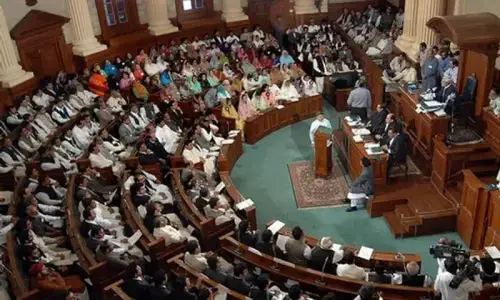
LAHORE, Nov 1: The two-day conference of opposition leaders of all four provincial legislatures concluded here on Saturday with a proposal for the establishment of a federal constitutional court, calling for water distribution among the federating units in accordance with the 1991 accord, demanding a new NFC award to meet a constitutional requirement and seeking abolition of the Concurrent List of the Constitution to give the provinces more rights.
The participants in the first ever conference adopted an 18-point declaration which ‘diagnosed’ the problems facing the country and offered their solutions, claiming that the decisions enjoyed the support of their respective parties.
Punjab Assembly opposition leader Qasim Zia, the host, who belongs to the PPP, said any party which came into power after the collapse of the present setup would be committed to implementing the declaration in its entirety and without reservations.
Nisar Khuhro (PPP) from Sindh, Gustasip Khan (Awami National Party) from the NWFP and Balochistan Assembly opposition leader Kachkol Ali (National Party) were the other participants in the conference held at the Punjab Assembly secretariat.
MMA’s Dr Wasim Akhtar, who was also present when the final declaration was read out, told reporters that the religious parties alliance also backed the decisions.
PML-N leader Rana Sanaullah Khan represented his party in the deliberations. PPP’s Rana Aftab Ahmad Khan and Munir Khan were also present on the occasion.
Explaining the need for the proposed federal constitutional court, Mr Zia said it would resolve any conflict between provinces and the centre and decide all constitutional matters, including the upholding of the Constitution against any usurper.
“The Supreme Court is already overburdened,” Mr Khuhro cut in, when a reporter asked what role the Supreme Court would play after the establishment of this court with such a vast jurisdiction.
About the composition of the court, Mr Zia said it should have equal representatives from the four provinces, recommended jointly by the prime minister and the opposition leader.
Recognizing the need for developing and conserving water resources, the participants said they supported “only those policies, projects, dams and development schemes that are undertaken with the consent and consensus of all federating units, without damaging the legitimate interests of one federating unit or the other.”
By implication, this means that Kalabagh dam and Greater Thal Canal projects should be abandoned.
Mr Khuhro said opposition leaders would soon form a committee which would meet at least once a year to take stock of the situation and see what measures political parties were required to take to set the house in order.
The next meeting of the opposition leaders would be held in January in Karachi.