0
0

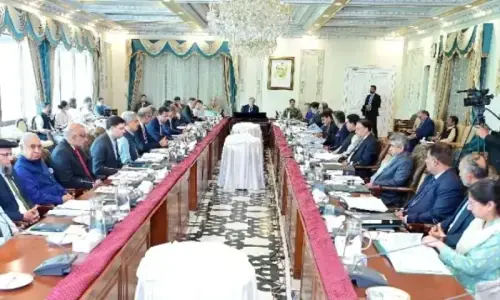
BANGKOK, Oct 21: Pacific Rim leaders vowed on Tuesday to dismantle terrorist organizations, strive for peace on the Korean peninsula and work to “re-energize” multilateral trade talks at the conclusion of their summit here.
The 21 heads of state and government, including US President George Bush, also agreed to eliminate weapons of mass destruction after two days of talks dominated by the “war on terror” and the threat posed by North Korea.
“We agreed that transnational terrorism and the proliferation of weapons of mass destruction pose direct and profound challenges to APEC’s vision of free, open and prosperous economies,” the Asia Pacific Economic Cooperation (APEC) leaders said in a joint declaration.
Widening the focus of the group founded in 1989 to promote free trade and economic cooperation, they committed to take “all essential actions to dismantle, fully and without delay, transnational terrorist groups that threaten the APEC economies”.
The leaders pledged to rid the world of weapons of mass destruction “by strengthening international non-proliferation regimes, adopting and enforcing effective export controls, and taking other legitimate and appropriate measures against proliferation”.
And agreement was also reached on curbing the spread of so-called man-portable air-defence systems, known as MANPADS, which Washington fears terrorists could use to shoot down civilian airliners.
Wearing vibrant Thai silk shirts, the leaders stood side by side as Thai Prime Minister Thaksin Shinawatra pressed home the need to work for a stable Korean peninsula, amid concerns raised by North Korea’s nuclear weapons programme.
“We seek a peaceful resolution through dialogue while addressing all the concerns of the parties, including the security concerns raised by the DPRK (North Korea),” said Mr Thaksin.
“We are committed to the maintenance of peace and stability on the peninsula and support continuation of the six-party talks and look forward to concrete and verifiable progress toward a complete and permanent nuclear weapons-free Korean peninsula.”
But despite a US push for an official condemnation of North Korea, the leaders’ document did not include a joint call for North Korea to disarm, nor was there a separate statement on the issue, as Japan had wanted.
Mr Bush, who left for Singapore on Tuesday on the next leg of his Asian tour, has ruled out giving Pyongyang the non-aggression treaty it demands, but said he was exploring ways to provide written security assurances backed by Washington’s partners in the six-way talks — South Korea, China, Japan and Russia.
The president and other top officials used the summit to sound out Washington’s dialogue partners on the new initiative with its urgency highlighted by the firing of a North Korean short-range missile on Monday.
Myanmar also avoided an official tongue-lashing despite the US president making clear he wanted Asian leaders to do more to push the ruling junta’s generals to release opposition leader Aung San Suu Kyi, who is under house arrest.
While the summit was overshadowed by security issues, to the ire of some leaders led by Malaysia’s Mahathir Mohamad, the world’s powerbrokers agreed to throw their support behind the multilateral trade negotiation process that foundered in Cancun last month.
“We agreed to re-energize the negotiation process... recognizing that flexibility and political will are urgently needed to move the negotiations toward a successful conclusion,” they said in the joint declaration.
The powerful grouping also vowed to push for an “ambitious and balanced outcome” of the Doha round of negotiations, which faltered in Mexico amid disputes over agricultural subsidies by rich nations.
“We agreed to work towards the abolition of all forms of agricultural export subsidies, unjustifiable export prohibitions and restrictions,” they said.
The leaders reaffirmed the “primacy” of the multilateral trading system and agreed that the Doha round of talks under the World Trade Organization (WTO) was vital for member nations’ prosperity.
Despite the long list of important economic and security issues, the summit, which in past years has been hijacked by political issues, was again distracted by diplomatic spats.
A row over Mahathir’s controversial comments about Jewish influence made at the Islamic summit last week flared again on Tuesday when he repeated that “arrogant” Jews rule the world.
“Well, the reaction of the world shows they control the world,” he said in an interview with the Bangkok Post after a volley of international criticism, led by Mr Bush and Israeli Prime Minister Ariel Sharon, who on Monday slammed the remarks as “slanderous”. —AFP