



 0
0

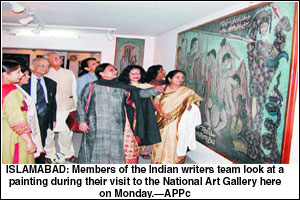 ISLAMABAD, Oct 20: The progression of dialogue between Pakistan and Indian writers brought forth an ironical fact: Pen is not just a harbinger of peace, as the topic ‘Pen and peace’ suggested, but is also the biggest cause of violence. The marathon sessions of the three-day conference on Monday saw the term ‘peace’ being juggled all across. Its definition varied from one person to another, depending on who he or she was in terms of religion and ethnicity; where they came from and what ideology they held. At times it was absolutely confusing as to what kind of peace was being discussed. Whether it was total peace or partial peace? Whether peace was merely ‘absence of violence,’ ‘a break between two wars’ or, as diplomats love to say, ‘composite peace.’
Whatever the case, it was obvious that peace could not be discussed without discussing violence and other thorny issues. The latent friction was particularly noted when some Pakistani and Indian writers, in the flow of emotions, took the ideas about the oneness of people and what bound the two peoples together a little too far. Far enough to tickle the sensitivities of ‘others.’ Call them zealots, rightist or the custodians of the so-called ideology of Pakistan, but they did register their concern.
Poet Zia Jallandhari was more candid when he reminded the audience that Pakistan and India were two separate countries. “It’s a reality that has to be accepted,” he said while concluding the proceedings. “This may be the basis to gain real peace.”
The basic idea was: Well, peace is good but let’s just keep it to its limits. “But who talked about Akhand Bharat,” whispered a Pakistani poet who did not wish to be named. His contention was that it was the inner insecurity that haunted us with such ghosts every now and then. He was not wrong, as nobody from the Indian guests had suggested the annulment of the Partition. The delegates from the South and West of India did not even seem to have any idea about sensitivities on the issue of getting together beyond ‘permissible limits.’
Another lesson of the day was that the journey of peace was no ‘honey and sugar’ all the way. There was an ocean of frictions not just between Pakistan and India but within their respective countries.
The discussion hip-hopped from the traditional tussle between the progressives and pro-establishment groups; the so-called right and the left; between Urdu and Hindi and Urdu and the rest. Multan’s Academic Dr Anwaar Ahmad best explained the Pakistani context. He nudged the discussion to Pakistani literature’s most sensational issue: Why Faiz is revered more than Ahmad Nadim Qasmi?
His contention was that while the Progressive Movement in India had its own dynamics, Pakistani writers were faced to fight with the establishment that sided with the rightist and there was always this sword of religion and ideology hanging on their heads. “So whoever suffered at the hands of the establishment, went to jails and exile, has earned people’s respect,” he said, countering Intezaar Hussain’s critique of the Progressives. “Manto remains the people’s man because he stood for them against all odds.”
Manohar Shyam Joshi led the Indian side in pointing out that the communication gap between the two countries was increasing by the day. “We get to know each through English now,” he said while narrating how translation has become so difficult in the absence of a common script. Others shared his view that if things continued the way they are going a time might come when we would not understand each other’s language. Hindi continues to be Sanskritized while Urdu in Pakistan is becoming more and more localized, a natural corollary of the gap of the last 56 years.
Amidst these occasional literary bouts there was articulation of some of the best works in contemporary literature.
Munnoo Bhai stole the Pakistani show by his all-time favourite Punjabi poem — an appeal to the chief of the Accountability Court (Ehtesaab day chief commissioner, saab buhadar). There could not have been a better piece to explain Pakistan’s social and political milieu. Sarmad Sehbai too enthralled the audience with his ‘jadeed’ poetry. Taran Gujral’s short story, Dr Jagtaar Singh and Dr Kanwal’s poems were heard in rapt attention. Dr Saeeda Hameed, a descendent of Khawaja Altaf Hussain Haali, her most notable relative in Pakistan being former Finance Minister Dr Mubashir Hassan, was impressive in her articulation.




























