0
0

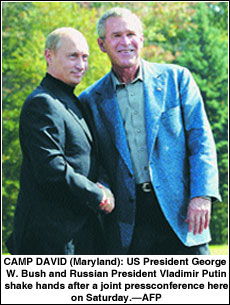 CAMP DAVID, Sept 27: US President George W. Bush and Russian President Vladimir Putin urged Iran on Saturday to give up any ambitions it might have of building nuclear weapons.
After talks at Camp David, Mr Bush appeared to obtain Mr Putin’s support for a slow transfer of Iraqi self-rule from US control in the face of demands from some nations such as France for a speedy transfer of sovereignty.
For his part, Mr Putin said a negotiated settlement to end the nuclear standoff around North Korea should be accompanied by US security guarantees to the isolated Stalinist state, a step Mr Bush has been reluctant to take.
The two leaders held talks on Friday night and Saturday morning at the presidential retreat and emerged to say they had set aside any differences they had over Iraq. Russia was a leading antiwar opponent in the bitter pre-war debate.
They were united in their demand that Iran, which along with Iraq and North Korea was part of Bush’s “axis of evil,” give up any effort to acquiring nuclear weapons, which Iran has denied doing.
“We share a goal and that is to make sure Iran does not have a nuclear weapon,” said Mr Bush.
The International Atomic Energy Agency, at Washington’s urging, has raised concerns about Iran’s nuclear aims and given Tehran until the end of October to dispel doubts that it is secretly developing nuclear arms.
“It is our conviction that we shall now give a clear but respectful signal to Iran about the necessity to continue and expand its cooperation with IAEA,” Mr Putin said.
But he appeared to give no ground on Bush’s demand that he stop Russian assistance to Tehran’s nuclear programme. Russia has a $800 million contract to help Iran build a civilian nuclear power plant.
Mr Putin declared that Russia has no desire to contribute in any way to the creation of weapons of mass destruction in Iran or anywhere else.
“I would like to reiterate that we have complied firmly with the provisions of the Non-Proliferaiton Treaty because this course is in our national interests. As to the joint work, we are ready to proceed,” he said.
On Iraq, Bush is seeking a UN resolution creating a multinational force and outlining a path toward democracy. US officials estimate it will take at least six months to write an Iraqi constitution, as some nations and the Iraqis themselves appeal for a speedier transition to self-rule.
Mr Putin made no demand for an immediate transfer.
“Russia is interested in seeing it occurring as soon as possible. At the same time we understand that this is a very complicated process that should be based on a solid legal and administration base and should go ahead stage-by-stage,” he said.
Moscow would await the outcome of the UN resolution to determine “the degree and extent and level of Russia’s participation” in Iraq’s reconstruction, Mr Putin said.
On North Korea, the two leaders agreed that Pyongyang should immediately give up its nuclear weapons programme in a verifiable way, but Mr Putin suggested the United States be willing to give North Korea a security guarantee.
North Korea has demanded a non-aggression treaty with the United States as condition for giving up its nuclear programme.
“Russia believes ensuring the nuclear non-proliferation regime should be accompanied by North Korea receiving guarantees in the sphere of security,” Mr Putin said.
IAEA CALL: The head of the International Atomic Energy Agency on Saturday called for “full cooperation and transparency from Iran” over an Oct 31 deadline to come clean on its alleged nuclear weapons programme or risk UN sanctions.
Asked about the likelihood of Iran conforming to the deadline set down by the IAEA on September 12, Mohammed ElBaradei told CNN: “I hope so, I hope at least that I will not be in a position to report that I am not getting full cooperation and transparency from Iran.”
“There is a degree of impatience on the part of the international community that this issue can not continue for ever.
However, he refused to speculate on the consequences of referring the matter to the UN Security Council, which could impose sanctions.
“I hope that the issue will not have to be brought to the Security Council. I hope that Iran will cooperate and take whatever corrective measures needed for us to be able to present a positive report,” he added.
“They say their programme is for peaceful purposes and if they really have nothing to hide it is to them to open all their facilities and all their books,” he said.
The IAEA has given Iran until the end of next month to answer all its questions concerning allegations that it is seeking to develop atomic weapons.—Reuters/AFP