



 0
0

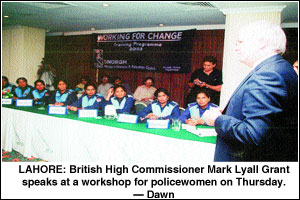 LAHORE, Sept 18: British High Commissioner Mark Lyall Grant said on Thursday that the security situation had improved in Pakistan.
Talking to newsmen at a training workshop for policewomen, Mr Grant said: “Of course, violent incidents do take place here and there are extremist movements who are targeting foreign interests. But the authorities have made efforts to improve the security situation, and it has improved. We’ve reflected that in our travel advisory.”
He said a British trade mission would be visiting Pakistan later this year. It would be the first such delegation to come to this country in two years.
Asked whether the British government intended to mediate between Pakistan and India on Kashmir, he said overall there had been progress in relations between the two countries.
“The situation between Pakistan and India is considerably better than it was 12 months ago. Some of the confidence-building measures such as people-to-people links have grown over the last few months, and we are encouraging both the governments to take that process forward and begin a substantive dialogue on Kashmir,” he said.
The high commissioner admitted that there had been a lot of problems with visa service due to security concerns. “In 2001, we had 54 visa officers in Pakistan as a whole in Islamabad, Lahore and Karachi. At the beginning of this year, we had only four because everyone who had a family had to be evacuated last year. As a result, there had been a big backlog, and we had to restrict the number of visas that are processed,” he said.
He said they had now built up the staff, and there were 32 visa officers in Islamabad and they were building up the service slowly. The delays for visit visas were now less than two weeks.
“But we are still having to restrict the applicants to those who have travelled to the USA, Australia, New Zealand and Canada in the last five years. We will be looking to widen those categories as soon as we have the ability to provide a proper service to all those who come in.”
Mr Grant said some 65,000 visas had been issued so far this year in all categories. “Last month we processed some 6,000 to 7,000 student visas. We put in extra people to prioritize student visas. Now that the students have gone, we are trying to reduce the waiting list for settlement visas from six to three months,” he said.
Speaking about the training workshop launched by the British Council in collaboration with the Simorgh Women’s Resource and Publication Centre and the Punjab Police, he said the women police force was an important part because they understood better women problems, and therefore, women played a vital role in the police force.
He said the training workshop aimed at to help the process of transforming the police force into a community-based force which was actually serving the people and not oppressing them.
He said an increasing number of ethnic minorities were in the police force in the UK. “We had a big recruitment drive to try and encourage more ethnic minorities who are traditionally not attracted by the police. There are certainly quite a large number of policemen from ethic minorities as compared to women.”
Asked whether the British government planned to assist in the establishment of a police forensic science laboratory, he said there had been no specific project in this regard. But if any proposal was put to us, obviously we would look at them.
The envoy said his government was undertaking a number of projects throughout Pakistan and police training was one of them. “This project will go on till next year,” he said.
“There are a number of different areas within the overall human rights funding. We are looking at the police force, at the prison services. They are sort of institutions where human rights are extremely important, and there is a need to properly educate those who are in these forces.”
Asked whether such programmes would be extended to other provinces, the envoy said: “We will consider similar programmes for police forces of other provinces.”
Earlier, speaking to the participants, the high commissioner said some 800,000 British citizens of Pakistan origin resided in the UK. Four senior police officials from South Yorkshire police would be visiting Pakistan shortly to train their Pakistani counterparts.
The ambassador also heard about the problems being faced by the women police and promised to convey their grievances to the higher authorities.
Acting British Council director Dr Iftikhar Elahi also spoke on the occasion.—APP





























