0
0

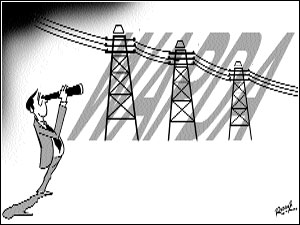 Whatever Wapda says through press releases or advertisements one thing is clear, i.e. if nothing is done to stop the rot, the mismanaged Utility will sink the whole nation with it.
Instead of proving or disproving what the utility has to say or what has been undone in the past, we would dwell into Wapda’s present and future efforts,specially in order to reduce the very high but static since the last five years, the line losses of above 25 per cent.
In addition, we may also ask as to why, instead of the above, does Wapda not think of ways and means to increase its present revenue level and to reduce the level of it’s current expenditures. On paper it may seem alike, but a big difference remain between both the suppositions. And following one specific idea against the other would surely lead to vastly different results. However, the non-professional would surely see no difference.
Wapda since long-specially since the early 1990s has not done much to improve upon its revenue level and similarly no special efforts were undertaken to curb or put on hold the ever-increasing expenditures. Incidentally, but for Engr. Shah Nawaz Khan who remained Chairman during 1974-75 or the harried Engr. Shams-ul-Mulk who headed the Authority twice during very tumultuous times, Wapda has remained a prisoner of whims of the non-professional and, for that matter, mediocre ones.
As a consequence, the Utility’s mission statement remained only selling its products, cutting its line losses and reducing the level of receivables. As the mission chosen especially in 1980s and 1990s had been exclusionary in nature, nowhere and at no moment during the last decade has Wapda vowed to be a service provider. As such its back-breaking tariffs, at the best-disrupted supply and an enormous drag on the nation’s already battered economy that we have to bear with.
Study of, and insight into, Wapda’s effort to reduce its technical losses reveal that it first started to improve upon its act under a US Aid EIR programme in the eighties and in the process was able to achieve much. However, this was put on hold during 1995-98 and instead of taking up the cudgel, Wapda’s new management simply axed the operations altogether for the next five years i.e. from late 1998 till July, 2003, when a 5-year plan to reduce losses by 5 per cent had to be conjured up and that too under compulsions from the IMF/WB which had put on hold the ever dreaded but welcome tranche.
The plan thus is exactly five years late-and tried to be erected on an earlier demolished edifice. The KESC sailing in equally stormy waters and sadly under the same command has, on the other hand, conceded defeat and advertised for a project director to oversee the implementation of its Rs13.349 billion comprehensive plan envisaged to be put in place in the coming three and a half years. It includes restoration of generation capacity by 143mw, addition of 790 mva transmission capacity and 500 mva auto transformation capacity on 12 new grid stations, addition of 86 km transmission lines and establishment of SCADA to monitor the supply of electricity at various levels.
The distribution networks rehabilitation includes extension of 11kv lines, installation of 3,000 new PMTS, installation of fault locators and knife switches on 300 feeders, LT breakers on 4,000 PMTS, bus bar arrangement in 600ms. buildings, shifting of meters (30,000 industrial, 1,200,000 residential and 600,000 commercial), removal of kunda (illegal connection), etc. This is a much better way of working and surely destined to pay dividends provided the professional/P.D. is left to do his job in the stipulated manner. On the other hand, no such effort is afoot in Wapda to tackle and implement it’s Plan.
This plan, approved by Wapda in its meeting held on July 1, 2003 and issued for implementation vide its No. S/AD/(Co.ord) 03003/MTG/2460-95, dated 10/07/03, is a classic case of much ado about nothing. The plan, issued for implementation after ten long days of its approval by Secretary Wapda, is perfunctory at best and seems to be issued with not much thought or conviction. And then this still remains with various officers-general managers in-charge of co-ordination, operations, finance and the CEO NTDC-barring the lastly listed all these gentleman here no say administratively or even functionally to check the holy cows holding the reins of the DISCOs—corporatized distribution companies of Wapda.
Moreover, expertise to handle such a plan too is not available with Wapda as all the required human resource has since been disbursed away from their specific areas of expertise. Sans authority, sans expertise nothing happens and nor would happen.
Discussing the innards of this plan one by one, we see that the first group of points relate to the resolve to upgrade existing 33kv and 66kv lines and grid stations to the 132kv level, provision of 2500 mvar additional capacitors at various grid stations, re-conductoring of over-loaded 132 kv transmission lines and replacements of over-loaded transformers. Implementation of all this remains the purview of the CEO NTDC and the eight maverick and fiercely independent DISCOS.
On the other hand no effort has also been made to set up a cell or a task force to oversee coordination and implementation of the 5-year plan. With the present level of HR, its vitality, lack of initiative and the style of management in vogue, improper or no co-ordination between the HQ and the DISCOS, the plan is sure to rebound. Taking up the second part of the plan we see that it pertains to the DISCOs and it would have to be taken up for implementation by them alone. However, it is a fact that the DISCOs in their present nascent stage of organization cannot be entrusted to look after these tenets of the Plan. Besides this inability to take up implementation is the sketchiness of the Plan itself and the fact that it cannot lead to the envisaged results.
The second portion of the plan talks about bifurcation of 11kv feeders presently carrying more than 300 Amps—as if up to this figure of flow no loss takes place— reconductoring against low capacity conductored feeders, augmentation of just the over-loaded distribution transformers,against the universally accepted provision of four times transformation capacity, against the average load/demand (Wapda’s distribution system just possesses two times of the capacity), replacement of pvc to pvc to LT lines, up-gradation of existing LT line capacity and replacement of energy meters installed prior to 1985.
A most important omission in the plan is the lack of any decision or even an initiative on metering and formulation of an apt metering strategy for the Utility. Without this imperative requirement in place, Wapda would fail to achieve the objectives it has laid out for itself. On the other hand, and an opinion to which experts would have no two opinions, formulation and implementation of an apt metering strategy would lead to achieving 5 per cent loss reduction each year. Adding up to this, other measures would accrue another 5 per cent reduction in the next five years. All told a 10 per cent reduction can thus be easily arranged.
The authors of this plan couldn’t have been more naive and living away from reality as it leaves great holes in between. Very important facets of a typical ELR Programme too have been left out,seemingly because of lack of understanding of Power Utility Operations. The dynamics, of operations peculiar to Pakistan too have been ignored. Similarly, we see that no step has been envisaged to be taken to ensure that the present non-specified/against-design work in the offing is put on hold.
Because of this, each step taken in the forward direction would lead to at least one step being taken backwards’ Thus the Plan, even after billions in expenditure, would result in nothing being achieved. However, earmarking an amount of Rs. 2.5 billion for system augmentation during 2003-04 (two months have since passed with nothing being done) and Rs1.5 billion for the STG (secondary transmission and grids) programme is laudable, but the programme/plan remains unachievable in the next five years as envisaged outlays of Rs2.5 to 4 billion are first to be sustained at this level and then ensured to convert 100 per cent into the plan tangibles. All this needs the capacity, the HR depth and the initiative to do things—all missing in Wapda of today.
All the above also leads us to conclude that Wapda simply fails to comprehend the actual problem, the reasons for the fast decline and why results do not match with what is routinely and falsely propagated. Actually the situation can easily be likened to the building of dams and barrages, while water losses keep on accumulating in the distribution arteries. As narrated in preceding paras, no plan what so ever succeeds without the setting up of what is exactly labelled as the project management units (PMUs). We have seen no mention of setting up of a PMU for the implementation of the Plan.
The ADB’s recently castigation of the public sector, it’s spending and the compromised quality of it’s delivery and the resultant leakages are an eye-opener; but also an advance proof that the Plan under discussion would be a disaster and the return on financial outlays would not justify the level of expenditure in the offing. Going a step further, we see that the ability and capacity of any organization to take up its (core) responsibilities is the value of its human resource. Similarly management of this resource plays a significant role in enterprize or organizational development. Here the age-old dictum that take care of your employees, and the employees would take care of the business, is most apt. It is because of this understanding that Japan—-of all the countries of the world— has spent a significant percentage of it’s national payroll on human resource and development thereof.
In order to take up a particular project in hand, the first step is always to gauge the capacity of the organization and in case the same is considered less than the envisaged requirement, then efforts need to be undertaken to build up or enhance the capacity. Wapda, unfortunately, after the onslaught of the last decade and especially because of patent non-professionalism of the last five years or so is in no position to take up anything in this regards.
This is all the more so because the worst hit have been the more technical amongst the technical departments of the Utility: planning, the design, project monitoring and intricate set-ups like protection etc. And this happened due to mindless downsizing and a clear lack of understanding of Power Utility Operations. As a consequence, Wapda no more possesses a change mechanism and nor is capable to re-engineer itself—both pre-requisites to correction— exactly what the Plan envisages.
Wapda on the other hand even lacks a conducive environment for professional grooming what to speak of an ability to improve upon the same—a must for capacity building. Another negative remains the undefined recruitment and placement policies of this Utility coupled with no or scanty talent inventories at its disposal. I, thus, cannot fathom how would the present non-professional handlers and keepers ever be able to orient themselves and the assailed human resource in the needed discipline to implement any plan for that matter. Also of great importance in the present ever expanding “below the line expenditures” (having nothing to do with the operations) of Wapda’s management and no stoppage in sight. It is feared that this kind of expenditure would make the plan simply unviable.