0
0

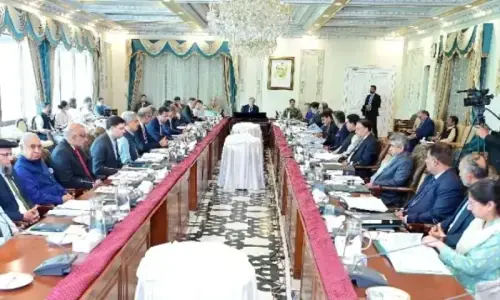
ISLAMABAD, Sept 1: The federal cabinet on Monday decided to establish special courts to punish those found guilty of adulterating food and drugs with up to 25 years imprisonment.
The cabinet approved the draft law for checking adulteration in medicines, food, and pesticides, prescribing a maximum punishment of 25 years for the offender.
The draft law, called Adulteration Offences (Special Courts Bill, 2003), is likely to be tabled before the National Assembly in the current session. It also covers adulteration of pesticides.
The law proposes a maximum penalty of 25 years rigorous imprisonment and a fine which may extend up to Rs1 million.
The provisions of the bill shall be in addition, and not in derogation, of the Drug Act, 1976, the Agricultural Pesticides Ordinance, 1971, or any other law for the time being in force.
The offences shall be tried by special courts which shall consist of a person who is serving as a district and sessions judge, or any other person who is qualified for appointment as a judge of high court or is a retired judge of a high court.
The investigation of the cases under the proposed law shall be the responsibility of the FIA.
A minimum limit of the fine has also been fixed for the convict, be he a manufacturer, wholesaler, distributor, dealer or retailer. The property of the convict would also be liable to forfeiture and licence liable to cancellation. The business of the company involved in the offence shall also be liable to closure.
The special court may take cognizance of offence upon a complaint by any officer of the federal or provincial government, other than a police officer, duly authorized in this behalf or upon the complaint by an individual consumer or a consumer’s association or organization.
No court other than the special court would have the power to grant bail. Appeal against the judgment of special court could be filed in the high court.
A provision has also been made for setting up a vigilance cell in the ministry of interior as well as in the ministry of law, justice and human rights to monitor the investigations, the work of public prosecutors and progress of the cases in the special courts.
Prime Minister Mir Zafarullah Khan Jamali declared that the government would not let anyone play with the lives of the people through adulteration of food and drugs the incidence of which, he said, was on the rise.
He said the adulteration of food and drugs was nothing less than an act of murder and deserved strongest possible punishment.
He expressed the confidence that the proposed law would act as a strong deterrence against this menace. Mr Jamali, however, told the interior ministry to take concurrent steps to ensure that innocent manufacturers, dealers or retailers were not harassed by the unscrupulous elements.