0
0

 KARACHI, Sept 1: The World Trade Organization, globalization, capitulating attitude of South Asian governments, militarization and rising poverty in the region were criticized at the inaugural session of a two-day South Asian “labour for peace” conference on Monday.
The conference, which is being attended by delegates from India, Bangladesh and Sri Lanka, is dedicated to former labour minister Omar Asghar Khan. It has been organized by the South Asian Labour Forum in collaboration with the Pakistan Institute of Labour Education and Research and the Centre for Education.
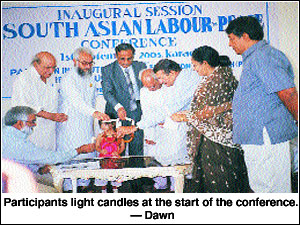
At the start of the conference, delegates and participants lit candles and prayed for peace in South Asia.
Participants criticized their countries for failing to safeguard national sovereignty by yielding to what was described as the WTO onslaught.
They were concerned about the continuing conflict between India and Pakistan which, they said, resulted in the militarization of the region at the expense of the working classes in all South Asian countries.
Politics of hate which led to conflict and war posed a threat to humanity, they said.
They pointed out that the cost of the continuing conflict and militarization had been rising not only in economic terms but also in social and political terms, adversely affecting the working classes.
Ruling elites used the conflict to fan the flames of communal and sectarian discord to keep the working class divided and legislate in the name of national security to effectively curb trade union activities and deny human and democratic rights, they said.
The message sent by former Indian Supreme Court judge V.R. Krishna Iyer, who failed to attend the conference for health reasons, encapsulated the central idea of the conference. The message says: “South Asia has a certain identity and must act unitedly if this region is to advance at all. Great is the potential for development, given concerted thinking and action in a spirit of dynamic cooperation.”
It adds that “the working class has a deep concern for the promotion of peace in the South Asia region and it must be underscored that without the active involvement of labour in these countries, peace and development will be a baffling task and tantalizing goal.”
The general-secretary of the Pakistan Workers Federation, Khurshid Ahmed, said that instead of resolving their differences through dialogue, the South Asian countries were spending a lot on militarization. He urged the South Asian countries to learn from the European Union.
The leader of the Indian delegation, Surendra Mohan of Hind Mazdoor Sabha, said the condition of the poor had deteriorated because of the policies of the WTO.
He deplored that the regional countries, despite being well aware of the consequences of WTO policies, were not acting upon the aspirations of the people.
Speaking about the relations between India and Pakistan, two rival countries armed with nuclear weapons, he said that whenever a step was taken towards peace, anti-peace lobbies undermined the effort and pushed the region closer to disaster.
He urged India and Pakistan to banish hatred, which bred tension and conflict and shoved nations into war.
The leader of the Bangladeshi delegation, Shirin Akhtar of Karmojibi Nari, termed peace essential for harmony and development.
She said: “We are sitting on a nuclear bomb and talking of peace. We should learn lessons from the war in Iraq.”
She warned that the WTO and multinationals were conspiring to rule third-world countries whose governments agreed to their agenda. She drew the attention of the audience towards the closure of many industries and redundancy and unemployment of workers.
The leader of the Sri Lankan delegation, Linus Jayatilake of the United Federation of Labour, said trade unions would have to work towards building up a social movement to fight off undemocratic forces.
At present, he said, international capitalists were bent upon forcing third-world countries to open up their markets for them. He added that multinationals had sought to divide labour movements. He shed light on the divisive tactics employed by international capitalists.
The director of the Human Rights Commission of Pakistan, I.A. Rahman, criticized the indifferent attitude of labour movements towards the problems faced by peasants, especially those of Okara.
He underlined the need for greater watchfulness of the designs of multinationals. He regretted that a large number of people in Pakistan were unaware of the danger multinationals posed to society.
J. John of the Centre for Education spoke about the issues facing the working classes of India and Pakistan.
In his inaugural address, Rasheed A. Razvi, a retired judge, said it was high time workers of Saarc countries seized the initiative and made their leaders change the status quo.
He emphasized the need for following the example of the European Union and transforming South Asia, where, he observed, borders are merely geographical and not mental. He deplored that peace movements in India and Pakistan had been stymied.
Mr Razvi said experience showed that the Kashmir dispute could not be resolved through military means.
B.M. Kutty, PILER joint director, in his welcome address, hoped that the conference would take a few steps forward in the pursuit of peace and justice for all, especially the perpetually deprived, marginalized and pauperized majority of the peoples of South Asia.
Working session: Deliberations during the working session focussed on the role of the media in peace-building and in the South Asian Free Trade Agreement.
Participants noted that despite the passage of a decade, Saarc countries were still in the grip of tension and conflict, with the arms race continuing unabated.
“This has been due mainly due to the total exclusion of the people of the region from the decision and policymaking process. Those who benefit from this destructive political, economic and social situation have actively thwarted any direct people-to- people contacts and consultation in the region. There is no freedom of movement or free flow of information for the common people of South Asia. To make matters worse, the ruling elites continue to feed the ordinary people with disinformation and even plain lies with regard to vital issues,” the participants observed.
They said that since protection of child labour was virtually non-existent, more and more children are working under conditions that were directly and indirectly hazardous to their health and development.
The president of the Pakistan Federal Union of Journalists, Ahfazur Rahman, said the media could play a vital role in persuading the South Asian countries to resolve their differences through dialogue.
He noted that most South Asian journalists had been working towards the cause of peace and amity in the region.