



 0
0

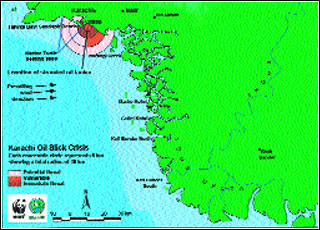 KARACHI, Aug 28: The rear portion of the Tasman Spirit is under constant threat by the weather and the sea and the salvagers are anxious to pump out the remaining crude oil from it in the shortest possible time.
Sources say the salvagers want to see an immediate halt to the continuous oil spill which is now reported to have started travelling in different directions in the sea.
The behaviour of the aft portion of the grounded ship which has already developed a five-degree tilt is highly unpredictable and the salvagers are counting on the ship Sea Angel.
The Sea Angel, with the storing capacity of 6500 tonnes, arrived here on Thursday and will be brought along the side of the Tasman Spirit on Friday morning. According to the sources the Sea Angel can be utilized for one or two trips and about 34500 tonnes of crude oil has been transferred to another big ship Endeavour-II, during the lighterage operation launched on August 4.
About 8000 to 9000 tonnes of oil is left in the ship, and observers believe that it will take another four days to complete the lighterage operation.
A maritime source has confided that the authorities and the salvagers hold that 24000 to 26000 tonnes of oil has spilt ever since the running aground of the Tasman Spirit on July 27.
In the meantime, the oil coming out of the Tasman Spirit has started drifting in some other directions and some of it reached the Sandspit beach on Thursday.
Jehangir Durrani, in charge of the World Wide Fund of Nature’s Wetland Centre (at Hawkesbay) said he had seen patches of oil at noon along the beach while going to Manora from Sandspit.
Mr Durrani reported the matter to the Karachi Port Trust authorities, after which a helicopter surveyed the area and returned. He said the oil patches returned with the receding water.
Dawn visited the Sandspit beach and saw very light black marks of oil along the high-tide mark, otherwise the beach looked clean and without any major oil marks, a total contrast to the blackened beaches of Sea View, Clifton and Shirin Jinnah Colony.
The WWF’s deputy director general, Dr Ejaz Ahmad, said that either that oil patch of around a square kilometre had come with the wind or it might have been one of the patches formed due to the aerial usage of chemical dispersants on the oil slick.
“Chemical dispersants break the oil spill in small patches, one or a few of which might have strayed westward to Sandspit,” he said.
Mr Ahmad further said that Sandspit and Hawkesbay were the nesting grounds of green turtles and Oilve Ridley turtles, and both the species were rare and threatened globally, and if the oil reached those beaches in bigger quantities, it would seriously harm the turtles whose breeding season had just started.
Meanwhile, the high-level coordination committee headed by Sindh chief secretary Dr Mutawwakil Qazi has decided to asses the total impact of the oil slick on environment and public health so that damages can be claimed.
The committee, set up on the directive of President Pervez Musharraf, met in a marathon session which lasted from 5pm to 830pm at the committee room of the Sindh Secretariat, and decided to continue its deliberations on Friday, sources said.
The slick has been caused by the spillage of thousands of tonnes of oil from the Greek vessel, Tasman Spirit.
Thursday’s meeting was attended by representatives of KPT, Navy, fisheries, ports and shipping, Maritime Security agency, Karachi Fish Harbour, federal government, provincial government and city government. It was decided to document the impact of the slick to plan a strategy to meet such a situation in the future.
The meeting also selected sites about 40-km from Gadap to dump the refuse of the Tasman Spirit and the oil polluted sand of the Clifton beach.
The sources said the meeting decided not to hide anything from the public and keep them informed through coordinated statements of all the agencies concerned.





























