



 0
0

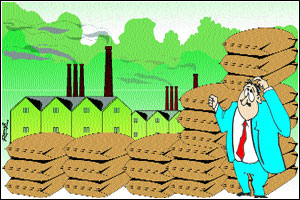 High cost of production all around is confronting the country with a sugar crisis again. This time the crisis is not of shortage of the popular commodity but of surplus and falling international prices. But at home the sugar prices are steady as the sugar mills do not want to reduce their price to liquidate their very large surplus. The surplus which in June was 1,567,037 tonnes has come down to 1.260 million tones on August 7th and is enough to meet the needs of the country until December this year.
So the Pakistan Sugar Mills Association (PSMA) has decided not to crush sugar-cane before January next year.
This year too the crushing started after December instead of in autumn upsetting the sugar-cane grower’s a great deal. Chairman of the PSMA Iskander Khan says that the PSMA had given the government enough time to take effective decisions but it had failed to do so.
The Prime Minister has appointed a four ministers’ committee to take decisions within 10 days. The committee includes ministers of finance, commerce, industries and production, and food and agriculture. But Commerce Minister Humayun Akhtar is out of the country and is not due to return home until August 18th.
The committee has to look for short term solutions to the problems as well as long term remedies which can satisfy all the stakeholders beginning with the sugar-cane growers and that may take more than 10 days.
As an immediate solution the government has decided to export 100,000 tones of sugar through the Trading Corporation of Pakistan. But since there is a large surplus of sugar in producing countries and world prices have come down greatly, the sugar mills association estimates it needs a subsidy of Rs 700 million. The government had earlier incurred a loss of Rs 593 million in exporting 100,000 tonnes of sugar. The sugar manufacturers also say that when they resumed crushing of sugar-cane after a long time they will not pay the growers the sugar-cane prices fixed by the government as they are uneconomic for them. What kind of solution for this problem the ministerial committee will come up with remains to be seen.
The growers are as numerous as they are influential and are well represented in the assemblies and the cabinet. Meanwhile, window of opportunity for export of sugar has opened in Bangladesh which has lifted all restrictions on import of sugar following the high rise in prices there.
Earlier Bangladesh had fixed a quota of 1500 tonnes for import but now it is being estimated the national need may be over une million tonnes.
Officially the annual need for sugar in Bangladesh 520,000 tonnes with a shortfall of 343,000 tonnes against the annual production of 177,000 tonnes.
But Bangladesh has kept import duty structure intact. So that access sugar may not been imported. The growers on their part have been pressing for higher and higher support prices for the cane in view of the higher cost of inputs like fertilizers and hold Rs 50 for 40 kg as the ideal price but the sugar mill owners hold the higher sugar cane price as the mother of all evils.
They say that sucrose content of the cane is very low and they are getting very low sugar out of the high priced sugar-cane and the growers argue the yield per acre in Pakistan is low compared to what is obtained in the Indian Punjab and hence they need higher prices.
This tussle between the growers and mill owners has been lasting for a very long while with a government not being able to find a solution. In fact the mill owner’s escape route has been to delay the crushing so that the growers will come to reason.
Earlier there was zoning for cane growing and selling to the mills under which cane grown in a particular zone has to be sold to the mills in the area but that did not work well as there were to many mills in some areas and too few in others and the mill owners as well as the growers were able to take advantage of that according to how well placed each one was.
The solution to the growers’ problem lies in modern methods of cultivation and making full use of research done in Pakistan. Instead many of the growers prefer to follow the old method of cultivation and don’t want to invest much in adopting the new methods.
The sugar mills have also to opt for ancillary industries to boost their revenues and reduce the excessive dependence on sugar for profits.
Previously the mill owners usesd to protest against the stock piling of sugar in view of the high interest cost but now the interest rates on loans obtained by them have come down and they feel less pressure on that account but still do not want to add to the 1.2 million tons and want the government to help.
The fact is that the production cost for sugar is high because of the high electricity rates and the transportation costs. It is all part of the high costs of the economy that we have developed as a result of which the Karachi Stock Exchange (KSE) is booming with its index touching 4346, although too few sugar mills are paying fair dividends. The sugar mills have been part of the sick sector or the problem area for long along with many of the textile mills which form the largest part of the companies listed on stock exchange. The ministerial committee should hence have to have clearly cut tasks.
The first is to clear the accumulated the stocks with least injury to everyone and second is to find a long term solutions for the major problem of the industry and the growers so that they do not confront the country with one crises after another and heavy demands on the public exchequer.





























