0
0

ISLAMABAD, Aug 11: Pakistan on Monday called for an immediate start of comprehensive peace talks with India to settle all issues between the two countries, including the festering dispute over Jammu and Kashmir state.
Foreign Minister Khurshid Mahmood Kasuri, speaking at the concluding session two-day conference of Pakistani and Indian parliamentarians and journalists, proposed that the dialogue should begin at the level of foreign secretaries on the basis of an agenda agreed by the top diplomats of the two countries as far back as 1997 and 1998 and the points agreed at the collapsed Agra summit two years ago.
“We are willing to go an extra mile in order to narrow down our differences,” he said while taking about some reciprocal steps taken by the two sides since Indian Prime Minister Atal Behari Vajpayee offered talks in April and Pakistan President Pervez Musharraf and Prime Minister Zafarullah Khan Jamali responded positively.
“It is imperative that we enter into a composite and sustained dialogue process and simultaneously move forward on all issues, including Kashmir, economic cooperation, cultural exchanges and sporting links,” he said.
Mr Kasuri called for “a serious and scrupulous introspection” to determine a wise course for the future of the two countries’ people and said: “The future of South Asia will be primarily decided within India and Pakistan.”
The foreign minister voiced Pakistan’s happiness at conciliatory moves made by both countries since Vajpayee’s offered talks in a speech in Srinagar on April 18, but said “there is an imperative need to initiate a dialogue process immediately”.
“Let us start talking at the level of foreign secretaries,” he suggested and said “a composite and integrated dialogue is the answer... (that) will generate its own momentum and pace for incremental gains”.
He said the two sides would “not have to reinvent the wheel” for the process in the presence of the eight-point agenda worked out by their foreign secretaries in 1997 and 1998 and added that this and the elements agreed at the Agra summit between President Musharraf and Mr Vajpayee in 2001 could provide the basis for a comprehensive dialogue.
The conference of the Indian and Pakistani parliamentarians, journalists and experts also issued a statement calling for an early resumption of dialogue between the two neighbours that has remained deadlocked since the Shimla failure.
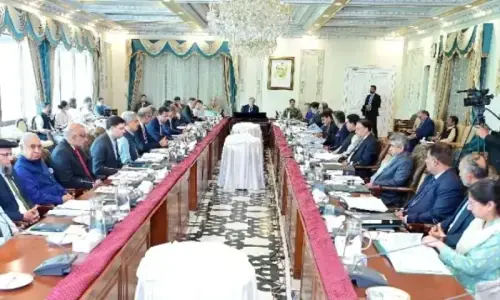
The meeting, attended by parliamentarians from almost all major political parties of the two countries, was organized by the South Asian Free Media Association (Safma) with the sponsorship of a Norwegian non-governmental organisation, NORAD.
Mr Kasuri said trade and economic cooperation could not grow “in a vacuum and less than friendly political environment”, apparently rejecting oft-repeated Indian proposals that the two sides discuss trade and economic matters before tackling the more difficult Kashmir dispute.
“We sincerely believe that a peaceful and secure environment in the region is of vital importance for the promotion of meaningful economic cooperation and development,” he said.
Mr Kasuri said while Pakistan had good relations with other countries of South Asia, improvement of relations with India was “a matter of top priority”.
“War is not an option between India and Pakistan. The only alternative is to talk on all issues of concern to both countries, including of course Jammu and Kashmir, talk substantively, and...with a view to achieving results,” he said.
“We should have a sustainable dialogue, uninterrupted and uninterruptible, that can yield a solution,” he said, echoing a proposal made in the Safma statement that the group called as the sense of the conference.
Mr Kasuri said the Agra summit could still become “a memorable milestone” if the progress achieved there was developed into “a forward-looking approach and built into an agreement regarding the architecture for peace process and dialogue”.
SHIMLA FORMULA: A four-point formula presented by President Musharraf at Agra about Kashmir, he said, showed a lot of flexibility from Pakistan and remained a valid basis for progress.
He cited these points as: India and Pakistan recognize Kashmir as a dispute, start a meaningful and sustained dialogue, negate solutions unacceptable to either side and all parties work towards a solution acceptable to India, Pakistan and Kashmiri people.
“This is a realistic offer,” he said and added: “We can still pick up the pieces and work towards a meaningful dialogue which will address the aspirations of the people of Jammu and Kashmir.”
Mr Kasuri also called for using the 12th summit of the South Asian Association for Regional Cooperation, due to be held in Islamabad on January 4-6 next, to make the seven-nation group “an effective instrument for realizing the aspirations of our people”.
“Pakistan looks forward to the visit Prime Minister Atal Behari Vajpayee and Foreign Minister Yashwant Sinha to Pakistan on that occasion and Indian contribution to making the summit a success,” he said.
Here are the main points on which the Safma statement said the conference participants reached a “broad understanding”:
- India and Pakistan expedite the dialogue process at the level of states and people and approach all requisites of confidence- building, conflict-management and conflict-resolution through an integrated, uninterruptible, result-oriented and well structured process.
- Participants agreed to pursue a “holistic vision that does not ignore any divisive issue”.
- While Kashmir issue and India’s concern for “cross-border terrorism” need to be addressed on a priority basis, no purpose will be served by ignoring possibilities of cooperation in various fields.
- All unreasonable restrictions on travel between the two countries be expeditiously dismantled.
- Political parties give priority to mobilizing their ranks for peace and good-neighbourly relations and allow greater space for civil society organisations to support the process.
- Stressed desirability of strengthening relations between parliamentarians, journalists, academics, businesspersons, experts, professionals, students, workers, farmers, artists and sportspersons of the two countries.
- All overt and covert restrictions on the free flow of information and ideas be removed.
- Resolved to strive to resist the forces of fanaticism, extremism and violence.
Earlier, representatives of major Pakistani and Indian parties made brief speeches about how the two countries should approach and settle their problems.
They included Ishaq Khakwani of PML-Q, Sherry Rehman of PPP, and Kanwar Khalid Younis of MQM from Pakistan, and Mani Shanker Aiyar of the Indian National Congress, Balbir Punj of the Bharatiya Janata Party and Mrs Sarla Maheshwari of the Communist Part of India (Marxist) from India.