



 0
0

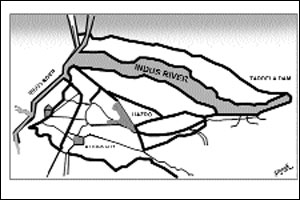 The Ghazi Barotha hydropower project, costing over $2 billion, will have a generating capacity of 1450 mw, which will make it Pakistan’s second largest hydropower station. The project entered its testing and completion phase in the first quarter of the year 2003.
The commissioning tests on the first turbine and generator commenced in May 2003 and the commissioning of the fifth or the last turbine and generator is expected in 2004.
The project comprises the construction of a barrage, a 52 km long power channel and a power complex that includes the installation of 1450 mw plant. The barrage is situated 7 km downstream of Tarbela dam and it is designed to divert the water released from Tarbela to the power channel. The channel runs along the left side of the Indus river and it is the largest concrete lined canal, designed to supply water to the power complex at a rate of up to 1600 cubic meter per second (that is almost equal to the quantity of water flowing in the Ravi river during a low flood).
The power complex has four major components, a head pond or reservoir, a fore-bay-cum-power intake, a powerhouse plus an outdoor switch-yard and a tail-race channel. The water will be stored in the head pond for less than 20 hours only to meet the daily peak demand of power. The fore-bay will transfer the water from the head pond to the tail-race channel via five pen-stocks and turbines. Before entering the tail-race channel the water will impart its hydropower to the turbines and then it will return to the Indus river.
The tail-race reconnects the project to the Indus river. The water will fall through a height of about 69 meters from the fore-bay to the tail-race, which will be converted into the electricity by turbines-driven generators. This interesting concept of the project was developed by a team of WAPDA engineers in the mid nineteen eighties.
Wapda awarded a consultancy and engineering services contract to Pakistan Hydro Consultants, a joint venture of Pakistani, British and American consultants, in the late 1989. The consultancy contract included the site investigations, planning and design of the project. Subsequently, Wapda extended the consultancy contract to include the monitoring of the procurement of power plant, the project management and the supervision of construction, testing and commissioning of the project. The consultants commenced the planning, design and field investigations in February 1990.
The design of the project was followed by the preparation of the specifications and bidding documents for 15 contract packages, three contracts for construction of civil works and twelve contracts for the supply and installation of mechanical and electrical equipment. The bids for all the contracts were invited and awarded under the international competitive bidding process. The construction and procurement phase of the project commenced in 1995. All three contracts for the civil works and eleven out of twelve mechanical and electrical contracts were won by foreign contractors.
Although Wapda financed over 43 per cent of the project cost, the role of Pakistani engineering industry in this mega project was surprisingly very small as compared to its capability and capacity. One domestic bidder only won a small contract, for the supply of auxiliary cranes at a bid price of Rs45.5 million. The local manufacturers also failed to win any major subcontract from the foreign contractors. Paradoxically, in a similar bidding process, completed in the mid-1980s, for 1728 mw Tarbela hydropower third extension project, the domestic engineering industry had won three mechanical and electrical contracts, besides a lot of work under subcontracts or supply contracts from the foreign contractors. Similarly, in the 1960s, during the construction of the Indus Basin projects, the domestic engineering industry played a very significant role.
Pakistan has an extensive experience of the operation, maintenance, repair and replacement of the equipment of 40 to 80 years old hydropower stations of Renala, Malakand, Dargai, Nandipur, Chichoki Malian, Shadiwal, Rasul and Warsak. The Renala power plant is 80 years old and the turbines of Warsak (almost 50 years old) annually handle about 50 million tons of the most abrasive sediment in the world. The depth of experience gained through the operation, maintenance and replacement of worn-out and obsolete components of these old hydropower plants is unique and highly valuable.
The repair of these plants requires skills and knowledge similar to that required for manufacturing a new plant. Pakistan had even acquired technical know-how for the design and manufacturing of the components of hydropower plants through transfer of technology arrangements. Pakistani companies also supplied high quality equipment for Tarbela hydropower third extension project in the 1980s and also carried out a lot of work as sub-contractors during the construction of Units 9 and 10 of Mangla hydropower station, including the fabrication of pen-stocks at the site. These companies also successfully completed the extensions of Mangla hydropower station as prime contractors. Our engineering industry has over 50 years experience of design and fabrication of hydraulic steel structures and it won, under the international competitive bidding, over 80 per cent of the contracts for design, manufacture and supply of gates and hoists of the link canals constructed in the 1960s as a part of the Indus Basin project.
Surprisingly, the local industry did not get any significant subcontract from the foreign contractors of Ghazi Barotha turbines, gates and cranes, despite its considerable expertise in the manufacture of parts of these items. The contract for supply and installation of these turbines (of the Francis vertical shaft type, capable to deliver an output of 295 mw, when operating at 100 revolutions per minute and at 69 meter head of water) was won by a reputed German contractor.
The turbine contractor developed and tested a model of the proposed turbine and after the successful model testing, he finalized the detail and shop drawings of the prototype turbine and its auxiliaries. He then subcontracted the works involving relatively labour intensive processes and bulkier parts to the subcontractors, associates and venders in East Asia, East Europe and Latin America. High tech parts like the turbine governors, control panels and guide bearings were manufactured by the contractor himself, and the servo-motors and valves were subcontracted to other German companies.
The stay rings, head covers, bottom rings and regulating rings of the turbines were subcontracted to a Chinese company, although these parts were within the manufacturing capability of Pakistani engineering industry. The wicket gates, runners and shafts were subcontracted to a South Korean, a Brazilian and a Czech company respectively. Relatively simple and low cost parts, like spiral casing fabricated from the preformed steel plates and some miscellaneous steel structures, were subcontracted to Pakistani companies, which work was far less than the capability and capacity of the domestic engineering industry.
The role of domestic engineering industry in the other mechanical and electrical contracts of Ghazi Barotha project, particularly in the supply of gates, cranes, medium voltage switch-gear, low voltage switch-gear, insulators, steel structures of switch-yard, structural components of generators, cables etc, was far less than in the turbine contract.
Despite the impressive experience, good workmanship and reasonable prices, the domestic engineering industry could neither compete with the foreign companies as contractor nor as subcontractor. It seems that the procurement procedures failed to offer fair and level playing field to Pakistani companies. There is an urgent need to look into this matter and take appropriate measures to remove the obstacles which unfairly affect domestic engineering industry.
The award of a contract or a subcontract to a foreign company, despite the availability of local manufacturing capability and capacity, is a loss to Pakistan’s economy because it increases unemployment, reduces the return from the investment in the domestic manufacturing facilities and increases the number of sick industries. In such a situation, the savings arising from the award of contracts to the lowest foreign bidders cannot make up the loss to the national economy unless the lowest domestic bid is unreasonably higher than the lowest foreign bid. It is a very serious matter and deserves immediate attention of the concerned authorities. As an interim action, the following measures may be considered to help the local engineering industry in marketing its experience and capability for the future hydropower projects:
* The contracting and engineering industries should be encouraged to pool their resources and adopt modern marketing strategies for competing against the foreign bidders. These industries should jointly and regularly analyze their roles in the domestic projects and submit to the government, through Pakistan Engineering Council, necessary recommendations for overcoming any bottlenecks affecting their role.
* A rational domestic preference should be applied for procuring the hydropower plants under the international competitive bidding, which should be determined through credible studies of the impact of awarding the contracts to foreign contractors on the national economy, poverty and employment. The foreign donors and financing organizations should be convinced to approve such domestic preference as a part of the ongoing poverty alleviation programmes, at least until the poverty is effectively mitigated.
*All bids under the international competitive bidding should be invited and compared on the basis of the quoted installed cost of plant, inclusive of all costs of importation plus any local and foreign taxes. The present practice of determining the lowest bid by comparing the quoted FOB factory prices of the bidders is neither realistic nor fair. This practice ignores the additional cost incurred by WAPDA in arranging, coordinating and clearing the imports from foreign contractors.
Furthermore, the inputs of the domestic bidders include the costs of importation and taxes on imported raw materials and proprietary products arranged from the domestic market, some of these costs cannot be accurately quantified and documented for reimbursement. However, the foreign bidders are not concerned about the importation costs because the actual costs are reimbursed to them.
* For the small and mini hydropower projects Pakistan should adopt the national competitive bidding, because the domestic capital market now permits implementation of these projects through local financing. In 1960s,the Government of Pakistan and WAPDA took a bold decision to construct Taunsa Punjnad link canal, one of the link canals of the Indus Basin project, through the national competitive bidding. The successful local bidders constructed the link canal in less than five years at a cost lower than other similar works executed by foreign contractors.
Over 60 km long Taunsa-Punjnad link canal included the construction of large hydraulic structures like head regulator, tail regulator, control structures, off-take regulators and drainage intakes and outlets; railway and road bridges; and the excavation of the canal in a very treacherous terrain. It also included the design, supply and installation of a large number of hydraulic steel structures, such as gates and hoists. It was a mega project of its time and its construction through indigenous expertise and the local contractors was nothing short of an outstanding national accomplishment. Today we should again consider the adoption of the national competitive bidding process for the development of our future hydropower projects of up to 50 megawatt capacity. The implementation of a 50 megawatt hydropower project will be far less challenging for Pakistani consultants, contractors and engineering industry than the implementation of Taunsa Punjnad link canal. The procurement of foreign expertise and precision equipment, if required, can be handled by Pakistani companies through international shopping.
The above measures and the policy of national competitive bidding for small hydropower projects will provide the urgently required stimulus to our engineering industry. A vibrant and competent engineering industry is very important for attracting the local and foreign investment in industrial and infrastructure projects. An efficiently operating domestic engineering industry is also necessary for reducing the cost of the national projects and for eliminating dependence on imported inputs for operation and maintenance of our projects. These factors add to the benefits of encouraging the domestic engineering industry to implement the future hydropower projects of up to 50 mw capacity through the national competitive bidding.




























