



 0
0

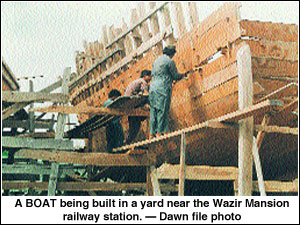 KARACHI, Aug 8: Boat-building, once a major profession and growing industry related to fisheries sector, has almost lost its strength and importance due to continued neglect over the last couple of decades by the relevant authorities.
There has been quite a good number of professionals, experts in boat-building and well-experienced in different related fields, in Karachi. However, denial of basic facilities to the professionals as well as other workers at Karachi Fish Harbour, KPT and Ibrahim Hyderi has constantly been discouraging them.
Local technical hands and workers in boat-building field are in great demand within the country as well as abroad.
Most of the professionals and workers live along the coastline, mainly near the harbour, Sandspit, Hawkesbay and in Ibrahim Hyderi, but a lot of them live in other parts of the city also.
Though both the authorities, KFHA and KPT, command a considerable portion of the coastline, none of them seem inclined to help revive and boost the boat-building industry by providing basic amenities like potable water or safety and security for the boat-builders and their properties at workplace.
According to an estimate, some 2,000 people are still directly employed in the trade and remain engaged in professional activities all the year round at the port and harbour. However, there exists no policy to ensure an improvement and bring about modernization in the field.
The boats with ‘keel’ length of 20 to 80 feet are built at these yards with raw material mainly imported from South East Asia. A standard size boat requires row material costing more or less two million rupees. However, the estimate varies with the size and quality and can go up to Rs20 million.
The boats with a keel length between 40 and 50 feet take some 12 months to be completed and a builder earns a minimum of Rs50,000 per boat.
Minor or major accidents are a routine feature of the boat-building yard where availability of dispensaries and medicines is a must. At present, the KFHA dispensary provides medical facility to the workers. However, the workers and boat-builders are not satisfied with the available facility. One of the boat-builders, Abdul Ghani, terms the facility ‘inadequate’ saying that he had to fetch a taxi to take an injured worker to a private hospital due to the non-availability of an ambulance and appropriate medical treatment.
Similarly, he says, the essential service of fire-fighting is not available at the yard. The yard doesn’t have fire-safety equipment which should have been at the disposal of the workers. Mr Ghani recalls that an under-construction boat had reduced to ashes due to the absence of fight-fighting equipment causing its owner a loss of about Rs0.6 million some four months back.
The KFHA earns Rs5.67 million per annum from the boat-building yard and nearly the same amount is earned by the KPT. However, no funds are spared for training or advanced programmes for the boat-builders. Besides, there is no policy for the welfare of the workers and contractors.
An official of the KFHA maintains that builders pay their annual registration fee to the Mercantile and Marine Department. They should also deposit some amount with the KFHA also.
According to the Chairman of the City Council’s Fisheries Committee, Abdur Razzaq Siddique, the modern history of boat-building started in 1949 when the first 30-feet sail boat was converted into a launch after an engine was fitted in it.
Since a big majority of boat-builders resided on Bhit Island, off Keamari, conversion of sailboats on a large scale was witnessed soon afterwards on the island. First cargo launch was built at the island in 1954. However, in the following years, boat-builders moved to the localities around Khadda Market from where they had a better access to the fisheries and boat-building yards. Launching of the newly-built boats used to be from a creek in high tide season.
This place gradually turned into the centre of boat-building trade in the country. Boat-builders gained expertise and experience giving a boost to the industry.
Initially, the traders at Khadda Market had restricted their output to fishing boats but later they switched over to trawler making. The trawlers meant to catch shrimps are known as Gujju and the fishing boats as Rach.
Presently, cargo boats are in great demand in Gulf and Africa region and are usually registered in the UAE. There operation area is the waters between East Africa and Gulf.
Over the past two years, some 70 wooden fishing and cargo vessels of 50 to 80 feet keel length have been built in Karachi and sold to Gulf clients.
Abdul Ghani is at present engaged in building two 60-feet boats for a Somali client, based in Dubai, at a cost of Rs8 million each. The order has been placed by a middle man who is expected to earn at least 100 per cent profit from the deal.
“Besides other distinguishing qualities, Pakistani boats can float even at six feet deep water while the boats, which are built in India, Iran and other countries of the region, normally require a minimum of 12-feet depth to sail smoothly, Mr Ghani points out.—PPI





























