0
0

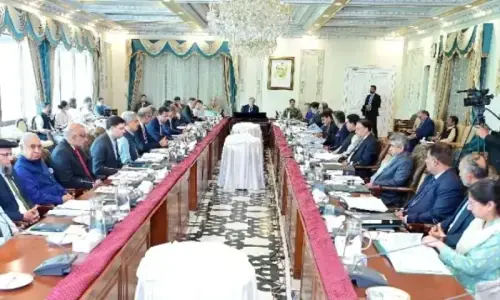
SAINDAK, Balochistan, Aug 6: The production at the Saindak copper-gold project formally began on Wednesday after it was inaugurated by Federal Petroleum and Natural Resources Minister Naurez Shakoor.
Balochistan, Mr Shakoor said, had entered the area of non- ferrous metal mining industry with the resumption of copper production in Saindak.
The federal minister was accompanied by Balochistan Chief Minister Jam Mir Mohammad Yousuf, provincial ministers, and other officials.
Mr Shakoor said that the Saindak project would earn over $45 million a year through export of cooper and its by-products, adding that the government had granted the status of an export processing zone to Saindak copper and gold-mine fields to enhance the project’s profitability.
Referring to the adjoining deposits at the Rek-o-Dek, he said that they were bigger than the deposits at Saindak copper fields, adding that more than a billion tonnes of copper ore was available there that would be exploited by an Australian company soon.
Mr Shakoor said that Chinese officials had also agreed to develop the Dudar Lead-Zinc Project in the Lasbela district, adding that an agreement in this regard would be signed soon. It would be the second mining project to be undertaken by the Chinese MCC Company in Balochistan, the minister said.
Referring to the Gwadar-Nokundi road, the federal minister for petroleum and natural resources said that it would help the government develop basic infrastructure besides boosting the trade and commerce activities in Balochistan.
The road, he said, would bring remote areas closer to the sea, adding that it would reduce transportation charges besides facilitating the development of the mining sector in the province.
China’s Ambassador to Pakistan Mr Zhang Chunxiang read out a massage of the Chinese Prime Minister that stated that the Saindak project would prove to be a new chapter of the exemplary friendship between the two countries.
Chairman of the Metallurgical Construction Company of China Mr Yang Changheng highlighted various aspects of the projects on the occasion.
Earlier, the Chief Executive Officer of MRDL, a subsidiary of the MMC of China, Mr Zou Jianhui, addressed a news conference, explaining the salient features of the project.
Dispelling the impression that the resumption of the production had been inordinately delayed, he said that in fact the project was starting output one month ahead of the schedule.
Referring to the composition of the project’s staff, he said that about 75 per cent of them belonged to Balochistan while more than 60 per cent of the employees were from the Chagai district.
The establishment of the refinery for separation of gold from blister copper would depend upon the production economics.
“If blister copper gives us more profit, then we will directly export the blister copper to the world market,” the CEO of the MRDL said. Otherwise, he said, the company would consider the proposal to establish a refinery at Saindak. However, he denied that there had been any accord to establish a refinery there, arguing that the cost of fuel for power generation was very high.
Referring to the transfer of technology at the end of the 10- year-long lease period, the CEO said: “We have made no formal commitment. However, it is our moral obligation to provide proper job opportunities to local people and train them in all trades.”
Earlier, Balochistan Chief Minister Jam Mir Mohammad Yousaf appreciated the Chinese government’s help in connection with the Saindak project, saying that Beijing’s help in this regard would long be remembered.
He said this while speaking as the chief guest at the commissioning of the producing unit of the Saindak Copper-Gold Project.
Prominent among those, who were present on the occasion, were MNA Hafiz Hussain Ahmad of the MMA, provincial ministers Syed Ehsan Shah and Amanullah Notezai, Chagai district Nazim Mir Arif Jan Mohammad Hassani, federal secretary for petroleum Abdullah Yusuf and Balochistan Chief Secretary Ashraf Naasar.
Balochistan, he said, was witnessing an important phase as a number of major development projects were being initiated, adding that their completion would usher in an era of development and economic prosperity.