0
0

The horse that won’t let us move
I would submit a story is good if it shows you around another world or your own world seen afresh. If it keeps you on the same level ground and does not give you a new view of life or a vision of things you have not had before then it would not be a good story at all. The function of literature is to lift and raise and broaden and deepen our view of life. The sage Krishnamurthy has differentiated between seeing of things and looking at things. When one sees one does not merely see the apparent but sees the reality behind the passing show, the flux, what the Hindus call ‘maya’, of which we all are a part and perhaps for that reason can only take notice of the happenings but not go higher up and view the drama in its entirety.
The writer of fiction, the good writer that is, attempts to convey what he or she has seen in the story that he is presenting. In Kanras, for instance, Ghulam Abbas is telling us how society drives people to undeserved destinies when they refuse to submit to its demands. In Mr Know-all, Maugham’s show- off suppresses his knowledge of the truth to save a woman from public disgrace. In Kaath ka Ghora, Rattan Singh, to whose art of short fiction Karachi’s progressive periodical, Irtiqa, has devoted an entire section in its latest issue, shows how a pushcart puller is keeping the world from moving ahead.
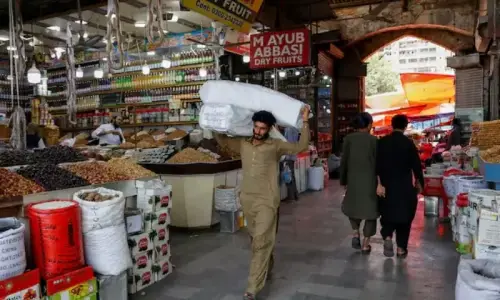
Bundu’s overloaded pushcart is stuck on an ascent of the Bazaar he is passing through. Behind him is a long line of cars, trucks, buses, motorcycles, scooters and tongas and rickshaws caught in between. In the cars are sitting ministers, mill- owners, business magnates, officers of government, shopkeepers, uniformed faujis and policemen, white-collared babus, women out for shopping, school and college students, doctors, nurses, engineers and countless commoners, all forced to trail behind Bundu’s pushcart inching up the slope. The minister checks his watch again and again as he is to meet a foreign delegation. He cannot figure out why the traffic is jammed. His driver goes out to check what is happening but returns and sinks down into his seat frustrated. The men who are sitting with the minister are fortunate to get the time to spend with the minister to thrash out the deal but the mill owners and the businessmen are restless in their seats as each wasted minute is costing them millions. The railway engine driver lifts the front wheel of his bicycle and rams it down on the road with anger. His train is due for departure and he is nowhere near the railway station. The students are happy to miss some periods of study but others are sorry to lag behind the class. The fauji with the steel helmet is honking in vain. His commander will certainly put him on fatigue for being late.
But Bundu is not aware of all this. He is not worried. Today he is unable to pull the cart; for one thing it is overloaded and its fulcrum is jammed besides. Then it is an unyielding slope. On top of all this today he does not feel like doing any work. He feels like the wooden horse he had once bought at a fair and regretted very much as unlike other children’s winding toys it could not move. He did put it between his legs and made as if the horse was galloping but nobody was convinced and ultimately he threw it into the fire. But that did not free him of the horse. It became a part of him, as it were. The other children who used to play with him moved on in life. One became a lawyer, another a teacher and some others government officers. But like his father he remained a cart pusher. And so would his son, Chandu. Why? A wooden horse cannot think. The very thought breaks him from inside. Meanwhile the people behind him are getting impatient. They are honking with frustration. Make a move. You have stopped the whole world, they shout.
So be it, he says, I am not on wheels like you. He may be right, they seem to agree. We cannot move unless he moves too. So the minister will remain stuck in his car and the train will keep on waiting for the engine driver and the great entrepreneurs and captains of industry will keep on losing money by the hour because the pushcart man cannot keep pace with them.
This simple two page story of a traffic jam seen through Rattan Singh’s eyes becomes a metaphor of the state of our world which is caught up in myriad problems because the dimwits who rule cannot see the pushcart man trudging up the slope with his burden. What they see are percentages, averages, charts and graphs and curves and econometric models. No wonder the richest, the mightiest and the most advanced power on earth has been wasting its energies and the energies of its hapless factotums on hunting down two men, one with an unkempt beard and the other with a bushy moustache. This has been going on for more than two years now. Apart from the huge resources wasted, the time that the world has lost on this perverse chase is truly mindless. The footsloggers alone are not applying the brakes, the high flyers too have their retro rockets on full thrust.
Rattan Singh has many admirers and friends in Pakistan. According to Dr Mohammad Ali Siddiqi, he belongs to the third generation of writers of Urdu short fiction with peers like Hajira Masroor, Khadija Mastoor, Jogindar Pal and Ram Lal to name a few. He is among those who have written less but written well. Born in Sialkot district in 1927, his early stories bear the hurt of exile but having filtered out the trauma his work has increasingly acquired a deceptive simplicity, a kind of casualness, if one could put it that way, which according to our learned Doctor, distinguishes him from Rajindar Singh Bedi, who is so meticulous and such a conscious craftsman. Rattan Singh takes you to territories you have been to but not seen. Dr Siddiqi also points to the shortage of tools in his workshop. But this serves him well, I would dare say. It makes him immediately accessible. The reader doesn’t have to labour through a great deal of craftiness and is spared of much intellectualese. Rattan Singh’s visit here some years back went unnoticed though he was well looked after by his literary friends. When he comes next time, courtesy Irtiqa, he will surely have more admirers.
Devolution fails to deliver
IT was the general consensus at a discussion between journalists and the visiting joint delegation of the World Bank, Asian Development Bank, NRB and other Pakistani and foreign agencies that the devolution plan has failed to deliver.
The delegation was part of a team and steering committee set up by the Pakistan government to monitor the working of the district government system and evaluate its progress during the past two years. The government has entrusted this work to the steering committee in six selected districts of the country — Bahawalpur and Faisalabad from Punjab, Khairpur and Karachi from Sindh, Qila Saifullah from Balochistan and Bannu in the NWFP. So far, the committee members have paid visits to three districts of Karachi, Qila Saifullah and Bannu to assess the devolution plan.
In Bahawalpur, the delegation invited the mediamen to ascertain their opinion about the devolution plan with particular reference to a solution to the basic problems of the common man, including redress of grievances against police by the district public safety commissions.
Mr Ali Raza, dealing with police and the safety commission, was informed that the commission had so far failed to prove its worth as people were not aware of their right to lodge complaints with the body due to lack of publicity and consciousness among the public. Instead, it was pointed out, that 100 to 150 complainants were daily seen gathered in the scorching heat outside the office of DPO(SSP) for want of justice.
The powers delegated to district and sessions judges to order registration of FIR and cases also did not prove beneficial as the complainants have to engage a counsel to first write down an application and then present it to the district and sessions judges. This is an additional financial burden on the complainants who should be provided access to the police station to get their FIRs registered.
It was brought to the notice of the delegation that ‘thana culture’ was continuing without any check, and there was no change in it despite tall claims by government officials. Corruption was rampant and the poor people were subjected to excesses by the police.
As regards the functioning of the three tiers i.e. UCs, tehsil councils and the district government, nothing had changed in respect of the provision of basic amenities to the people. The district, tehsil and UC Nazims were free to do anything and only those members at all tires benefited who supported them. Favourite UC Naib Nazims had been provided funds which were utilized by them without the due approval of the house. If UC Nazims were provided funds by the district Nazims, they too would spend these on their own ignoring the majority of the members. Rivalries between the Nazims were resulting in suffering to the common man.
The Tehsil Municipal Administration responsible for providing civic amenities to the citizens was also a failure. Sanitation in Bahawalpur city was poor, sewerage was not functioning properly and during the rainy season the low lying areas were inundated. Potable water was not available even to the residents of Bahawalpur city and donkey-carts could be seen selling cans of drinking water.
About the working of the district council, it was found that it was a one-man show. The district government budget was passed without any discussion and the deputy opposition leader was not allowed to speak on the budget. The opposition leader after its passage had levelled allegations of being deprived him of the right to speak on the budget.
With reference to the aids released recently by the National Reconstruction Bureau in national dailies, it was pointed out to the members of the steering committee that a UC Nazim would never dare to write the annual report of the SHO of his police station. This can never happen as the police officials are so strong in their area that nobody can even dare to say anything against any police official, what to talk of the SHO who is always powerful. The NRB has taken into account the facts of our society while announcing the powers of UC Nazims to write down the annual reports of SHOs.
It was conveyed by the mediamen that officials of the DMG group were not pleased with the new system as they felt that they were made subordinate to district Nazims whereas in the past they had been dictating the elected people and had an upper hand in the system. The members were informed that the government officials from the Provincial Civil Service were happy with the introduction of the devolution plan as they got their promotions in large number and in the setup of a district their strength had increased.
However, District Nazim Tariq Cheema, DCO Imran Ahmad, EDOs and DOs claimed that under the present system, there was a visible reduction in the problems of the people and the district government was running its affairs in a well-planned method and relief was being provided to the people in accordance with the rules and regulations.
The Nazim said efforts were being made to execute uplift projects as 70 per cent of the district government’s budget had been reserved for education. He said mega sewerage projects had been taken in hand in Bahawalpur, Ahmadpur East and Hasilpur, in addition to the construction of a number of parks here.
The DCO said all budget proposals were presented in the house of the district council. These proposals were earlier reviewed by the district development committee which duly approved them.
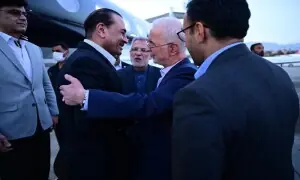
The delegation, which was led by Ali Shahryar Sarwar, comprised Dr Doug Porter (Asian Development Bank), Zahid Husain (economist; World Bank), Ms Shahnaz Arshad (senior urban specialist; World Bank), Ali Raza (police), Sarwar Bari (national coordinator) and Abdul Sabur (national field coordinator of NGO ‘Pattan’), Mrs Rehana Hashmi and Syed Ali Murtaza. They will visit other places during the current month. Each member will submit his own report to the government, while a comprehensive report on the devolution plan will be submitted during the first week of next month.
It is expected that after studying the report and the recommendations made by the delegation, the NRB may submit its proposals to improve the working of the district government system.
Two candidates of the Sadiq Public School, Bahawalpur, have bagged the highest position in the results of intermediate examination, 2003. According to a press release, Syed Mohammed Ishaq Shah clinched the first position in the general science group by securing 862 marks, while Ahmad Jamal Hashmat got the second position in the pre-medical group.