0
0

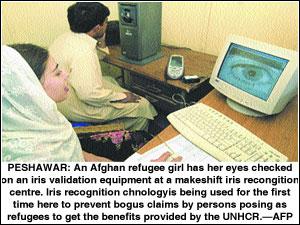 PESHAWAR, July 22: “Come here, sit on the chair,” a woman UN refugee aid worker directs a shabbily-dressed Afghan boy as he enters a small, makeshift office set up inside a freight container on the Pakistani border with Afghanistan.
The office is staffed by two women who are conducting iris validation tests as part of their work with the United Nations High Commissioner for Refugees.
“Look into this glass with your eyes wide open,” the UNHCR staffer asks the boy, pointing towards an eyepiece on the computer he is facing after taking a seat.
“Not wide enough,” she comments, looking at his eye’s image on the monitor.
The boy pulls on his eyelids to give her a better view and the operator swiftly clicks the mouse over the images on the screen. The test is over and the boy leaves the room to join his family members who, having passed the same test, are now waiting outside.
Led by a bearded elder with a paper in his hands, the family can now move towards a tented booth on the other side of the compound where the UN workers will verify their credentials as genuine refugees returning from Pakistan.
“We started conducting iris tests for Afghan refugees returning from Pakistan, above the age of 12, to curb the number of people who try to recycle — to come over and over again — to avail assistance under the UNHCR repatriation programme,” says Masti Notz, head of the UNHCR office here.
For a five-member family of returning Afghan refugees, UNHCR assistance includes 150kg of food, two square metres of hygienic cloth, two pieces of plastic sheeting, 1.5kg of soap and transportation assistance.
Returnees from refugee camps receive an extra $5 per family if they take construction material home.
The assistance has proved lucrative enough for many poverty stricken Afghans to cross over again after a tiring journey of hundreds of miles and try to reclaim the aid a second time.
Little known in Pakistan and Afghanistan, iris recognition technology is being used for the first time here with refugees.
Through a standard camera the machine captures a photographic image of the iris, converts it into digital format and stores it in the database. It takes only about one second to match an iris with those previously stored in the database and to check whether the same person has been recorded before.
It is effective and fast technology in biometric identification, says project coordinator Samad Khan.—AFP