0
0

ISLAMABAD, July 20: Commerce Minister Humayun Akhtar Khan said here on Sunday the government would shortly amend the Wapda Act to allow major industrial units to acquire gas-fired self-power generation capacity which he believed would result in decrease in the input cost of domestic industrial production.
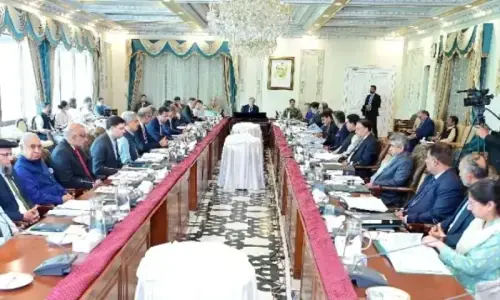
Addressing the post-trade policy press conference, the minister said the decision to this effect had been taken in the federal cabinet on Saturday with a view to make Pakistani products more competitive in the international markets.
Under the Wapda Act nobody is allowed to set up its own power generation for industrial or commercial purposes without a No-objection Certificate from the Water and Power Development Authority.
Replying to a question, the minister said the country had adequate exportable surplus to achieve the target of $12.1 billion set for the year 2003-04. He said the new trade policy gave a major role to the corporate sector and the government would act as a facilitator.
Elaborating on the main features of the trade policy, the minister said the policy aimed at sustaining the phenomenal growth in exports recorded in the out-going year and to prepare for the challenges that Pakistan would face with the phasing out of textile quotas by 2005.
He said the measures announced in the trade policy would further enhance Pakistan’s comparative advantage in textile sector, help develop small and medium sectors like rice, carpets, leather, surgical instruments, cutlery, sports goods, build on agricultural supply base and strengthen the marketing efforts.
He said to strengthen our traditional edge in textile sector, technology upgradation would be ensured through the special fund of Rs3.7 billion, joint ventures and establishment of garment cities in Karachi, Lahore and Faisalabad. He said in these garment cities focus would be on textile dyeing, processing and finishing.
Mr Khan said special export zones would be created and the government would provide financial support for relocation of industries with export potential, reducing production cost through bulk and off peak utility rates, extension of freight subsidy and support for social, environmental and security compliance to meet the World Trade Organization requirements.
The minister further said efforts would be made to create combined affluent treatment facilities in 12 existing industrial estates for textile and leather sectors.
Replying to a question, Mr Khan said without having any sustainable political dialogue with India, Pakistan would not be ready to discuss trade-related matters.
About Pakistan-Afghanistan transit trade, he said it was one of the main sources of smuggling.
To another question, he said Turkey and Iran had expressed their willingness to enter into free trade agreements with Pakistan. The one with Sri Lanka, he added, was ready and Bangladesh and Indonesia would also discuss with Pakistan free trade agreements.
He said during the visit of President Pervez Musharraf to Algeria, Morocco and Tunisia, the three countries also agreed to discuss free trade agreements with Pakistan.
He said the Organisation of Islamic Conference would be finalising preferential trade agreement between the members countries, in near future.