



 0
0

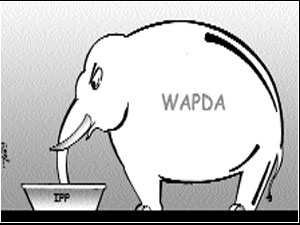 According to updated balance sheets of Wapda, the utility has incurred staggering losses of Rs35.4 billion in FY 2000-01, Rs52.7 billion during the last FY 2001-02 and a record-breaking Rs53.7 billion for the current FY, ending June 30, 2003.
This, of course, is after the lesser estimated losses for these particular years and the phenomenal profits of Rs38.2 billion and Rs16.0 billion during the FY’s 1998-99 and 1999-00 respectively.
These details and the revenue garnered/collected for each year along with the expenditure incurred under various heads in depicted in the accompanying table. The expenditures incurred against fuel (furnace oil and natural gas) and the amounts paid each year right from 1998-99 onwards to the dreaded Hubco and the IPPs (clubbed together as IPP payments) would make very interesting reading.
Keeping the figures of Wapda’s own balance sheets in view, the reader may well understand the situation and also wonder about the accumulated and stupendous loss of Rs141.8 billion during the last three financial years-specially when all and sundry has been proclaiming atop their voices about the great profitability of Wapda under it’s present non-professional management.
However, the requirement and the reason for umpteen upward tariff revisions during this very period would be well understood. Now on the other hand, side by side the proclamation of profitability and taking Wapda out of stormy waters, Chairman Wapda has been blaming the last three year’s loss on the government’s non-payment of their dues-billed as the ‘public sector receivables’, the 300% increase in fuel bill (from whence did this figure arrives remains a mystery) and the 173 per cent forced increase in the IPP payments.
Answering criticism, he is on record having said that the actual tariff increase was only 15 per cent-which was earlier claimed to be 17.1 per cent, while the rest of the increase was on account of the GOP enforced GST, the CBR’s with holding tax and the provincial electricity duty. The fact that the actual tariff rise exclusive of the GST, the with-holding tax and the ED was upwards of 52 per cent and which, in some classes of tariff, rose more than 100 per cent has been simply ignored.
The figures in the balance sheet show that the revenue increased by only 28.5 per cent i.e. from Rs123.8 billion to Rs159 billion, while total expenditure increased by a whooping 149 per cent i.e. from Rs85.6 billion to as much as Rs212.7 billion for the FY 2002-03. Wapda’s assertions that its revenue doubled from a paltry Rs93 billion during 1997-98 to Rs186 billion during the FY 2001-02 and that it would touch the Rs200 billion to Rs215 billion mark for fiscal 2002-03 has, like other phantom achievements, no basis at all except for the fact that this figure seems to have been provided to the President of the Republic too, who in turn made it a part of his various addresses to the nation.
On the top of it, we see that the IPP expenditure shows an increase of 173 per cent i.e. from a lowly Rs42.5 billion to the staggering Rs116.0 billion for the just completed FY 2002-03. Thus we see that an extra Rs73.5 billion has been paid by Wapda under this head for the FY 2002-03 in comparison to the first year of the present management. Wapda’s management also talks about the new IPPs added since the FY 1998-99 and then points a damning finger towards these new power producers. It also castigates the previous governments for the IPP accords, but then takes the credit for the availability of power these days and for doing away with loadshedding of the past.
In this regards, the record shows that indeed six new IPPs did join the fray and were instrumental in getting paid to the tune of Rs8.1166 billion during 1999-00, Rs19.752 billion during 2000-01 and Rs36.224 during the FY 2001-02. These new IPP are Habibullah Coastal (123 MW), Rousch Power (358 MW), Saba Power (109 MW), Uch Power (525 MW), Fauji Kabirwala (144 MW) and lastly Liberty Power (212 MW)-totalling 1471 MW in all.
The last of these IPPs has the dubious honour of being originally sponsored by the Ibrahim Alwan, of the World Bank, actively engaged in Hubco’s heavily over-invoiced project by the World Bank. He subsequently sold his undertaking to the unsuspecting Malaysians.
Individual payments to these producers for the FY 2002-03 are not available and hence have not been quoted. Even if these payments are added to the base figure of the IPP payments for FY 1998-99 viz Rs42.5 billion, we see that increase under this head of account is not justifiable and that such an increase cannot ever be allowed to take place by any management worth it’s salt.
Again referring to the table, we see that the increased IPP sale took place only on account of un-warranted requisitioning of energy by Wapda. Actually as against 15.151 billion units during FY 1997-98, as much as 24,446 billion units were purchased by WAPDA from the IPPs (inclusive of Hubco) during 2000-01, which has some-what waned during the next two financial years viz FY 2001-02 and 2002-03 and now stands at 22,098 MKWH or billion units. This misuse of IPP power is justified by Wapda as necessary on account of the ongoing drought conditions- meaning that the drop in hydel production from 22.446 billion units during 1997-98 to 17.492 units for the fiscal 2001-02 had to be compensated by the IPP purchases.
However, scrutiny reveals that the increased IPP purchases took place because of the bad state of repairs of the Utility’s own cheap power producing hydel and thermal plants and a skewed use of the still available units. Understandably, the reduced hydel production during the last three FYs can easily be attributed to the ongoing drought, silting and depletion of the Mangla, Tarbella and Warsak reservoirs, but the reason for reduction in WAPDA’s own cheap power producing thermal capacity needs further elaboration. Investigation leads us to believe that out of the total 5300 MW of installed thermal capacity, over 2000 MW remained inoperative during FY 2000-01 and also onwards mainly due to maintenance problems and somewhat because of paucity of gas and fuel oil and other undefined reasons — all which can be attributed to management deficiencies.
Further in-depth inquiry found that Wapda tried to generate record hydel generation through Mangla and the Tarbella stations during the 2000-01 winters and as a consequence waters were released in generous quantities at a time when the emphasis should have been on conservation-specially when there had been a clear warning of the impending drought early last year.
This was done to produce cheap electricity in order to off-set the IPP cost and to nullify effects of Wapda’s reduced thermal capacity. This resulted in reduced agricultural production and unwarranted infighting between provinces.
Out of the 2000 MW of this shut or reduced thermal capacity, some very important and strategically located small powerhouses have been put to pasture, ostensibly because these are considered expensive to maintain.
However experts calculate the cost of production at one of these shut plants that is, the 20 MW Mesco powerhouse at Rs2.30 to 2.60 per unit-less than one third of the average IPP cost/unit. This plant is already on gas, while efforts are tardily afoot to convert the rest of Wapda and IPP units to gas, which would entail a lot of expenditure and time — and it may also not take place keeping the current expertise and priorities in view.
The present 85 MW gas turbine station at Shahdara Lahore can produce power at anything between Rs3.25-3.50 again less than what the IPPs would cost. Moreover, this station has the capability of coming on to the national grid in 5 to 7 minutes and can cater for the provincial metropolis in times of nation-wide failures like that of August 31, 01 when supply was disrupted for a long duration of four hours. Power experts consider retiring of these and other powerhouses as ill-conceived and a loss to the nation. They consider this as inward planning, specially when severe load shedding is envisaged as early as during financial year 2004-05.
The recent spate of international and local tenders for repairs and maintenance of thermal units appearing in the national press further attests to the above and to the fact that full capacity may only be attained by Wapda after a period of 12 to 18 months which in the normal time taken to receive bids, evaluate the same award the works and arrange completion etc. Enquiry into the belated efforts by Wapda to arrange thermal capacity to its fullest, would lead anyone to the information that cases for repairs were kept pending by the management for two years or so and only cleared during the last 15 months. No cogent reason has been attributed to this delay and, as usual, instead of accepting the responsibility for the delay in taking up rejuvenation of the dilapidated thermal units, (a regular and normal affair), Wapda has converted the overly delayed overhauling of 15 of these units during FY 2002-03 as a special achievement.
The press release (Dawn, July 5, 03) then goes on to salute the fact that the generation of 19.49 billion units during FY 2002-03 was the highest since FY 1998-99, when only 15.54 billion units were generated. All these figures are wrong and have also been used selectively and out of context. According to Wapda’s own statistical data and relevant balance sheets (see table), we see that FY 98-99 saw a total generation of 53,485 billion units with hydel’s share of 22,446 billion units which sharply came down to only 17,194 billion units in 2000-O1-and instead of Wapda’s own thermal units coming in to fill in the gap, we see the dreaded IPPs selling as much as 24,338 billion units-the situation carries on with a little respite during the FY 2002-03 when indeed 19.49 billion units were generated through Wapda’s own thermal units. In actuality, the requirement was to contain IPP purchase to a maximum of around 15 to 17 billion KWHR in case of inability to sell more power, while the cheap power producing thermal units should have filled in the gap created by the so called drought conditions and then gone on to generated around 24 billion KWHR or units.
As such had Wapda maintained its own thermal units, there would have been no need at all for any tariff hike. Similarly, if the thermal units are made up-to-mark and purchase from IPP’s are kept at the bare minimum, again WAPDA would have no need to ask for any increase in tariff-which now against the present war against terrorism, can be extremely detrimental to our already battered economy. Members of the business community are very critical of the non-accountability of such lapses by the government and the inability of the ministry for water and power and the Auditor general to take cognizance. Here, the scribe was informed by senior government officials, that the ministry does not have any hold or check over Wapda.
Officials of NEPRA also said that Wapda had been time and again required to improve its efficiency, reduce losses and recover arrears before making any new application for increase in tariff rates etc-but all to no avail.
Sources in the ministry of water and power reiterated that the last increase in tariff rates by 11 paisas per unit under the garb of fuel adjustment was never proposed by the ministry and had been thrust by Wapda itself. They also agreed that had Wapda’s own cheap power producing thermal units been available for generation, WAPDA’s expenditure would have been much less with no need for any tariff increase. They further said that the ministry could not be held responsible for Wapda’s inefficiency as it exercised no control, what so ever, over it.
It would thus be safe to conclude that Wapda’s unprecedented increase in IPP purchases since 1990-00 through simply keeping its cheap power producing thermal units starved of repairs, overhauling and BMR in one of the main reasons for its colossal losses.
And so colossal are these losses on account of the wide gap between the cost of self production and the IPP produce, that it is simply holding Pakistan’s economy as it’s hostage.
Public Sector Development and Poverty alleviation too remain a mirage for the poor people of this country. And in case nothing is done to change the mindset of this Utility’s management, all financial improvement plans (FIPs) would come to a naught.




























