



 0
0

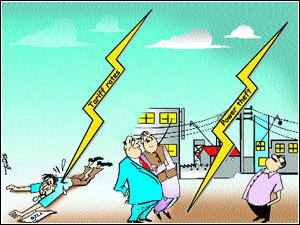 There is a kind of stampede by the power-producing and distributing companies formerly under Wapda to secure official approval for raising their tariff rates with blessings of the National Electric Power Regulatory Authority (Nepra). Leading the brood is the mother-hen which wants an increase of 20 to 25 paisa per unit, while the distribution companies want a 15 paisa rise per unit.
The usual reasons for demanding the rise in rates are given. They are rise in the price of fuel oil, higher operating and administrative costs and large financial deficits to cover.
In the past, only the mother organization, Wapda used to move the Nepra along with the KESC which has its independent accounting but now the three major power generating companies, including the Jamshoro Power Generation company and eight distribution companies too have moved the Nepra.
The distribution companies had also tried to move Nepra in the past, but their petitions were returned for technical reasons. But now the Nepra chief says the petitions would be returned for making technical corrections and then accepted. But the rise in power tariff may differ from company to company instead of all of them being given a uniform raise.
As the price of oil goes on rising, fortnight after fortnight, the power producing companies have a valid reason to ask for higher power rates, say the power company officials.
Though there is very little taxation on fuel oil, compared to other oils, the price of that oil has been very high for long although this is summer and not winter when the demand for hearing oil is very heavy. The price rose to Rs13,273 per tonne this fortnight.
The rupee, though steady against the dollar, is not very strong compared to currencies of many countries, particularly in India where the dollar is comparatively cheaper by Rs10 per dollar which makes all imports less costly.
Wapda has a power loss rate of over 26 per cent while KESC’s loss rate is over 40 per cent despite varied attempts to bring that down. Wapda’s hydel power generation is hurt by the low water level of rivers in the Punjab before the rains, and hence its increased reliance on thermal generation or gas which too is in short supply there.
Wapda’s critical problems in collecting its power bills from the tribal areas continue and the same is the case in Azad Kashmir, which has lately been improving.
Wapda has always found it difficult to collect bills from the large defence sector. Federal government has always been slow in paying its bills.
The provincial governments are usually derelicts in payment of their power bills and have often to be threatened with power cut to ensure payment of the bills.
Autonomous bodies like water supply and drainage organizations have always been too slow in making payments, and invariably build up large arrears.
Then there are the hundreds of thousands of Kunda operators who steal power openly or clandestinely. They are in large numbers in the ‘kutcha abadis’ and in posh areas like Clifton and Defence Housing Authority with their powerful residents. While trying to collect bills from the ‘kutcha abadis’ or disconnecting their power supply can create a law and order problem or a political problem, the persons in Clifton and Defence Housing Authority are powerful individuals.
It is common to see youngsters in hundreds use kundas to draw power to play night cricket in the street in many places. It is also common to see many streets lit up using Kundas during the Milad-un-Nabi celebrations and other religious festivals and national days, like Independence Day.
The officers of the KESC are also given 999 units of power a month free and they burn that away merrily, whether they need it or not to the envy of their neighbours.
Official departments as a whole make late payments, while Wapda and the KESC have to pay full interest on their large loans. The interest payments keep accumulating. And the government then comes to the help of the afflicted organizations. Last year the government paid Rs52 billion as subsidy to Wapda and the KESC, which could have been put to far better use.
To overcome the problem of tampering with meters in posh areas, the meters were brought out of the houses in parts of Clifton and Defence Housing Society. And good results were reported. And then the sudden shifting of the meters stopped without any valid reason. If the results were so good why was the shifting stopped?
World Bank’s representative in Pakistan John Wall says as the government departments were often guilty of not paying the bills or exempting certain areas from payment of bills, the bank has stopped blaming Wapda for its inefficiency. There are many reasons why the theft and loss of power is so heavy. Power is lost during the generation as the generators are old or are poorly maintained. So KESC, for example, has more break-down in power supply than load-shedding. While the load.-shedding can be specific and brief, the break down can last for very long and be frequent and excessively vexatious.
The distribution and transmission lines too break down often as low quality equipment had been used and very poorly maintained. And replacing much of the worn-out equipment or system will cost a great deal of money.
It is also true that the higher the power rate, the larger the power theft. It is more like taxation where the higher the taxation, the larger the tax evasion.
The KESC’s loss rate, described as transmission and distribution loss in 1985-86 was 17 per cent and in 1900-91 23.58 per cent, and is now 40 per cent. If the power rate is raised abnormally, the theft rate too would go up.
To overcome the problem, the KESC should be ready to provide power connections to the ‘kutcha abadis’ and other areas where power theft is heavy. And the connection should be given at low rates.
The fact is the KESC is thinking of newer and newer ways of raising revenues in a big way, including heavy charges for the load factor. And that is driving more and more consumers towards stealthy ways of getting power.
Then, there are the powerful men who rely on Kundas for their power supply. They get connected to the power system at night and get disconnected by early morning.
A minister in one of the posh Clifton apartments, some years ago, was giving a dinner. He wanted more power which he got through a ‘kunda’. But the ‘kunda’ stayed there permanently for at least two years. No effort was made to dislodge it. I would not be surprised if it is still there.
It is not that the KESC chiefs do not know how to cut into the power theft and punish the power thieves. After four years of military administration of the KESC, the consumers would expect a sharp fall in the theft rate. Instead it has gone up by 2 to 3 per cent. What kind of conclusions do we draw? Explanations offered are not convincing. We expect positive results and a fall in power theft along with a drop in power rates. Instead each consumer now is paying for not only for himself but also for the neighbour who steals the power and causes frequent break down in supply.
There should be a way of cutting into the power theft instead of NEPRA taking the large power theft as irremediable and yielding to the demand for a rise in the power rates and giving more elbow space to the power officials.
Power break-downs became a major law and order problem in the city and there have been large demonstrations. And after the privatization of WAPDA units and KESC, as the power rates are raised to increase the revenues of the incoming new owners, there can be confrontations between the new management and the consumers. It is hence imperative that positive steps are taken to ensure that the relations between the new owners of and the consumers are smooth based on a normal on a commercial ethos. The country needs not only more power but also at fair rates. All official steps should now move in that direction instead of the former WAPDA units and KESC be content with yet another rise in power rates and the promise of more on a quarterly basis.




























