



 0
0

 There are three possible approaches to face problems relating to environmental issues in Pakistan: (1) totally ignore them; (2) delay the progress and economic growth in the name of environment and, (3) save its eco-system, including its wild life, fauna and flora, ground water and surface water, and air.
Unfortunately, there is a tendency to focus on environment as the only issue, ignoring all other aspects. It is for the decision-makers to take a balanced view between the environmental concerns and the economic issues and arrive at a right conclusion.
Two case studies are presented to illustrate the point: the Left Bank Outfall Drain (LBOD) and the present Right Bank Outfall Drain (RBOD), now under design and construction.
LBOD: A Rs780 million tidal link was proposed by a foreign consultant to save the coastal belt near Badin (mostly salt plains with no agriculture) from the out falling saline drainage water from LBOD. This area is very close to sea and has few dhands (shallow lakes) with partly fresh and partly saline water. The main thrust of the argument for building the tidal link was to save these dhands from saline water and save the incoming Siberian birds, which settle down on dhands in winter.
One can appreciate the concern of an environmentalist of the dhands water levels. However, if one looks at it keeping in view economic scenario, the whole project built with a loan with high interest rate from the World Bank, it would appear to be an environmental extravagance and unaffordable luxury for a very poor Pakistan.
Unfortunately, it seems that no Pakistani is powerful enough or qualified enough to question its wisdom and anyone who raised any question was ridiculed by their own countrymen for ignoring such an “environmental treasure of Pakistan”. It was even beyond the powers of Wapda, or the Irrigation Department (Sindh) to question the wisdom of the donor agencies since the paymaster was the World Bank and its associates and the consultants were from Europe.
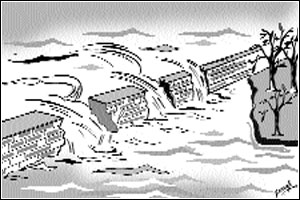
However, the whole wisdom behind the project came crashing down when within three years, first the main Chorli wear on the tidal link crashed to the channel bottom (1998) and soon after the tidal link was washed away. Now, there is no tidal link except for few broken, discontinued banks and the saline drainage water seen spreading all over. Thank God, the Sindh government rejected World Bank offer to rebuild the link, of course with a fresh loan. The world has seen that the tidal link was not an unavoidable environmental necessity worth Rs780 million, because the Siberian birds are still coming and the dhand waters’ marine life continues to exist with slight changes.
Amri archaeological site: We now come to a problem, a sensible decision which would save the country an amount of Rs300 million and a potential risk to the safety of Right Bank Outfall Drain (RBOD) now under construction on the right bank of Indus.
It is feared that a decision based not on ground realities in the name of environment and for saving questionable archaeological site would not only raise the cost of the project but put it under the threat of River Indus. It should be noted that RBOD itself is a grand environmental project to save millions of acres of the right bank land from water logging, Manchar Lake from salinization and finally save River Indus from pollution likely to be caused due to discharge of saline drainage water, down stream of Sehwan.
RBOD at village Amri passes through a space which exists in between two archaeological sites which are in shape of earthen mounds. These mounds are supposed to be the ruins of an habitat dating back to Indus civilization. However, it is still not established, and any work done in the past was in 1960 and since then lot of encroachment has taken place and one can see village clinics and other buildings around. The space between mounds is being cultivated since years.
There are three alternatives available for the RBOD route around Amri. The first is to pass the drain in-between the two mounds which are 380 ft apart. The surface width of the drain is 150 ft leaving a distance 115 ft from the edge of the drain to each mound. The total digging involved is to a depth of 15 ft from the surface. For this alternative, a measure to save the mounds, A and B— the likely archaeological site—, it has been proposed to hand dig this reach of the channel 1000 ft under the guidance of the Archaeological Department. If any thing worth was found, it would be handed over to the museum and the digging stopped. The there will the alternative 2 or 3 left. Further, the channel would be lined to protect the site from any potential seepage.
The second alternative would be to totally by-pass the site and take RBOD on the left side. This would take RBOD into the flood plain of River Indus and very close to the main channel. It would be under constant attack from the river in floods. This would also result in cutting through the agricultural lands of farmers with small land holdings and would result in their dislocation. For this option, special structures would be required to protect the RBOD from floods and provide a large number of foot bridges, for affected lands costing Rs300 million. Further a large sum would have to be added in resettlement cost on this amount.
The third alternative is to take it on the right of Amri, which would cause dislocation of the railway line and national highway and would cost Rs350 million, more than the first alternative, plus dislocation of farmers and cutting through their agricultural lands.
The clients on insistence of archaeological department are considering alternative 2, while the alternative one should be accepted on the following grounds:
i) Would the cost less by Rs 30 to 40 crores?.
ii) The risk involved to the archaeological site is not of the level of the range of Rs30 crores.
iii) No risk is involved to the safety of RBOD in alternative 1 and therefore is the safest route, as compared to route 2.
iv) compromise between environmental and economical considerations based on the principles discussed above, the best choice for Pakistan would be alternative 1.
v) The damage being done to the living human beings by cutting through their lands and displacing them in alternative 2 and 3 is of greater significance than a possible damage with questionable chance of any risk to the dead, non- living archaeological site which after all is neither a Taj Mahal nor a Mohinjodaro.
vi) Should a poor country like Pakistan ape the affluent west and walk in their foot steps in matters of environmental policies. Surely not, we have to adopt and adapt to our own economic conditions and ground realities.




























